Published resource license

https://editorialia.com/wp-content/uploads/2020/06/standardisation-in-support-of-the-cybersecurity-certification.jpg

Standardisation in support of the Cybersecurity Certification

The document presents the value of the cybersecurity standardisation efforts for certification, the roles and responsibilities of Standards Developing Organisations (SDOs) in this context, and discusses various ways how standardisation can support efficiently the process of certification schemes creation by following a step by step methodology.

https://editorialia.com/wp-content/uploads/2020/06/mysql-notes-for-professionals.jpg

MySQL® Notes for Professionals

MySQL® Notes for Professionals book is compiled from Stack Overflow Documentation. (187 pages, published on May 2018)

https://editorialia.com/wp-content/uploads/2020/06/ict-security-certification-opportunities-in-the-healthcare-sector.jpg

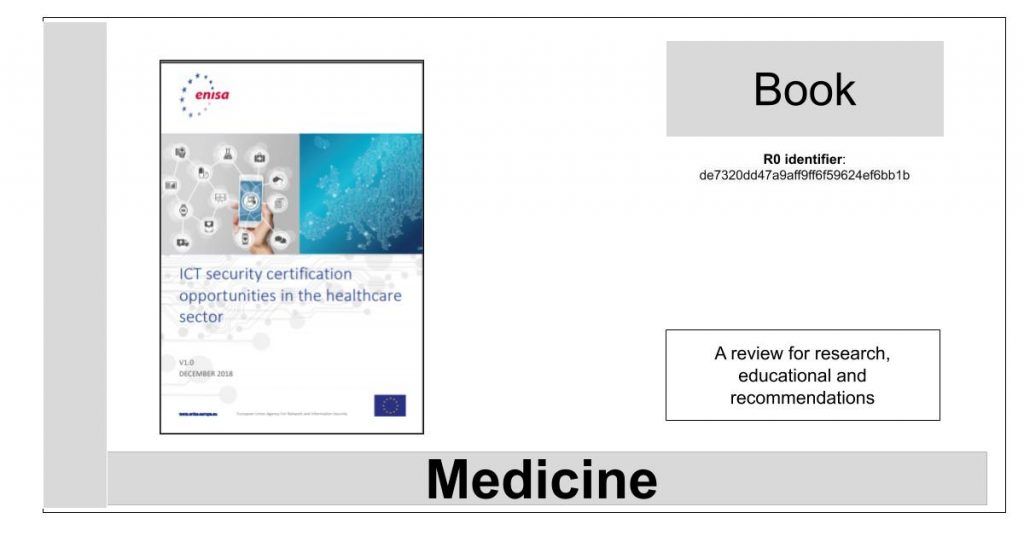
ICT security certification opportunities in the healthcare sector

Digital solutions for healthcare open a plethora of new possibilities in this area. They provide a technical base for easy testing, they improve significantly the quality of service by allowing immediate access to medical data – results of tests, history of treatment; they facilitate correct diagnosis by easier analytics and correlation of data and easier monitoring of patients’ health parameters. They facilitate setting up appointments with appropriate doctors at a convenient time

https://editorialia.com/wp-content/uploads/2020/06/c-notes-for-professionals.jpg

C Notes for Professionals

C Notes for Professionals book is compiled from Stack Overflow Documentation. (333 pages, published on May 2018)

https://editorialia.com/wp-content/uploads/2020/06/fundamentals_of_data_visualization.jpg

Fundamentals of Data Visualization

Guide to making visualizations that accurately reflect the data, tell a story, and look professional. It has grown out of my experience of working with students and postdocs in my laboratory on thousands of data visualizations.

https://editorialia.com/wp-content/uploads/2020/04/defining-artificial-intelligence.jpg

Defining Artificial Intelligence |🇪🇸 Definiendo Inteligencia Artificial

The starting point to develop the operational definition is the definition of AI adopted by the High Level Expert Group on artificial intelligence. To derive this operational definition we have followed a mixed methodology. On one hand, we apply natural language processing methods to a large set of AI literature. On the other hand, we carry out a qualitative analysis on 55 key documents including artificial intelligence definitions from three complementary perspectives: policy, research and industry.

https://editorialia.com/wp-content/uploads/2020/06/advanced-r.jpg

Advanced R

Advanced R helps you understand how R works at a fundamental level. It is designed for R programmers who want to deepen their understanding of the language, and programmers experienced in other languages who want to understand what makes R different and special. This book will teach you the foundations of R; three fundamental programming paradigms (functional, object-oriented, and metaprogramming); and powerful techniques for debugging and optimising your code.

https://editorialia.com/wp-content/uploads/2020/06/ipython_interactive_computing_and_visualization_cookbook.jpg

IPython Interactive Computing and Visualization Cookbook

IPython Interactive Computing and Visualization Cookbook, Second Edition contains many ready-to-use, focused recipes for high-performance scientific computing and data analysis, from the latest IPython/Jupyter features to the most advanced tricks, to help you write better and faster code.

https://editorialia.com/wp-content/uploads/2020/04/artificial-intelligence-foundations-of-computational-agents.jpg

Artificial Intelligence: Foundations of Computational Agents

It presents artificial intelligence as the study of the design of intelligent computational agents. The book is structured as a textbook, but it is accessible to a wide audience of professionals and researchers. In the last decades we have witnessed the emergence of artificial intelligence as a serious science and engineering discipline. This book provides an accessible synthesis of the field aimed at undergraduate and graduate students. It provides a coherent vision of the foundations of the field as it is today. It aims to provide that synthesis as an integrated science, in terms of a multi-dimensional design space that has been partially explored. As with any science worth its salt, artificial intelligence has a coherent, formal theory and a rambunctious experimental wing. The book balances theory and experiment, showing how to link them intimately together. It develops the science of AI together with its engineering applications.