NEUROSYMBOLIC INTELLIGENCE · CLINICAL INFORMATION AND TRACEABLE REASONING
A report says that a lesion was seen on a previous examination. A system enters “lesion present” into a table intended to describe the current examination. The words have been recognised, yet the record has changed their meaning.
This fictional example concerns information extraction, not diagnosis. It asks how a system can distinguish a statement from an interpretation, and an interpretation from a checked record. A language model may propose the interpretation. Explicit rules can then examine its structure, timing and supporting evidence. The difficult boundary lies between those two operations.
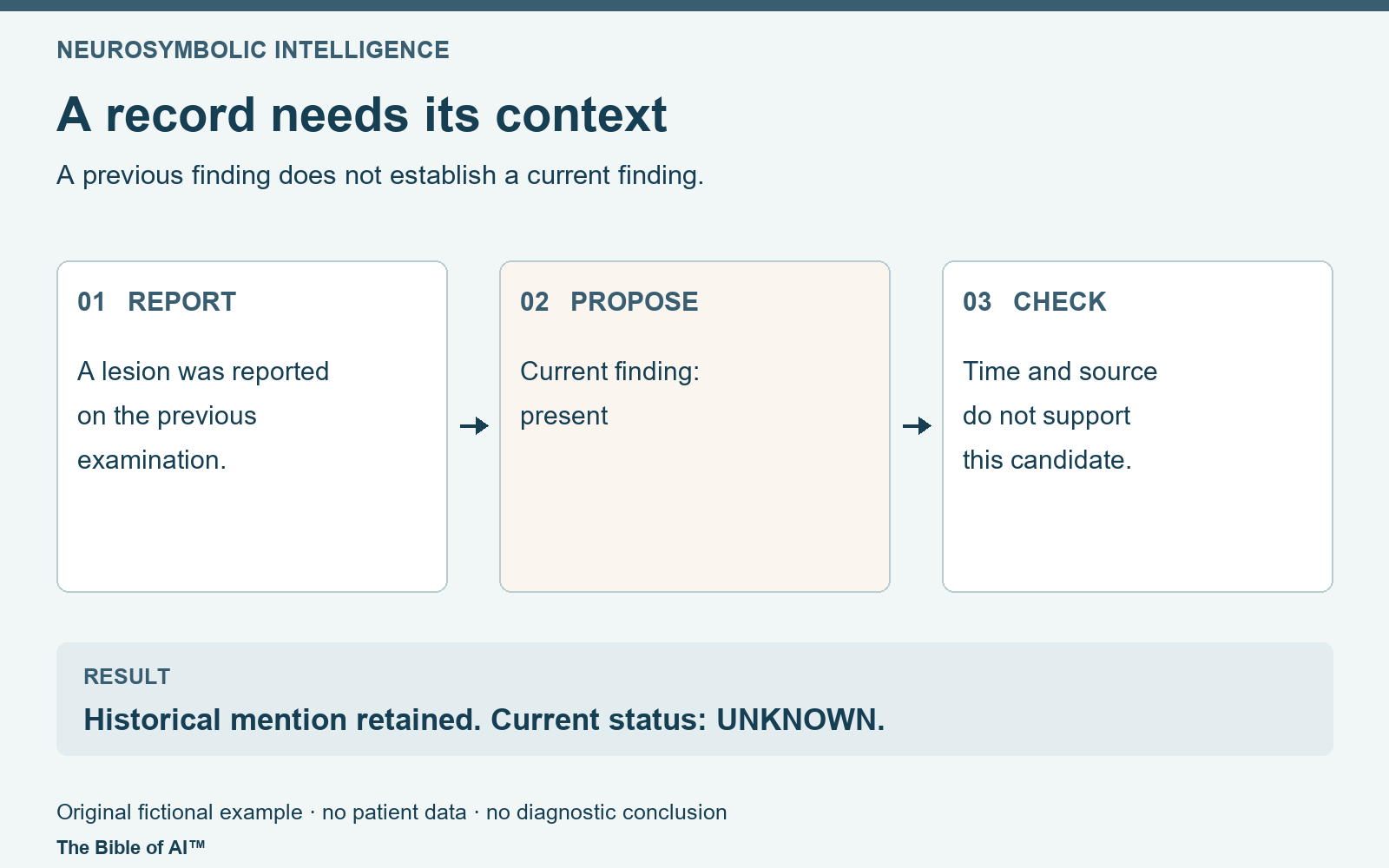
One sentence, two different questions
Consider these two invented fragments:
“A lesion was reported on the previous examination.”
“No focal lesion was identified on the current examination.”
For the first fragment, a record of a historical mention is supported. A record asserting a current finding is not. For the second, the supported record is a negative observation in the current examination. Even that statement should retain its scope: “not identified in this examination” is not identical to “cannot exist”.
Our illustrative representation therefore keeps five elements together: the finding, whether the text asserts or negates it, the examination to which it refers, the supporting passage, and whether the interpretation is uncertain. Removing any one of these can make a concise record misleading.
The first deterministic check is modest. A candidate that claims to describe the current examination must not cite only a previous examination as its support. If the extracted time label says “previous”, a rule can reject the mismatch. If the language model has incorrectly labelled that passage “current”, checking the labels alone will miss the error. The interpretation itself needs independent scrutiny.
Unknown is an outcome
A useful system needs an explicit result for information that the source does not establish. In this example, we reserve four outcomes: reported present, reported absent, unknown and conflicting. These describe the evidence in the text. They are not four diagnoses.
“Current status cannot be determined” remains unknown. A missing field also remains unknown, although for a different reason. Two incompatible current statements about the same finding, examination and scope create a conflict that should be retained for review. A later corrected report may resolve that conflict, but its relationship to the earlier version must be recorded rather than assumed.
The following cases are an original specification exercise. Their expected results are declared here; they are not measured performance of a language model.
| Source situation | Expected record | Failure to detect |
|---|---|---|
| Present finding explicitly described as current | Reported present, with its passage | Losing the examination context |
| Current finding explicitly negated | Reported absent, within that observation | Dropping the negation |
| Finding mentioned only in an earlier examination | Historical mention; current status unknown | Promoting the past to the present |
| Current finding described as uncertain | Unknown; retain the uncertainty | Turning a possibility into an assertion |
| No relevant statement or no usable time context | Unknown; state what is missing | Treating silence as absence |
| Present and absent statements with matching current scope | Conflicting; retain both passages | Silently choosing the preferred statement |
These cases also expose a limit of a simple truth label. Different anatomical sites, examination methods or dates can explain an apparent disagreement. The rule must compare like with like before declaring a conflict. Otherwise, a mechanism intended to catch errors will manufacture them.
What standards can check
The W3C’s Shapes Constraint Language, SHACL, specifies validation of RDF data graphs against declared conditions. It offers a formal way to express requirements on a structured representation. [2] Applied to our example, a shape could require one examination reference and an allowed status value. A conforming record would satisfy those declared conditions; it would not thereby establish that its interpretation of the report was correct.
Provenance answers another question: where did a record come from? The W3C PROV data model represents entities, activities, agents and derivation relationships. [3] In our example, retaining the report version, quoted passage, extraction step and rule version would let a reviewer reconstruct how an entry was produced. That trace supports inspection. It does not make an unsupported entry true.
Keeping the checks separate helps. A record can be structurally valid but semantically wrong; correctly attributed but outdated; internally consistent but unsupported. A single green “verified” label would conceal these differences. A more useful account says which check passed and which uncertainty remains.
A clinical study, with a defined boundary
Prenosil and colleagues combined GPT-4 with the Plato-3 expert system in a retrospective study of 206 prostate-cancer PET/CT reports from one hospital. The reports were divided equally between development and validation. [1]
The scope matters. Table 1 lists 26 parameters, but reports neurosymbolic results for ten: 2,060 entries, all marked correct against the reviewed reference. The remaining sixteen are marked as not examined by that system. The table pools all 206 reports; its perfect total should not be presented as a separate validation-set result or as universal clinical accuracy.
The underlying RUDS software is not publicly available without restrictions, although the ontology and prompts are supplied. Commercial interests are disclosed. We have not independently reproduced the experiment. Its bounded result motivates further evaluation; it does not establish that every report or extraction task will be handled correctly.
Where determinism helps, and where it stops
The earlier articles examined a geometric deduction and a constraint on a proposed driving command. Here the object being checked is a representation of a sentence. In all three cases, the premises define the reach of the conclusion.
With the same structured inputs and rule version, a deterministic check can reproduce its decision. Repeating the language-model extraction is a separate operation and may produce different candidates. Recording only the final label would hide that distinction. Retaining both the candidate and the reason for acceptance or rejection makes changes inspectable.
An evaluation should therefore measure extraction and checking separately. It should include correctly rejected candidates, erroneous acceptances, unnecessary rejections and unresolved cases. Reporting accuracy only among accepted records would hide how many difficult reports were deferred. Testing a fixed set repeatedly would also leave open how the system behaves with a different institution’s language and report conventions.
Our contribution here is the fictional specification and its adversarial cases, not a clinical extraction service. The examples require no patient information and make no recommendation about diagnosis or treatment. They show why rules can be valuable without claiming that rules supply the missing evidence.
A useful neurosymbolic system should be able to say: this record satisfies these conditions, this passage supports this interpretation, and this part remains unresolved. That is a more informative achievement than attaching certainty to every sentence a model produces.
Sources and image credit
- Prenosil, G. A., Weitzel, T. K., et al. (2025). Neuro-symbolic AI for auditable cognitive information extraction from medical reports. Communications Medicine, 5, 491. Full text; especially Table 1 and code availability.
- W3C (2017). Shapes Constraint Language (SHACL). W3C Recommendation.
- Moreau, L., and Missier, P., editors (2013). PROV-DM: The PROV Data Model. W3C Recommendation, 30 April 2013.
Image credit: original illustration for The Bible of AI™. All report fragments and verification cases in the illustration and teaching example are fictional. No patient record or figure from the clinical study has been reproduced. Sources checked on 20 November 2026.
Liked this post? Follow this blog to get more.