A model can recognise a pattern or propose an answer. What makes that answer consistent with a rule, a mathematical constraint or a checked sequence of steps? This collection examines how learning and symbolic reasoning work together in mathematics, vision, robotics, medicine and other fields. We distinguish what a system learns from what it can verify, and examine where its assumptions fail.
From a proposed answer to a justified result. Learning can help identify a pattern, choose an action or suggest a proof. Explicit rules make it possible to examine which steps follow from stated conditions. Reviews distinguish a successful example, a checked result and a guarantee within declared assumptions.
Research directions
Ordered by publication date, newest first. Each review distinguishes what is learned, which rules are applied and what the available evidence establishes.
20 Nov 2026
From a medical report to a checked record: what can rules verify?
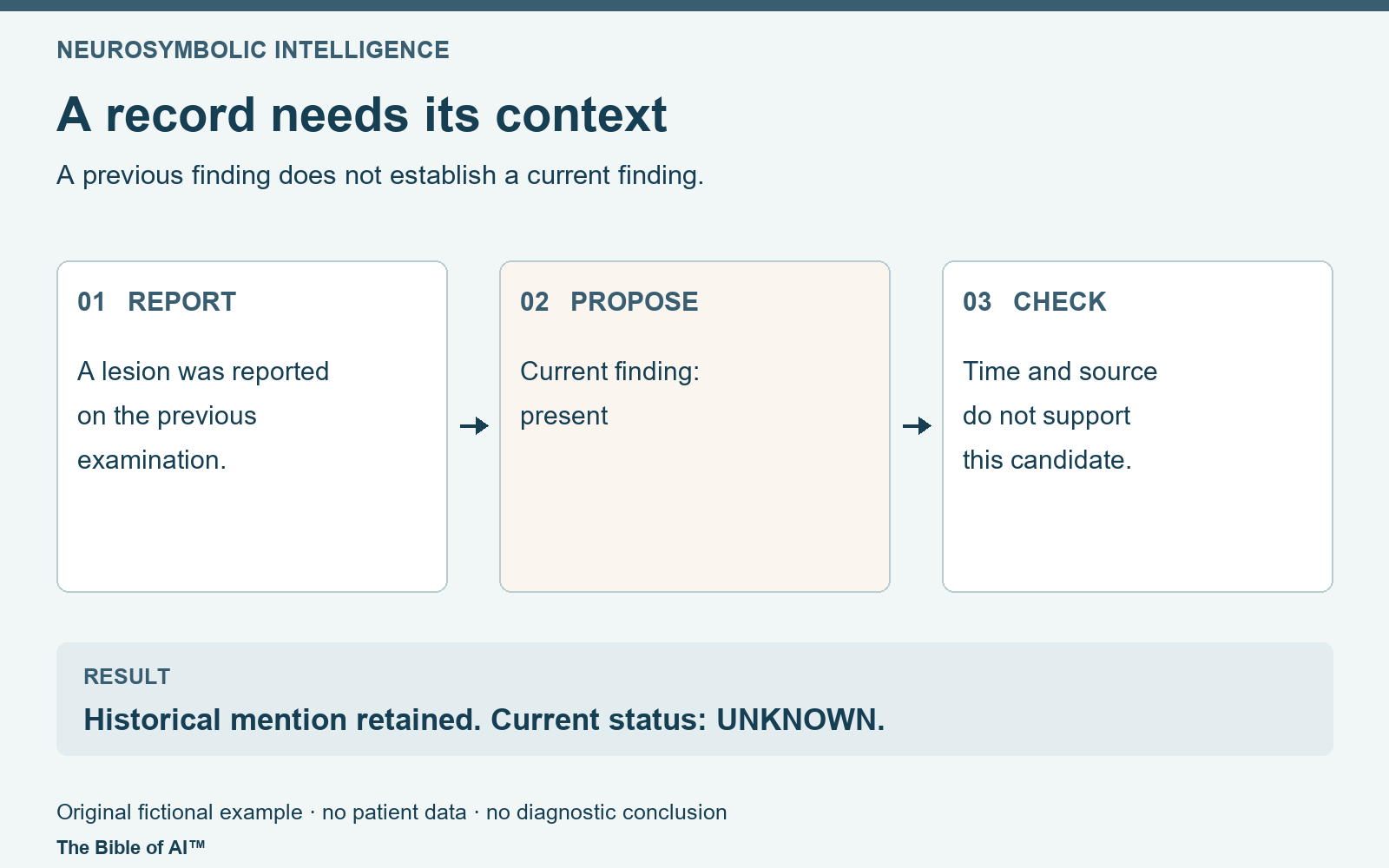
A report can mention a finding without saying that it is present now. It may describe an earlier examination, deny an observation or leave a question unresolved. Turning those sentences into a database requires more than finding familiar words. This article follows an original, fictional example through a proposed extraction, explicit checks and a decision to retain uncertainty. A clinical research study provides a bounded comparison, while standards for data validation and provenance help distinguish a well-formed record from a true statement about the world. The central question is what a deterministic rule can establish when the text it receives is incomplete or its interpretation is wrong. The answer matters for research collections built from medical reports: a reproducible check can expose an inconsistency, but it cannot replace the evidence that the record is supposed to represent.
20 Nov 2026
The driving model proposes a move. Which rule can stop it?
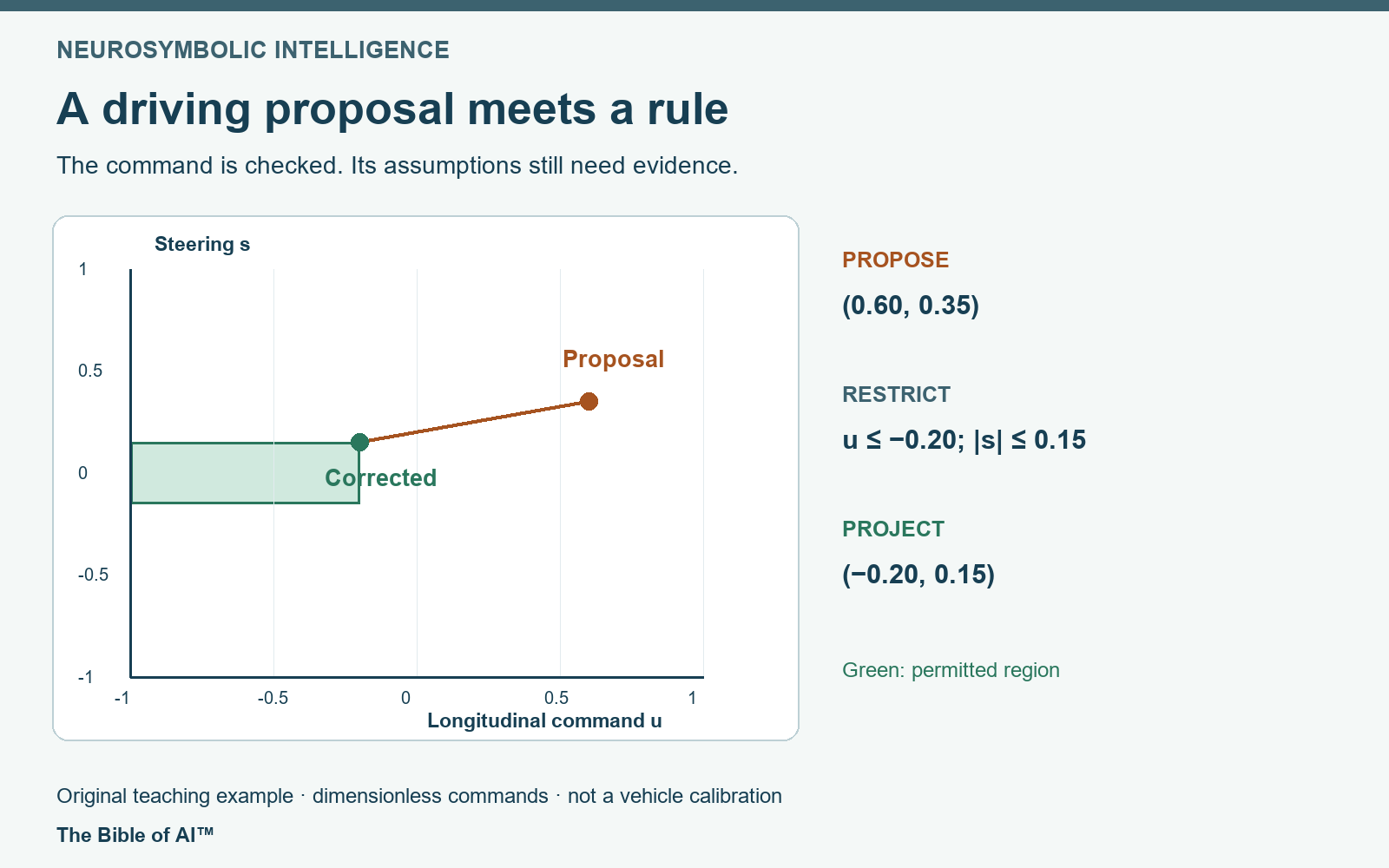
A vehicle can recognise the road and still propose a manoeuvre that should not be executed. This article examines the boundary between a learned driving policy and a rule that can restrict its commands. A small, fully specified example shows how acceleration and steering limits change a proposal; a second calculation shows why the same rule becomes unreliable when its assumptions about braking are wrong. Research on symbolic shields provides the foundation, while a recent simulation study illustrates both the benefits and costs of intervention. Fewer collisions in some scenarios can come with longer delays and lower performance elsewhere. The question is what has actually been checked: a command, a model of the environment, or behaviour on a real road. These are different levels of evidence, and the distinction matters when learning is used inside a physical system.
20 Nov 2026
When an AI draws another line, what makes the proof valid?
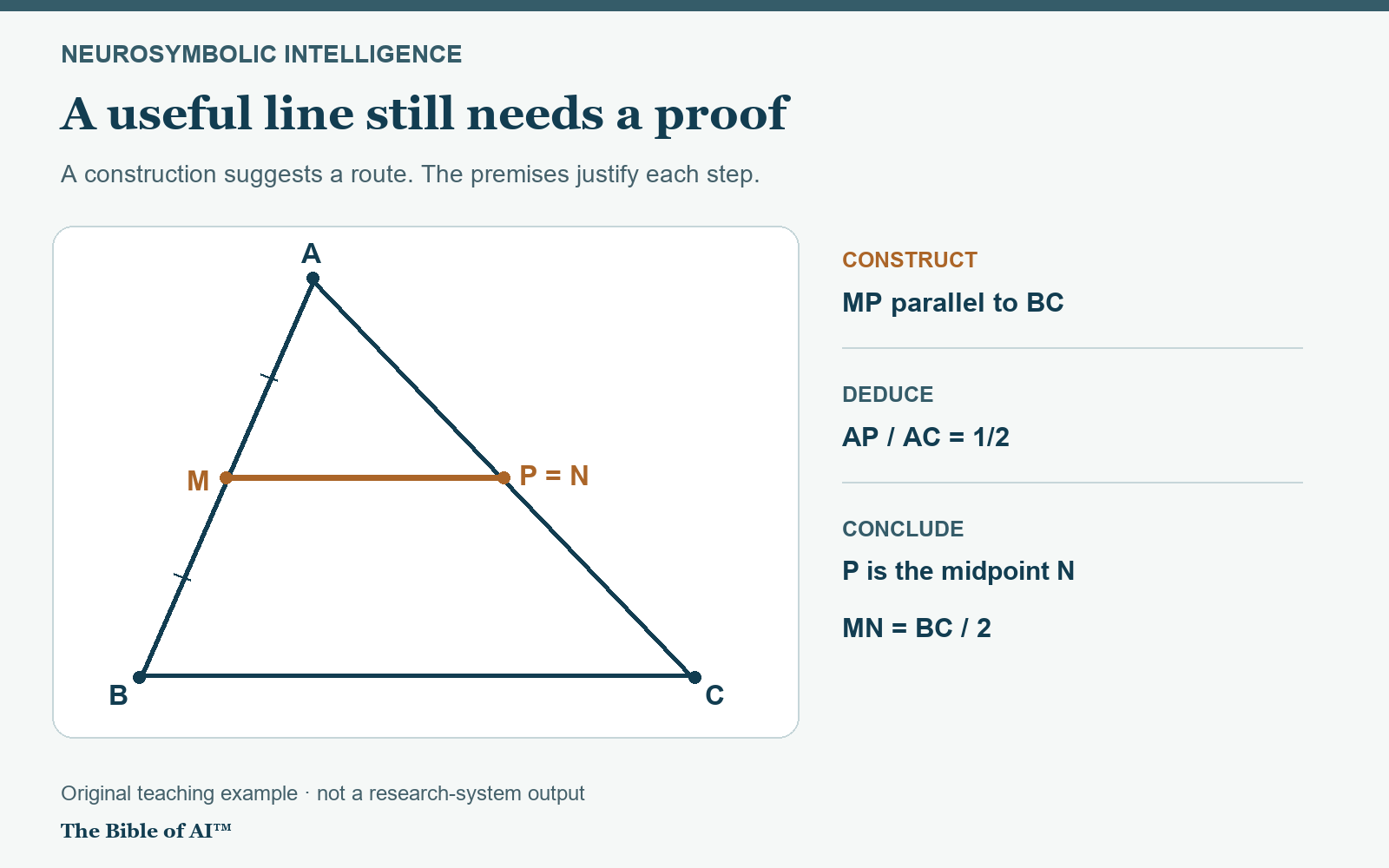
Adding a line to a triangle can reveal a route to a proof. It can also create a convincing picture that establishes nothing. This article follows a simple geometric construction to distinguish a useful proposal from a justified conclusion. The reader can check each step: what is given, what is constructed, which rule applies and what remains to be shown. A deliberately incorrect shortcut reveals why a missing assumption cannot be repaired by repeating the same answer. AlphaGeometry2 provides the research context for this distinction between learned suggestions and symbolic deduction. Its published evaluation is read with its actual denominator and the limits of its mathematical language. The available implementation also makes it necessary to distinguish testing a deductive component from reproducing an entire system. The question for this collection is how learning can assist reasoning while the conditions for accepting a result remain explicit and open to examination.
Reading the evidence
Selection is editorial and not exhaustive. Reviews examine learning, symbolic representations and explicit rules across mathematics, vision, robotics, medicine and other fields. Primary scientific sources are preferred. A demonstration, a benchmark result, an independent reproduction and a formal guarantee are identified as different forms of evidence.
Deterministic execution does not by itself establish that premises are true, rules are sound or an implementation is correct. Reviews state the assumptions and scope of each result. Illustrations and worked examples are distinguished from experimental findings. Newly published articles appear in this collection automatically.