A box rests on a table. A humanoid slips its hands into position and lifts. A moment ago the table carried the weight. Now that same weight presses through the robot’s arms, hips and feet. What must the machine learn before it can lift one foot to take the first step?
The answer begins with a change of support. As the foot leaves the floor, the forces holding up the robot and its load must pass through the other foot. A trial in Beijing captures the difficulty in a few movements. A robot picked up a box, turned and walked away from the table in 26 of 30 attempts. Its AI chose movement targets. A separate controller kept the steps physically feasible. Together they show where learning enters a machine that can lose its balance. [2] [3]
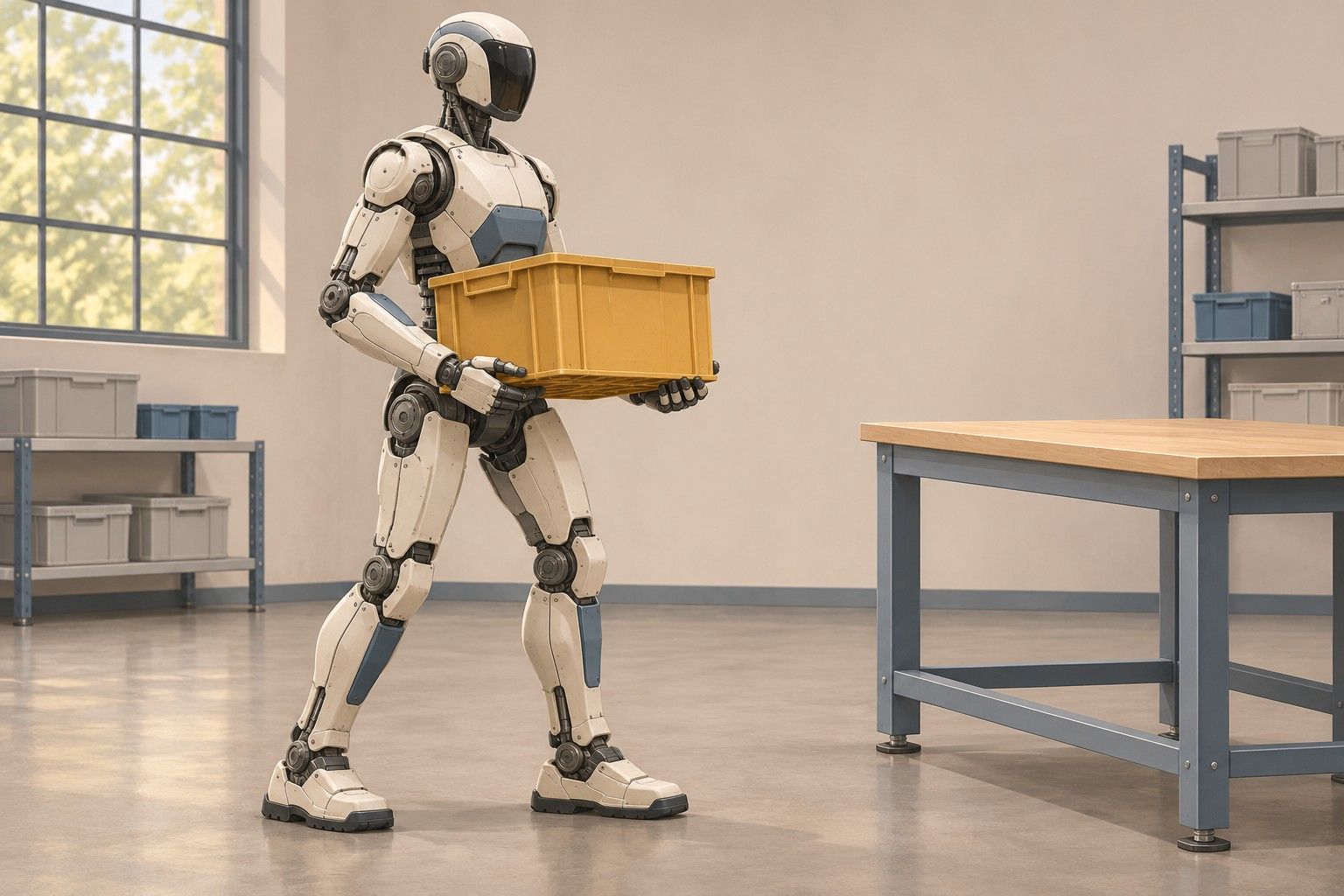
What changes when the box leaves the table?
Imagine holding a 5 kg box still. If its centre of mass is 0.30 m in front of a horizontal axis through the shoulders, gravity exerts a turning moment of about 14.7 N·m about that axis. Bring it to 0.15 m and the moment falls to about 7.4 N·m. The calculation multiplies mass by gravitational acceleration (9.81 m/s²) and by horizontal distance. It describes the box’s contribution alone. The arms have weight too, and the two shoulders share the effort. [2]
Standing still on a level floor, with only the feet supporting the combined load, the vertical line through the combined centre of mass must meet the area spanned by the foot contacts. Walking changes the problem. A body already moving forward can pass beyond the stance foot. The controller must estimate how fast it is moving and place the next foot where the floor can supply enough force to redirect it. A sliding foot or a late step changes what recovery is possible. [2]
How does practice become a correction?
At Oregon State University, researchers trained Digit in a physics simulator with boxes of different sizes and masses. They divided the work into five skills, including picking up the box and walking with it. During practice, the robot earned a higher score for making gentle contact and lifting the box towards the target. A separate reward favoured keeping the centre of pressure near the middle of the area supported by the feet. It is the point on the ground where the combined upward force under the feet acts. Repeated trials changed the rule that maps observations to joint commands. On the physical robot this trained rule could respond to the next observation without another round of training. [1]
On hardware, Digit picked up boxes ranging from 1 to 8 kg. A camera read a marker on the box, the team supplied its mass and dimensions, and an operator directed navigation and switched skills. With the heaviest box the robot leaned forward enough to need an adjustment. The walking-with-box controller’s 100% success figure belongs to 10,000 simulated episodes of that skill. The paper gives no equivalent success rate for complete physical deliveries. [1]
The Beijing team used a depth camera, an inertial measurement unit and force sensors in the feet of its BHR10. The camera helps locate the load. The inertial unit measures angular velocity and specific force, and the feet register changes in support. On hardware, a walking stabiliser turned the learned targets into continuous trajectories for the body and feet. Joint drives then executed the movement. An overhead hoist protected the robot during testing. The 26 successful trials ended when it walked away carrying the box. The authors also describe failures to establish contact. The four unsuccessful box trials therefore cannot be counted as four falls. [3]
There is also a timing constraint inside the electronics. On Stanford’s HumanPlus, a different research platform, a learned controller supplied joint position targets at 50 Hz, one every 20 milliseconds. A feedback controller ran at 1,000 Hz, adjusting torque between those updates. This is how a motor can start correcting a joint error while a higher-level decision is still pending. The two frequencies describe different operations. [4]
Can training improve the delivery itself?
In the WEVO experiment, a Unitree G1 approached a side platform, squatted to lift a basket with both hands, carried it back and set it on a table. To score a success the basket had to come to rest stably on the table. The researchers started with a policy trained to imitate synthetic demonstrations. They then tested ways to improve it, including practice inside a video model that predicts what the robot would see after a proposed action. The results below all come from the physical robot. [5]
| How the policy was trained | Placements |
|---|---|
| Imitation of synthetic demonstrations alone | 2 / 20 |
| Additional DICE-RL training on recorded robot trials | 8 / 20 |
| Additional DICE-RL training directly in the LEGS simulator | 0 / 20 |
| Additional DICE-RL training in the video model | 13 / 20 |
| Additional AWR training in the video model | 14 / 20 |
Starting from the same policy, DICE-RL trained directly in the LEGS simulator produced no stable placements in 20 hardware trials. Training in the video model produced 13 in 20. Each row represents one training run for that method and task. Only one placement separates the two video-model methods shown, too few to rank them reliably. A robot could stay upright and still miss its grasp or set the basket down badly. The final score alone cannot tell us how often a loss of balance caused a failure. [5]
What would count as progress for AI?
At a GXO warehouse, mobile robots bring totes to a station where Digit transfers them to a conveyor. Agility Robotics describes a footstep planner and a predictive controller that follows the planned steps. The manufacturer’s account establishes a use for coordinated arms and legs. Attributing that installation’s performance to one of the laboratory learning methods would require evidence about the controller actually deployed. [6]
A useful comparison would give a humanoid and a wheeled manipulator the same route, loads and placement tolerance. Count unaided deliveries per shift, record dropped loads and human interventions, and measure electricity drawn per successful delivery, including charging losses. Repeat with an unfamiliar box whose contents sit to one side. A conventional feedback controller might also recover on its first attempt. To establish what learning contributes, test both controllers on the same humanoid with the same sensors and the same load shift. Record whether it needs a recovery step, drops the box or needs outside support. Those observations can reveal a difference in balance even when both controllers complete the delivery.
Sources and scope
Evidence reviewed through 21 November 2026. The experiments have different endpoints. Oregon State tested individual skills and demonstrated transfers between tables. The Beijing trial ends after departure, the WEVO trial after placement, and the warehouse account concerns an operating station.
- Oregon State University (2024). Sim-to-Real Learning for Humanoid Box Loco-Manipulation. IEEE ICRA. Table IV and section VI report the simulated and physical tests, respectively. DOI 10.1109/ICRA57147.2024.10610977.
- Massachusetts Institute of Technology (2024). Highly-articulated Legged Robots. Underactuated Robotics, chapter 5. Mechanics of contact, centre of pressure and foot placement.
- Beijing Institute of Technology (2025). Robust Visuomotor Control for Humanoid Loco-Manipulation Using Hybrid Reinforcement Learning. Biomimetics 10(7), 469. Sections 5.1 and 6.1–6.3 define the task, hardware trials and walking stabiliser. Section 7 discusses failed contacts. DOI 10.3390/biomimetics10070469. Full text at PubMed Central.
- Stanford University (2025). HumanPlus: Humanoid Shadowing and Imitation from Humans. Proceedings of the 8th Conference on Robot Learning, PMLR 270, 2828–2844. The control architecture illustrates how joint commands reach the motors.
- Amazon, Stanford University and the University of Texas at Austin (2026). WEVO: World Model-Enabled VLA Optimization for Whole-Body Loco-Manipulation. Preprint, arXiv:2611.25251v1, 18 November. Section IV-A and table II define the basket test and report results on hardware.
- Agility Robotics. Digit’s Next Steps. Manufacturer’s account of footstep planning and tote handling at a GXO logistics station.
Liked this post? Follow this blog to get more.