Juan Antonio Lloret Egea, Director (BackGround) · AI and Society
Imagine a parent asked to account for every euro of childcare support. Across town, a regional minister approves a grant worth millions. Who chose the recipient? Which rule applied, and whose advice did the minister take? If a government can single out one family for inspection, the family should be able to trace a decision taken in its name.
What can the state learn from a single record?
For the 1890 US census, clerks recorded each person’s answers on a separate punched card. Machines could then tally the answers. A count of children can help a district plan its schools. The stakes change when an authority links records collected for different purposes. A home address, a ticket and a payment may together suggest where someone went and whom they met. In the EU today, a public authority must justify its use of personal data and respect the purpose for which the information was collected. US Census Bureau, history of census tabulation. EU General Data Protection Regulation (GDPR), Articles 5 and 6.
For Dutch families claiming childcare allowance, the danger was real. The Dutch Data Protection Authority fined the Dutch Tax Administration €2.75 million over its use of applicants’ nationality. The regulator found that the practice was unlawful and discriminatory. Nationality was one of the indicators used to select applications for closer scrutiny. For a parent, the first sign of such a decision may be a letter asking for more documents. The OECD reports that tax administrations use AI to help select cases for review. The people selected have good reason to ask what drew the authority’s attention and how they can challenge an error. Dutch Data Protection Authority, findings on childcare allowances. OECD survey of tax administrations.
Consider a passenger travelling by train to a lawful demonstration. Would she still go if she thought her journey might be used to infer her political views? In a case about passenger records, the Court of Justice of the European Union limited systematic checks on travel within the EU. In particular, it ruled out self-learning systems that could change the criteria for assessing passengers in advance without human intervention or review. In Spain, the same Constitution that requires people to contribute to public expenditure according to their means also protects the home, privacy, freedom of expression and peaceful assembly. Court of Justice, Ligue des droits humains, C-817/19. Spanish Constitution, Articles 18, 20, 21 and 31.
Who scrutinises those who authorise public spending?
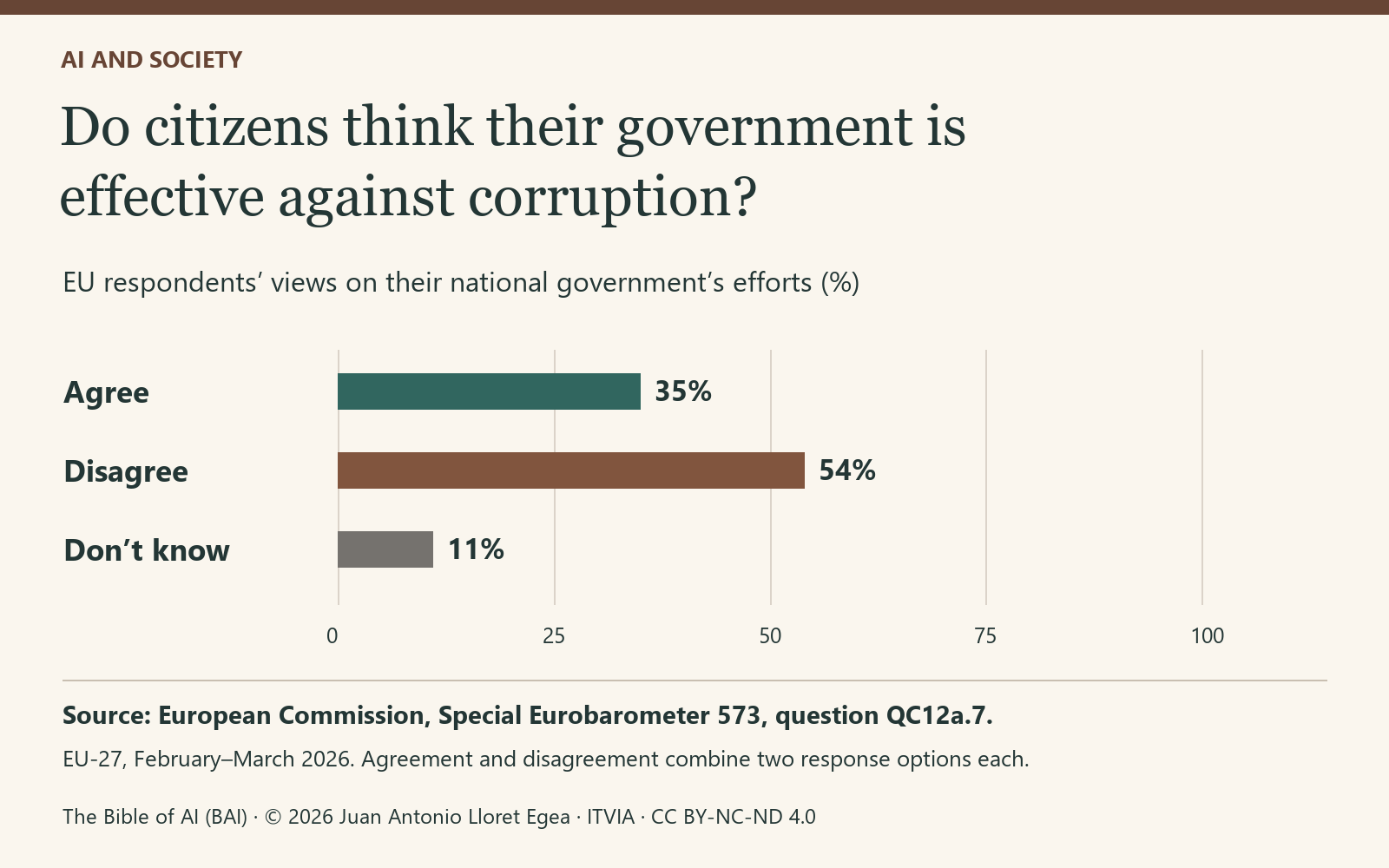
In a 2026 survey across the European Union, 35% of respondents agreed that their national government’s efforts to combat corruption were effective. A majority, 54%, disagreed. The remaining 11% answered that they did not know. These figures describe how people judge their government’s efforts. The survey question asked neither how often corruption occurs nor whether citizens would welcome AI surveillance. European Commission, Special Eurobarometer 573.
The Bible of AI (BAI) · © 2026 Juan Antonio Lloret Egea · ITVIA · CC BY-NC-ND 4.0
When the decision is made closer to home
In Spain, understanding a single decision can mean reading a national law, the rules of an autonomous community and a municipal notice. The Constitution recognises territorial autonomy, binds every public authority to the law and prohibits arbitrary action. Two regions may lawfully make different choices. A regional minister or a town council must still act within its powers and respect the rights of the people affected. Germany’s Länder and the states of the United States have powers of their own under different constitutional arrangements. For a resident in any of the three countries, the practical question is much the same. Which authority made this decision, and where can I challenge it? Spanish Constitution, Articles 2, 9, 137 and 139. German Basic Law, Article 30. US Constitution, Tenth Amendment.
Imagine that a regional department rejects a grant application from a residents’ association that has publicly criticised the government. The application appears to meet the published conditions. What reasons did the committee give? If a written objection circulated before the vote, who received it, and did the minutes record a dissent? That record may protect the official who spoke up. Membership of a small committee alone establishes little about what any one member knew. Spain’s General Subsidies Act requires public grants to be managed objectively and without discrimination. For the association, the immediate questions are why it was excluded and how it can appeal. Spanish administrative law requires reasons for acts that restrict rights or legitimate interests and specifies what the notice must tell those affected. Spanish General Subsidies Act, Article 8. Spanish Administrative Procedure Act, Articles 35 and 40.
How can a resident trace a grant after work?
The original notice may be in a regional gazette, the amendment under a different title, and the award on a transparency portal. A parent with one evening to spare may never put the three together. Spain’s transparency law requires public bodies to publish specified information about contracts, contract amendments and grants. A civic AI service could help the parent ask a precise question. “Which rule applied on the day of the award, who signed the decision, and where can I read the reasons?” A useful answer would give dates, link to the relevant pages and identify any missing document so the reader could request it. Spanish Transparency Act, Articles 8 and 12–17.
Such a service could trace decisions taken by a particular officeholder or governing coalition over a defined period. The same search criteria should apply across parties. Anyone wrongly identified as the signatory should be able to open the original document and have the attribution corrected. In the EU, a service processing personal data must have a lawful basis and limit the data it uses to what its purpose requires. In Spain, taxpayer information held by the tax administration is generally confidential, subject to statutory exceptions. Publishing the award of a grant gives the public a way to examine the award. It gives nobody a general right to inspect the recipient’s tax return. GDPR, Articles 5 and 6. Spanish General Tax Act, Article 95.
Public auditors already use related tools. The European Commission’s Arachne+ brings together project and contractor data to help authorities decide where EU spending warrants closer inspection. In Brazil, the federal comptroller’s Alice system uses AI to examine procurement documents. In 2024 it analysed more than 161,000 procurement procedures. That work led to 212 audits. An audit may uncover an irregularity, allow a contract to be amended in time or clear those involved. The number of audits tells us how often authorities took a closer look. Only the findings can tell us whether the suspicion was justified. European Commission on Arachne+. Brazil’s federal comptroller, Alice.
What would it take to establish legal responsibility?
Start with a decision that can be checked. A meeting with a lobbyist, a former minister taking a job or a grant to an organisation linked to a party may warrant a closer look. Each may also have a lawful explanation. An allegation that someone took a bribe calls for evidence of the benefit offered or received and its connection to an official act. The same evidential standard should apply to the governing party and to the opposition. A minister who could quietly direct the system to investigate only opposition-run towns would acquire a powerful means of intimidation. Independent control of case selection and a record of who ordered each inquiry would make that abuse easier to expose.
The EU AI Act draws a boundary here. It prohibits using AI to predict a person’s risk of committing a crime solely from profiling or an assessment of personality traits. Suppose investigators already have objective, verifiable facts directly linked to criminal activity. The prohibition does not prevent AI from assisting their assessment of a person’s possible involvement on that basis. Investigators still need lawful authority for the inquiry. A discrepancy between a signed award and a payment is something an auditor can check. A prediction about the signatory’s character cannot establish guilt. EU AI Act, Article 5(1)(d).
An official deciding a tax appeal, a professional licence or access to healthcare exercises authority conferred by law. Spain’s Constitution requires the administration to serve the public interest impartially and subjects its action to judicial review. Under Article 404 of the Spanish Criminal Code, the offence at issue requires an authority or public official to issue an arbitrary administrative decision knowing it to be unjust. An overturned decision, even one that caused serious harm, does not by itself establish that knowledge. Anyone accused is entitled to the presumption of innocence. Spanish Constitution, Articles 24, 103 and 106. Spanish Criminal Code, Article 404.
Who audits the AI that public institutions use to detect fraud?
Suppose a tax authority asks its AI to identify possible fraud in benefit claims. The supplier reports how many claims the system flagged. Who checks why the same families keep appearing, or why an office that authorised improper payments escaped scrutiny? A reviewer who sees only flagged cases will miss the mistakes that never produced an alert.
I would equip an independent public audit body with AI to help sustain that scrutiny around the clock and at scale. An independent audit body should choose the questions and the sample, including cases that raised no alert. Its reviewers need lawful access to the original records. If both systems read the same incorrect entry, both may flag the wrong family. A human auditor should have the authority to halt a referral, hear the person affected and secure a correction. The supplier should explain how it tested its model and what failures it identified. The institution should account for every decision it takes on an alert. The audit body should publish its own error rates and corrections while protecting the identities of those involved.
The US National Institute of Standards and Technology recommends involving assessors who are independent of the development work. Its guidance is voluntary. I propose giving that body the authority, access and resources to examine both administrative decisions and the AI systems that support them. NIST AI Risk Management Framework, Measure 1.3.
What a Dutch student received after the decision was reversed
The Netherlands provides a documented example of algorithmic scrutiny and redress. DUO, the student finance agency, used fixed rules to select recipients of the grant for living away from home for fraud inspections. Algorithm Audit, an external organisation commissioned by DUO, applied an open-source machine-learning tool to examine the selection. In the 2014 records, 53% of one group, composed of students in vocational education, had been classified as high risk. In another group, mostly university students living farther from their parents, the proportion was 3%. These were rates of suspicion assigned by the system. The audit helped expose how the selection concentrated scrutiny on particular groups. Algorithm Audit, figure 49 · Open-source audit tool.
Journalists had raised the alarm in 2023. In November 2024, the Dutch Data Protection Authority concluded that the selection criteria lacked objective justification and were discriminatory and unlawful. A later judgment records what happened to one student selected through that process. After a home inspection, the ministry demanded repayment and imposed a fine. The student appealed. On 23 December 2024, the ministry revoked its decisions. The court records payment of €8,389.89 in student finance and €1,246.74 in interest, together with a refund of €857.87 already paid towards the fine, €120.32 in further interest and €5,993 for legal assistance. The ministry acknowledged that its decisions were unlawful. Government response to the original investigation · Data protection authority’s findings · Judgment of 20 November 2025, sections 2.2 and 4.1.
The machine-learning audit established disparities across groups. The individual secured redress through an appeal. The published record does not establish that the audit tool identified his particular case. It does show why independent access to the selection process matters, and why an institution must be able to correct the consequences of its own unlawful decisions.
What the Italian contract files show
Imagine an audit office with time to examine one completed contract in a hundred. Which files should it open? The University of Padova research team behind RE LightGBM M3 published the trained decision trees, down to their thresholds and the values assigned at each leaf. The team drew on more than 1.1 million Italian contracts for which it had information about execution, including cost overruns. An auditor can inspect how the ranking was produced. Applying it before the work has been carried out would require information that does not yet exist. The project’s PolyForm Noncommercial licence expressly permits use by government institutions. Read the Open Models assessment of RE LightGBM M3 · Inspect the trained model · Project licence.
The meaning of a “positive” case matters. The researchers counted an upheld legal challenge or a recorded closure on specified criminal or anti-mafia grounds. A definitively dismissed challenge counted as negative. Most contracts had no known outcome under these rules. Across four evaluation groups, 46 of the 210 known positives appeared in the highest-ranked 1% of contracts. On average, the proportion of known positives in that first 1% was 21.89 times their proportion in the corresponding evaluation group. Yet when the task was to rank a known positive above a known negative, the model performed only slightly better than chance (mean ROC AUC of 0.531, against 0.5 for chance). An upheld challenge may reveal an unlawful award. Determining that someone acted corruptly requires further evidence. Results for the four evaluation groups.
Our journal checked a second division of the same Italian records using the researchers’ published scores. This time 43 of the 210 known positives reached the top 1%. Neither exercise tells a Spanish municipality how many irregularities its auditors would substantiate. Before adopting M3, the municipality should compare it with its usual selection procedure on later contracts, using the same staff time. Independent reviewers should examine files from both lists without knowing how each was selected, together with a random sample from outside both. Publish the number of substantiated findings per hundred files, the hours each finding took and what the random sample uncovered. The competent audit body must examine the evidence and sign its findings. Any sanction belongs to the authority legally empowered to impose it.
What an unusual price can tell an auditor
Isolation Forest can help an auditor spot contracts that differ from comparable awards. The open-source code in scikit-learn 1.9.1 supplies the method. An independent audit body would have to train its own model on past contracts, using details such as the number of bids and the size and timing of price changes. It could then rank later contracts for inspection before looking at the alerts issued by the authority’s own system. Isolation Forest source code · BSD 3-Clause licence.
Suppose three amendments doubled the price of repairing a road. The contract might draw attention even if flood damage justified every extra euro. Conversely, an overcharge repeated across many contracts might look ordinary. The score alone cannot establish wrongdoing. To test the method, auditors could compare how many discrepancies they confirm per hundred files reviewed under each selection method. They should also inspect a random sample that neither system flagged. Only the underlying documents and a human review can establish what happened in a particular case.
What commercial models add
Commercial systems also deserve a defined role in an evaluation. OpenAI’s Astra for Law combines GPT-6 Astra with legal sources and reports improved performance on its US legal research evaluation. Gemini 4 Argon is available through the legal platform Harvey. The UK AI Security Institute used Claude Opus 5 as an auditor model in controlled investigations of another model’s behaviour after a security incident. Each example identifies a task, a version and a setting in which the technology has been examined. Their relevance to a Spanish tax decision or a municipal grant must be tested against the applicable law and the original records. OpenAI’s evaluation · Harvey’s model availability · AI Security Institute study and methods.
An administration could commission document retrieval, comparison of contract versions and checks on whether a stated reason is supported by the cited record. The evaluation should measure mistaken allegations, missed discrepancies and the time needed to verify each result. Procurement terms should require lawful data processing, controlled access, a record of model versions, disclosure of relevant defects and cooperation with independent auditors. The provider should answer for the failures within its responsibility. The deploying institution should answer for its choice of system, its local validation and the decisions taken with it. The contract should make those responsibilities enforceable. European Commission model contractual clauses for public procurement of AI · GDPR, Articles 5, 6, 28 and 35 and Chapter V.
What should a resident be able to inspect?
The public authority that puts a model to work should name the official accountable for its use and publish a protocol anyone can follow. A resident should be able to consult the version in use, its purpose, the factors it considers and the results of independent audits. The public service should let anyone run a published example against that version and trace the result to records cleared for disclosure. Someone affected by a decision needs a further route to request the relevant records, identify a mistaken entry, obtain a reasoned response and challenge the decision before the competent body. Each request should receive a dated reference. The protocol should say who must reply, by when, and how to contest a refusal. Spanish law distinguishes public access to information, subject to statutory limits, from an interested party’s right to inspect the administrative file. Spanish Transparency Act, Articles 12–16, 20 and 24 · Spanish Administrative Procedure Act, Article 53.
If an alert contributes to a public decision, the authority should be able to reconstruct what happened on the day. It should preserve the dated source records, model version and inputs, the score and selection rule, the reviewer’s findings and the official’s reasons for acting or closing the case. An independent auditor with lawful access should be able to reproduce the score and trace any later correction. Spain’s technical standard for electronic case files provides a concrete basis for preserving the evidence. It specifies the documents, a signed electronic index and the metadata needed to identify the file. That record allows the person affected to contest the facts and the competent authority or court to assess their evidential weight. A score alone cannot establish liability. Spanish interoperability standard for electronic case files · Spanish Administrative Procedure Act, Articles 70 and 77.
What if software itself issues an administrative decision? Spanish law covers administrative acts performed entirely by electronic means, without the direct involvement of a public employee. The administration must decide in advance which bodies are responsible for supervision, quality control and other functions. It must also identify the body that will answer a legal challenge. The resident can then address a challenge to a public body that must answer for the decision. Spanish Public Sector Act, Article 41.
A program that alerts an official to a discrepancy plays a different role from one that decides a person’s entitlement. Under the GDPR, the general rule protects people from decisions taken entirely by automated means if those decisions affect their legal rights or have a similarly significant impact. The regulation sets out exceptions and safeguards. For criminal law enforcement in Spain, a separate law applies. It covers fully automated decisions that have adverse legal effects or otherwise significantly affect the person concerned. They require express legal authorisation and safeguards. One of those safeguards is the right to have a human being review the decision. GDPR, Article 22. Spanish Organic Law 7/2021, Article 14.
When the damage is done, who pays?
The person harmed bears the loss first. In Spain, a resident seeking compensation for harm caused by an administrative decision claims directly from the public authority concerned. Having the decision overturned does not automatically entitle the resident to compensation. Among other conditions, the claimant must show an actual loss that can be valued in money and is specific to a person or group. The loss must be attributable to the public service, and the claimant must have had no legal duty to bear it. If the claim succeeds, the authority pays from public funds. The resident need not first prove which individual official was at fault. Spanish Public Sector Act, Articles 32, 34 and 36(1).
What happens to the official who caused the loss? After paying compensation, the administration must act on its own initiative to pursue any personal liability arising from intentional wrongdoing, gross fault or gross negligence. It must follow the statutory procedure. The law also provides for proceedings where conduct of that gravity damages the administration’s own property or rights. The official has a right to be heard. Criminal responsibility is a separate matter for the courts. Citizens should be able to establish how much the decision cost, whether the authority examined personal responsibility, and what it decided. Spanish Public Sector Act, Articles 36 and 37.
The Director’s view
Would I use AI to scrutinise the official decisions of every politician, whatever their party, and every civil servant, permanent or temporary, entrusted with taxes, grants or other public money? Yes. Twenty-four hours a day. A minister who authorises a payment at midnight owes the public as clear an account as the official who signs one at noon. Each chose to accept public responsibility. That choice carries a duty to explain how public power was exercised. The audit should follow the decision wherever and whenever it was taken. The official’s home life, private correspondence and lawful associations remain their own.
There are grounds for public unease, and the evidence deserves a careful reading. Between 2012 and 2025, Spain’s score on Transparency International’s Corruption Perceptions Index fell ten points to 55 out of 100. The index records how experts and businesspeople perceive public-sector corruption. In the OECD’s survey in Spain, the proportion reporting high or moderately high trust in the national government rose from 37% in 2023 to 43% in 2025. That year, just 21% reported that level of trust in political parties. A citizen can reasonably demand closer scrutiny without assuming that confidence in every institution has declined. Transparency International, 2025 Corruption Perceptions Index. OECD Trust Survey, Spain.
The courts also merit scrutiny, with due respect for judicial independence. In Spain, 52 corruption trials ended in full or partial convictions in 2025. In 2026, 40% of respondents in Spain rated the independence of courts and judges as fairly good or very good. In a separate survey, 31% thought there were enough successful prosecutions to deter corruption. Neither survey can tell us whether a particular judgment was sound. I would use AI to help citizens trace a case from referral to the published judgment. Where the law permits disclosure, they should also be able to see whether any money was recovered. Judges must remain free to decide each case on its merits. Spanish Constitution, Article 117. European Commission, 2026 Rule of Law Report, country chapter on Spain.
Excessive speed can cost a life. Enforcing a limit therefore requires a trustworthy measurement, an instrument whose accuracy can be checked and a fair procedure for examining what happened. Spain’s metrological rules place speed-measuring instruments under formal control. The same discipline should inform the scrutiny of public power. Both the conduct under examination and the means used to examine it must be open to correction. Spanish rules on metrological control, Annex XII.
A citizen called before a tax authority is expected to account for their conduct under the law. Those who exercise political authority should face equally rigorous scrutiny of their public decisions. Permanent civil servants, temporary staff and political appointees should regard independent audit as an ordinary condition of holding responsibility for public money. An AI alert should be treated as a provisional indication requiring investigation. A qualified human reviewer must establish whether the apparent discrepancy is real, examine its lawful explanations and record the evidence before any adverse decision is taken. The person concerned must have a meaningful opportunity to respond.
That scrutiny should extend to the institutions that supervise others, including European and international bodies. Their mandates and procedures differ, but their stewardship of public resources should be independently examinable. An audit should be capable of uncovering a conflict arising from political commitments, personal ties, financial interests or obligations to former officeholders. If an earlier failure was concealed, the institution’s interest in avoiding embarrassment should carry no weight against a lawful inquiry. Such concerns require evidence in each case. The presumption of innocence must govern how allegations are investigated and judged. It is entirely compatible with independent examination of public decisions.
The tools discussed here already support procurement review, legal research and the examination of algorithmic behaviour. Their use in a particular administration must be justified by evidence from that setting. A system that helps inspect thousands of records should still allow a reviewer to follow a single grant, an amendment, a signature and a payment. Its value should be measured by substantiated findings, errors corrected and harm prevented. The provider, the institution deploying it and the people acting on its output must remain answerable for their respective responsibilities.
Impartiality has to be demonstrated in the data, the selection of cases and the treatment of contrary evidence. Independent auditors need access sufficient to test those choices. A documented human procedure must allow an unsafe system to be suspended. Any restriction or suspension of scrutiny should identify who authorised it and why, so that those being examined cannot quietly determine when the examination ends. A trustworthy public system must be traceable, open to challenge and capable of improvement.
What can this offer the parent asked to account for every euro? A way to discover who authorised a grant, what evidence justified it, who considered an objection and where the money went. Public authority carries a duty to answer those questions. Citizens should be able to follow the record, obtain a correction and seek accountability through the competent institutions. Those entrusted with the public’s money must accept the scrutiny they require of the public.
Liked this post? Follow this blog to get more.