Juan Antonio Lloret Egea, Director (BackGround) · AI and Society
Imagine two people calling to change a date. One wants a parcel delivered on Friday. The other has a hospital appointment on Friday and says, almost as an afterthought, “I’m not sure I can wait that long.” The first caller may be glad to settle the matter without waiting for a shop to open. The second needs someone to hear the question behind the request. An automated service could record both calls as successfully completed.
What counts as getting help?
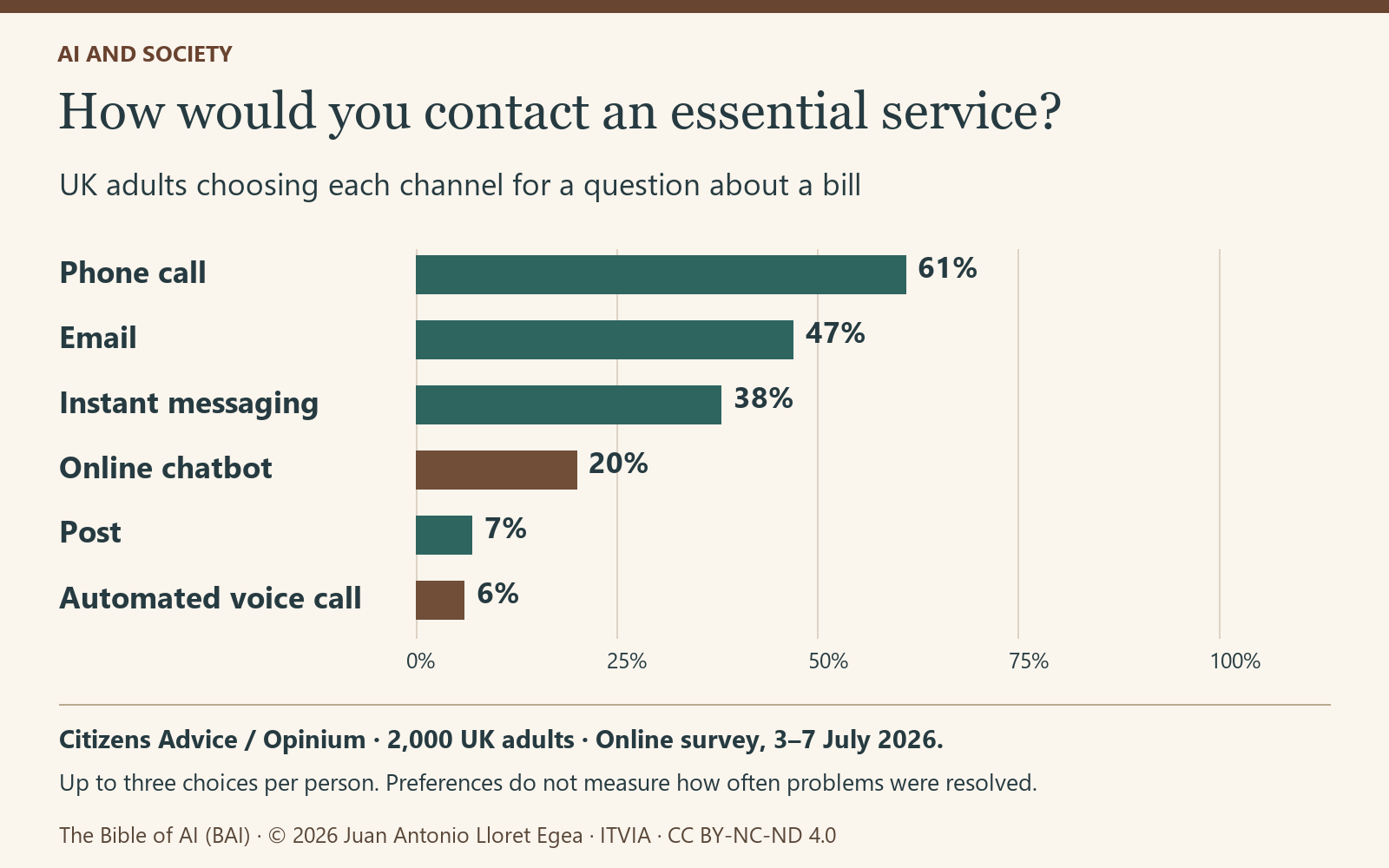
Asked how they would prefer to contact an essential service provider about a bill, 61% of UK adults in a Citizens Advice survey conducted by Opinium chose the telephone; 20% chose an online chatbot. Respondents could choose up to three ways to get in touch. Some may have wanted both: a written answer when a question is straightforward and a conversation when it is not.
The Bible of AI (BAI) · © 2026 Juan Antonio Lloret Egea · ITVIA · CC BY-NC-ND 4.0
There is a human cost to making the wrong channel compulsory. Among respondents who struggled or failed to reach a person about a bill, 49% reported stress or frustration, 44% a delay and 14% giving up. Those figures describe that group, not everyone who used a chatbot. A voice menu that sends a caller back to the beginning can be as dispiriting as a chat window that keeps asking them to rephrase. A human adviser can hear hesitation, ask what has changed and, with permission, take up the case without making the caller tell the whole story again.
There is also evidence of a benefit when AI sits beside the adviser. In a study of 5,172 technical support agents at one company, those with access to AI suggestions resolved 15% more issues per hour on average. Less experienced staff improved in both speed and quality; among the most experienced and best-performing staff, speed improved slightly while quality declined slightly. The callers were still dealing with people. The study did not test replacing them with an automated helpline.
A parcel and a patient
A retailer can let an assistant read a delivery record and offer a new date, provided the customer can check the change and an employee can undo it. A hospital can use an assistant to give directions or confirm visiting hours. Deciding whether someone can safely wait for care is a different task. A booking assistant should transfer that question to an appropriate professional, even when the caller never uses the word “urgent”. A model’s performance in retail says nothing about its fitness for clinical triage.
Even where two services use the same underlying technology, they need different evidence, permissions and people on duty. Before a system influences clinical priority, the hospital needs evidence for that particular purpose and patient population, including how patients and staff fare together in realistic conditions. It needs a staffed route for ambiguous calls and a fallback when the system is unavailable. A missed delivery can often be rearranged; time lost before a clinical assessment may be impossible to recover. See the international principles for developing medical devices that use machine learning.
When an answer is wrong, who must act?
The model provider answers for what it builds and supplies. It should substantiate its performance claims, explain which uses and populations it has tested, disclose known failure patterns and tell services when a new version changes behaviour. If an update starts dropping the word “not” from callers’ requests, the provider must investigate the defect, warn affected services and supply a correction or a safe way to withdraw that version. A general warning that AI can make mistakes does none of this.
The organisation running the service answers for what happens on its line. Its managers choose the task, set the system’s permissions and provide the staff who can take over. They should test local accents, accessibility needs and out-of-hours calls, including whether anyone actually answers a transfer. If the model correctly asks for a nurse but the call goes to an unattended extension, the hospital must fix that route. If a faulty update and an unanswered extension both played a part, each organisation owes an account of its own decisions. The caller needs one place to report the problem, a person empowered to restore the service and an explanation of what was done.
An assistant that can cancel an appointment or change a booking needs stricter limits than one that can only suggest an answer: ask for confirmation, keep a proportionate record of the action and give a person authority to stop or reverse it. Preserve enough information to distinguish a model error from a fault in the service that connects it to local records. Legal liability depends on the facts, the parties’ roles and the applicable law. For high-risk AI systems, the EU AI Act distinguishes the duties of system providers and organisations that use them. A model supplier need not be the provider of the finished system. None of these distinctions makes the software an answerable party or leaves the last employee to take the call responsible for everyone else’s choices.
Knowing who is on the line
At the first exchange, the service should say in ordinary language: “You’re speaking to an AI assistant. I can check booking times. To speak to a person, say ‘adviser’.” The words matter only if the transfer works. A calm voice or a fluent explanation can make a wrong answer sound settled. In an experiment on reliance on AI advice, asking people to form their own judgement first reduced some errors, but the extra effort was not always welcome. Someone calling in distress should not have to detect the error to get help. For consequential changes, read back what will happen and offer a genuine chance to disagree.
What happens to the people who take the calls?
Time saved might give an adviser room to listen to a bereaved caller. It might also mean a post is abolished, a vacancy goes unfilled or someone loses paid shifts. A shorter week chosen on the same pay is a different outcome from a shorter rota imposed on someone who needs the hours. A study of an online freelance market found early losses in work and earnings in occupations more exposed to generative AI; Danish employment records showed no detectable average change in earnings or recorded hours over the period studied. Neither finding tells us what happened on a particular helpline. Ask staff about lost shifts and harder calls, and publish figures for staffing and paid hours alongside waiting times.
The fair test comes after the line opens. Can callers reach someone, get a mistake corrected and finish what they called to do? Count people who give up as well as those whose cases close. Compare repeat calls, delays, and outcomes for people who need help communicating. A useful balance is possible when people set the rules, test them against appropriate standards, check results after each change and retain the authority to stop the system. Whether that balance has been reached is a question for the people who called on Friday, including those whose calls were never answered.
Liked this post? Follow this blog to get more.