NEUROSYMBOLIC INTELLIGENCE · MATHEMATICS AND VERIFIABLE REASONING
A triangle is missing the line that would make its proof easy. A model may suggest where to draw it. The reader still needs to know why that line helps and whether the conclusion follows. A fluent explanation, an attractive diagram and a valid deduction are different achievements.
AlphaGeometry2 makes that distinction concrete: a learned model suggests auxiliary constructions, while a symbolic component derives consequences. [1] We begin with a much simpler example that the reader can inspect without running an AI system.
A line that earns its place
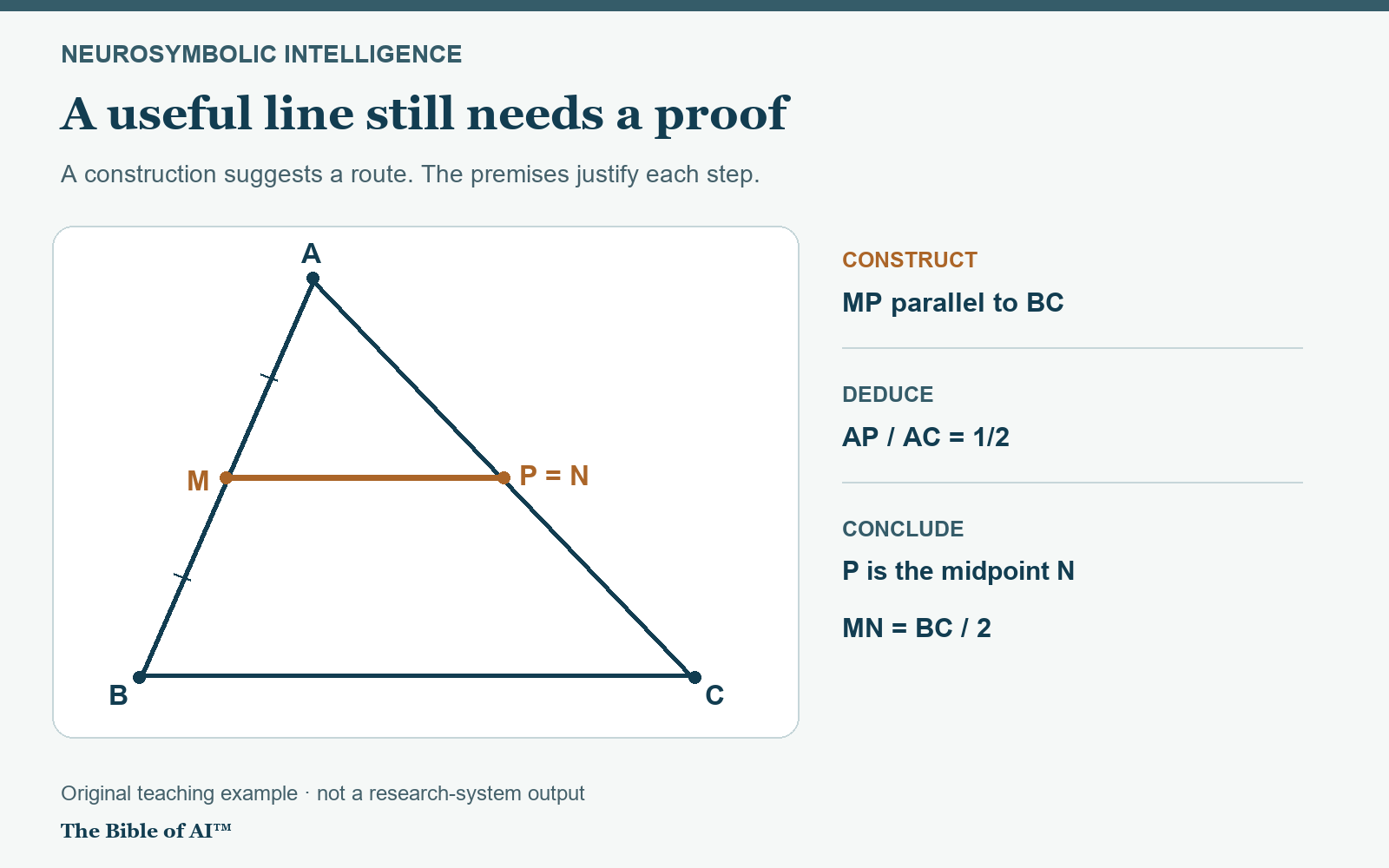
Take a non-degenerate triangle ABC. Let M be the midpoint of AB and N the midpoint of AC. We want to establish two things: MN is parallel to BC, and its length is half the length of BC. The drawing suggests both. Measuring the picture would only describe that particular drawing.
Construct a line through M parallel to BC, and call its intersection with AC P. At this stage, do not assume that P and N are the same point. Proving that coincidence is the useful part of the argument.
- Use the given midpoint. AM/AB = 1/2 because M is the midpoint of AB.
- Apply the construction. MP is parallel to BC. The corresponding angles make triangles AMP and ABC similar.
- Use similarity. AP/AC = AM/AB = 1/2, and MP/BC = 1/2.
- Identify the point. P lies halfway along AC. N was defined as that midpoint, so P = N. Therefore MN is parallel to BC and MN = BC/2.
The proposal was to draw a parallel. The proof established its consequences and showed that its intersection was the point we needed. Nothing in this elementary argument requires a language model. A learned system could help choose a construction in a harder problem; its suggestion would still need justification.
The distinction is useful even when the proposal succeeds immediately. “The points appear to coincide” and “the two definitions identify the same point” are different reasons for accepting a step. The latter can be examined without trusting the appearance of the diagram.
A plausible shortcut that fails
Change just one condition: M lies on AB but is no longer specified as its midpoint. The conclusion does not follow. Take A = (0, 4), B = (0, 0), C = (6, 0), M = (0, 3) and N = (3, 2). N is still the midpoint of AC, but MN slopes downwards while BC is horizontal.
The parallel construction itself remains possible. What fails is the assertion AM/AB = 1/2: that ratio is now 1/4. A system that silently supplies the missing midpoint condition has changed the problem. A system that applies the original argument twice has repeated the mistake.
This counterexample was prepared for the article. It is not a reported failure of AlphaGeometry2. Its purpose is to make a general requirement visible: a rule must be applied to premises that actually hold. Repeatable output alone does not establish that requirement.
What the published result measures
Chervonyi and colleagues report 42 solved exercises out of 50 in IMO-AG-50. Those exercises come from 45 original geometry problems from the 2000–2024 International Mathematical Olympiads; some were split during formalization. Six exercises were outside the system’s formal language and two were attempted without a solution. Its symbolic component alone solved 16. [1, Section 7 and Table 4]
The 84% result therefore concerns this geometry benchmark, not an entire Olympiad examination or mathematics generally. The authors’ comparison with an average gold medallist is a benchmark comparison, not an awarded medal. Their reported system combines learned search with rules; it does not establish that language models alone solve the task. [1]
Checking a component is not reproducing the whole system
The authors’ public repository supplies the DDAR symbolic component and worked problems. Some examples can be handled by that component alone; harder examples are supplied with auxiliary points. The repository explicitly distinguishes these demonstrations from the full AlphaGeometry system. [2]
That distinction matters when judging a reproduction. Successfully checking a proof with supplied auxiliary points does not show that the same implementation discovered those points. A useful independent report would state what was supplied, what the program generated and what it checked. This article does not claim to have reproduced the complete AlphaGeometry2 benchmark.
Where deterministic rules help—and where they stop
A deterministic procedure gives the same result when its relevant inputs and execution conditions are fixed. That property is useful for repeatable checking. It does not, by itself, make the inputs true, the rules sound or the implementation free of defects. A learned proposal mechanism and a rule-governed deductive component can also have different reproducibility properties.
There is a further distinction between finding a proof and checking one. Lean, for example, is designed around a small logical core that checks proofs, with automation built around it. That is an example of a checking architecture, not a claim that AlphaGeometry2 uses Lean or that the two systems provide identical assurances. [3]
Return to the triangle. There are at least three places to examine an answer. First, does the mathematical statement represent the intended question? Second, does every deduction use an applicable rule and satisfied premises? Third, does the implementation correctly carry out those operations? A mistake in the first stage can leave a perfectly coherent proof of the wrong statement.
The same questions can guide research elsewhere, but the geometry result does not validate a robot, a vehicle or a medical system. Those applications introduce observations, uncertainty and changing environments. A rule about an obstacle, for example, also depends on whether the obstacle and its position were represented correctly.
What should accompany an answer?
For this collection, an inspectable answer should make its starting conditions visible, distinguish supplied information from generated proposals, and expose the steps connecting them to the conclusion. It should also identify an unsupported case rather than quietly replacing the question with an easier one.
In the worked example, the decisive step was P = N. The added line became useful because the argument justified that equality. That is the question to carry forward: when an AI proposes a step, what allows us to accept it?
Sources and image credit
- Chervonyi, Y., Trinh, T. H., Olšák, M., Yang, X., Nguyen, H. H., Menegali, M., Jung, J., Kim, J., Verma, V., Le, Q. V., and Luong, T. (2025). Gold-medalist Performance in Solving Olympiad Geometry with AlphaGeometry2. Journal of Machine Learning Research, 26(241), 1–39. Full paper. The PDF states publication in October 2025; the repository announcement is dated January 2026. The paper is licensed under CC BY 4.0.
- Google DeepMind. AlphaGeometry2: symbolic engine and examples. Repository documentation consulted on 20 November 2026.
- Lean FRO. The Lean Language Reference: Introduction. Documentation consulted on 20 November 2026.
Image credit: original illustration for The Bible of AI™. It represents the elementary construction explained in this article. No figure from the cited research has been reproduced. The numerical counterexample and the worked proof are educational examples; neither is presented as an experimental result of the study.
Liked this post? Follow this blog to get more.