NEUROSYMBOLIC INTELLIGENCE · AUTONOMOUS SYSTEMS AND VERIFIABLE CONTROL
A driving model proposes an acceleration. An obstacle lies ahead. The important question at that instant is whether the command should reach the vehicle. A fluent explanation of the decision does not apply the brakes.
This is a different task from checking a geometric proof. A vehicle acts on an environment that changes while it observes it. Nevertheless, one architectural question carries over: can a learned proposal be examined against explicit conditions before it is accepted?
A rule at the boundary of an action
The idea of a shield gives this question a precise form. Alshiekh and colleagues describe a reactive system derived from a safety specification and an abstraction of the environment. It can restrict the actions offered to a learner or inspect an action after the learner has selected it, correcting violations while limiting unnecessary interference. Their guarantees concern the specified properties and the assumed environment model. The work was presented at AAAI in 2018, following a 2017 preprint. [2]
This foundation matters because an execution-time check is not an invention of language models. Logic, state representations and explicit specifications have their own history in artificial intelligence and formal methods. A neural component may contribute perception or action selection; the rule that authorises an action need not be another neural network.
Nor does attaching a rule automatically make a system trustworthy. A useful account must identify what the rule receives, what it can reject and what it cannot know. The following example makes those questions small enough to inspect directly.
Two commands, three bounds
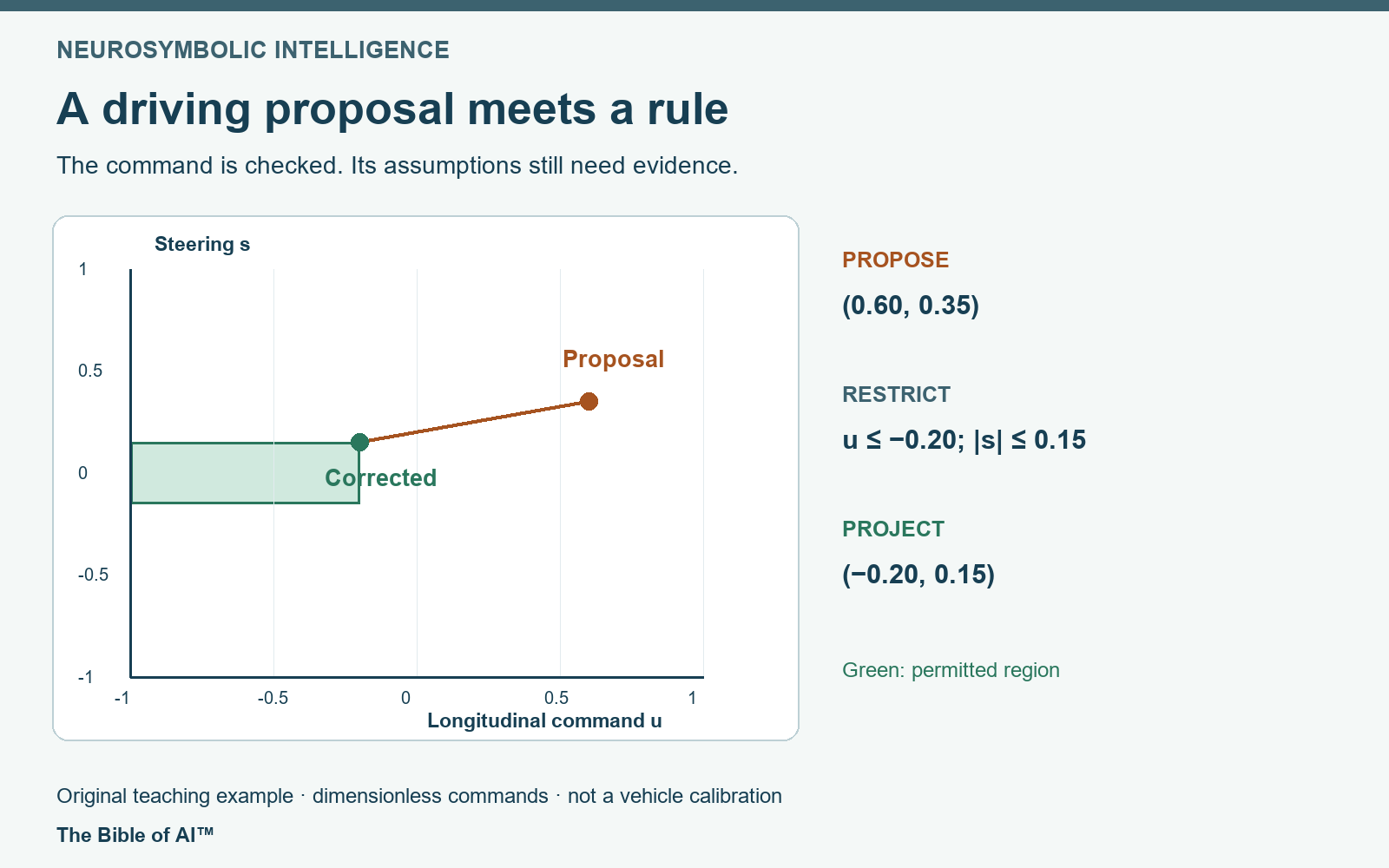
Consider an illustrative control space with two dimensionless coordinates. Let u be a longitudinal command, with negative values representing braking and positive values acceleration. Let s represent steering. Both range from −1 to +1. These conventions are chosen for the example; they do not specify an actual car’s response.
Suppose a model proposes (u, s) = (0.60, 0.35). A separate calculation has produced these limits for the current observation:
- u must be no greater than −0.20.
- s must be no less than −0.15 and no greater than +0.15.
- The original actuator limits, −1 to +1, still apply.
The permitted region is therefore a rectangle. If “nearest” means the ordinary Euclidean distance in these equally weighted coordinates, the closest permitted command is (−0.20, 0.15). Each coordinate is clipped to its permitted interval. The original proposal violates both the longitudinal upper bound and the steering upper bound.
The result can be checked without trusting a verbal explanation. The corrected point satisfies all three bounds. Moving either coordinate away from its clipped value while remaining in the rectangle increases the squared distance from the proposal. This establishes the projection for this rectangle; it does not prove that the vehicle will stop before an obstacle.
Change the proposal to (−0.40, 0.10). It already lies inside the rectangle, so the check leaves it unchanged. Change the limits so that no point can satisfy them simultaneously, and there is no nearest permitted point to return. An implementation must identify that failure and invoke a separately specified response. Silently weakening a bound would change the requirement.
Even the distance measure deserves attention. Equal numerical changes in acceleration and steering need not have equal physical consequences. Rescaling a coordinate or choosing different weights can change what counts as the smallest intervention. A rule-governed system still contains engineering choices that require justification.
The premise can fail before the rule does
A second original example concerns stopping distance. Assume a stationary obstacle, constant speed during a delay, constant braking deceleration afterwards, a level road and no additional safety margin. Under those simplified assumptions, the stopping distance is:
d = v × delay + v² / (2a), where a is the positive magnitude of braking deceleration.
At 20 metres per second, a delay of 0.4 seconds and a deceleration of 5 metres per second squared, the calculation gives 8 + 40 = 48 metres. An obstacle 60 metres away would leave 12 metres under this model. If the achievable deceleration is instead 2.5 metres per second squared, the same calculation gives 8 + 80 = 88 metres. The rule can be executed perfectly and still reach the wrong operational conclusion if it receives the first braking value when only the second is achievable.
These numbers are educational assumptions, not stopping-distance advice or vehicle settings. They isolate one source of error. Uncertainty in distance, delayed observations, road gradient and motion of the obstacle would introduce further questions. A formal description such as Responsibility-Sensitive Safety makes assumptions and responses explicit; adopting such a description does not remove the need to justify its parameters in the intended setting. [3]
Missing information also differs from favourable information. “No obstacle was detected” does not logically entail “the path is clear”. Work by Carr and colleagues addresses shielding under partial observability, where a decision must account for incomplete knowledge of the environment. That is a distinct research problem, not a feature that every simple rule filter automatically provides. [4]
What a recent driving experiment reports
Patiño Idarraga and colleagues’ August 2026 preprint places a guard after a frozen TransFuser v6 policy. Five rules constrain obstacles, speed, red lights, pedestrians and steering stability. The guard uses exposed scene information and changes commands without retraining. [1]
The reported CARLA simulation uses Fail2Drive’s 200 routes: 100 familiar and 100 modified counterparts, with three seeds. Table 3 gives these success rates:
| Scenes | TFv6 | With guard |
|---|---|---|
| Familiar | 93.3 | 92.3 |
| Modified | 70.7 | 81.3 |
The second change is 10.6 percentage points, approximately 15% relative improvement. The first is a one-point decrease. The authors also report fewer pedestrian collisions, from 6.3% to 3.0% of routes, alongside more delays. These comparisons do not establish collision-free operation. The unguarded row is identified as the public-leaderboard result; the guarded row is the authors’ run with identical weights. The table does not give confidence intervals. [1, Tables 2–3 and Section 4.2]
What would make the claim stronger?
Our reading is that the evidence should be examined at three different levels. First, the command check: does the output satisfy the declared bounds, including boundary values and impossible combinations? Second, the physical interpretation: are those bounds appropriate for the measured state and the uncertainty surrounding it? Third, the behaviour of the whole system: do interventions reduce relevant failures without creating unacceptable new ones?
A useful independent evaluation would retain the unmodified model, match scenarios and random seeds, report uncertainty and disclose each intervention. It would test false detections as well as missed hazards, unusually weak braking as well as nominal braking, and situations where stopping leaves the vehicle stranded. It would also measure the time needed to produce the corrected command. A late correct answer can be unusable in a moving system.
This article has checked the arithmetic and the geometric projection in its own examples. It has not reproduced the driving benchmark or tested a vehicle. The examples establish what their stated assumptions permit, while the research comparison remains a reported simulation result.
The practical question for neurosymbolic intelligence is therefore precise: which part of a proposed action can be checked, using which observations and under which assumptions? A deterministic rule can make an intervention inspectable. The obligation to examine its premises remains.
Sources and image credit
- Patiño Idarraga, S., Silva, E., Yasmin, R., and Shoker, A. (2026). Herding End-to-End Autonomous Driving via Neuro-Symbolic Safety Guards. arXiv:2608.11451v1, 11 August 2026. Preprint; version checked on 20 November 2026. Version record.
- Alshiekh, M., Bloem, R., Ehlers, R., Könighofer, B., Niekum, S., and Topcu, U. (2018). Safe Reinforcement Learning via Shielding. AAAI 2018, 2669–2678; preprint first submitted in 2017.
- Shalev-Shwartz, S., Shammah, S., and Shashua, A. On a Formal Model of Safe and Scalable Self-driving Cars. First submitted in 2017; cited version revised 27 October 2018.
- Carr, S., Jansen, N., Junges, S., and Topcu, U. Safe Reinforcement Learning via Shielding under Partial Observability. Preprint version of 23 August 2022; subsequently presented at AAAI 2023.
Image credit: original illustration for The Bible of AI™. The command-space example and stopping-distance calculations are educational constructions. No research figure, vehicle test or experimental output has been reproduced.
Liked this post? Follow this blog to get more.