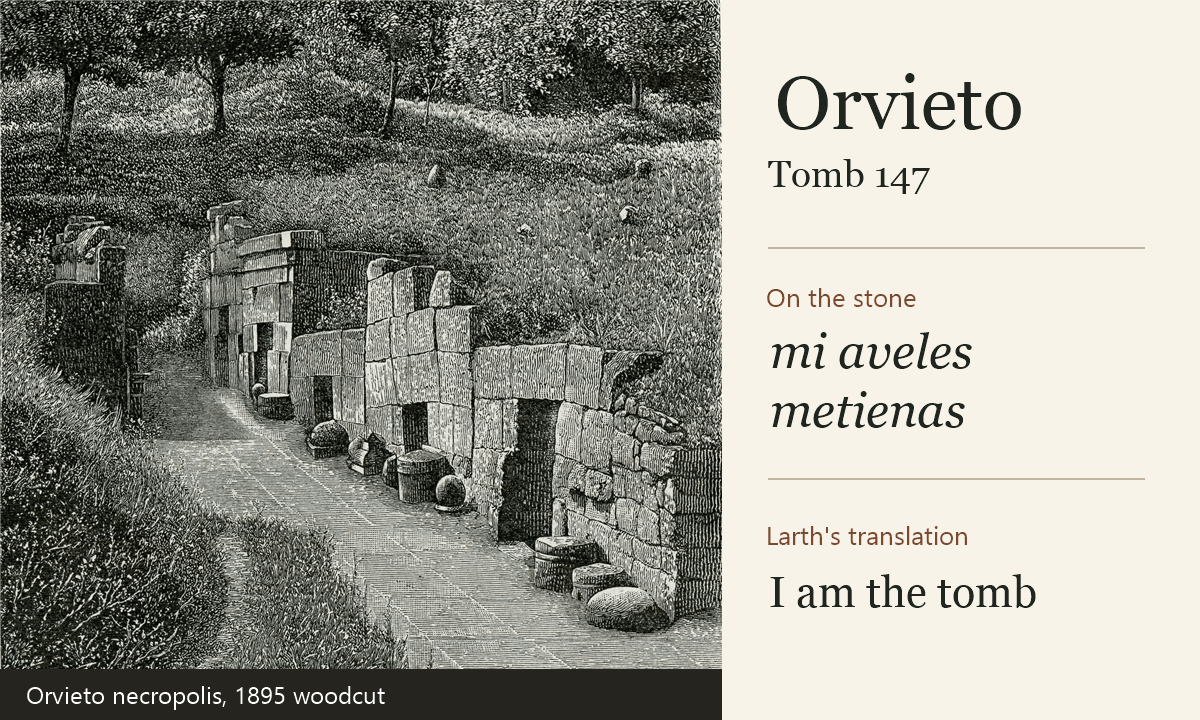
Three words are carved above the entrance to an Etruscan tomb at Orvieto. Two of them tell us whose tomb it was. In 2023, researchers at Maastricht University published what happened when their translation model, Larth, read those same words. It answered “I am the tomb”. The word “tomb” is the one thing the stone leaves unsaid. Where, then, did the name go? [1] [2] [4]

Who is speaking on the stone?
At Crocifisso del Tufo, outside Orvieto in central Italy, streets run between rows of burial chambers. Inscriptions on the stone lintels often identify the people to whom the tombs belonged. Archaeologists found two burials in tomb 147. The grave goods place the first burial shortly before the middle of the sixth century BC. The same three words appear twice on the monument, once on the front and again in larger letters on its north side. The second inscription runs for 2.36 metres along the wall. [1] [5]
The catalogue records the words as mi aveles metienas. The first, mi, means “I”. The other two give a personal name and a family name, both with endings that express possession. One way to put that relationship into English is “I belong to Avele Metiena.” A translator who writes “I am [the tomb] of Avele Metiena” supplies the words in brackets from the setting. Neither translation tells us which of the two people buried inside bore that name. The inscription identifies the person to whom the monument belonged. [1] [2] [3]
What did Larth learn from earlier translations?
Larth received a transcription. Its designers built a small neural network that could attend both to whole words and to the letters within them. They collected 7,139 Etruscan texts, of which 2,891 had an English translation. These pairs let a model learn how recurring expressions are usually rendered. A familiar opening can therefore produce natural English even when the rest of the inscription contains a name that the model handles poorly. [4]
Across the combined test material, one configuration scored 10.1 on BLEU, a measure of how closely sequences of words match a reference translation. BLEU gives no special weight to an owner’s name simply because that name is what a visitor came to find. On the smaller collection used for the Orvieto example, a dictionary-based method did better by two other measures, one comparing characters and the other counting the edits needed to reach the reference. [4]
Return to the entrance of tomb 147 and the result is easy to check. In “I am the tomb”, Larth supplied the setting that a visitor could see, although the model had only text in front of it. Its answer then stopped just where the English phrase “of Avele Metiena” would begin. A reader might recognise a funerary formula from those four English words. To answer the question on the museum label — whose tomb? — the reader needs the two words still there on the stone. [2] [3] [4]
Sources and bibliography
- P. Binaco, “Volsinii. Orvieto, Crocifisso del Tufo”. Rivista di epigrafia etrusca, Studi Etruschi 78, entry 22, pp. 212–213 and plate XXX. Excavation, burials and both inscriptions on tomb 147.
- Etruscan Texts Project, inscription 214. A stone tomb lintel from archaic Volsinii (Orvieto). Catalogue transcription and reference to the 1990 edition.
- J. Drigo, “As línguas da Itália antiga: um breve panorama”. Mare Nostrum 9 (2017), section 5.1. Word-by-word analysis of ETP 214, including the two genitives.
- G. Vico and G. Spanakis, “Larth: Dataset and Machine Translation for Etruscan”. Proceedings of the Ancient Language Processing Workshop (2023), pp. 39–48. Sections 3.1 and 5.5, table 9 and figures 6–7 give the corpus, the Orvieto example and the model comparisons.
- Musei nazionali dell’Umbria, “Necropoli etrusca di Crocifisso del Tufo”. Archaeological site guide on the layout of the necropolis and the ownership formula over tomb entrances.
Liked this post? Follow this blog to get more.