A clay tablet, a broken decree and a faint figure beside a desert path ask different things of a reader. One preserves a language we understand in a script few people can read today. Another has lost the very letters that would settle an argument. The third may never have represented speech at all. This collection follows the people and instruments that help us read each kind of evidence.
State of the field · From decipherment to archaeological survey
Learning to read a script. The Rosetta Stone records a decree in two languages and three scripts. Greek offered scholars a point of comparison for Demotic and Egyptian hieroglyphs. Champollion drew on his knowledge of Coptic in his breakthrough of 1822. With Linear B, patterns of signs studied by Alice Kober helped prepare the ground for Michael Ventris’s identification of Mycenaean Greek in 1952. Linear A still awaits a generally accepted decipherment. These cases show why identifying a script, identifying its language and translating a particular sentence are separate achievements. British Museum exhibition guide (PDF) · Cambridge on Linear B.
Reading words and finding parallels. Cuneiform served several languages. A 2023 study trained a system to translate Akkadian from encoded signs or transliterations into English. The process begins after someone has identified the signs on the clay. Ithaca offers candidate letters for damaged Greek inscriptions. Aeneas, a later system for Latin inscriptions, retrieves related texts and can use a photograph alongside the transcription. Across these projects, what a model can learn depends on earlier acts of copying, editing and digitisation. The readings preserved by successive generations now shape the examples a machine can compare. Akkadian translation study · Ithaca · Aeneas.
Seeing a surface. At Herculaneum, X-ray scans and virtual unwrapping let researchers examine the surfaces of carbonised scrolls while keeping the rolls closed. In the Maya lowlands of Guatemala, airborne lidar measured terrain beneath vegetation and helped archaeologists map settlements and infrastructure. At Nazca, researchers searched aerial photographs and checked promising locations on the ground. Each technique reveals a different kind of trace. A date, a reading or an account of what a landscape meant to its inhabitants needs further evidence. Herculaneum scrolls project · Maya lidar survey · Nazca field survey.
What limits translation today? An October 2026 study of Old Assyrian Akkadian reported about 6,700 paired sentences in the largest aligned corpus for the dialect. In its tests, training on the full collection brought a larger gain than increasing model size. An apparent advantage of one model family also shrank when each was tuned separately. For a museum deciding where to put scarce time, this gives fresh weight to the painstaking work of matching a transcription to a reliable translation. Read the comparative study.
Articles in the collection
-
Who found the 303 new figures in the Nazca desert?
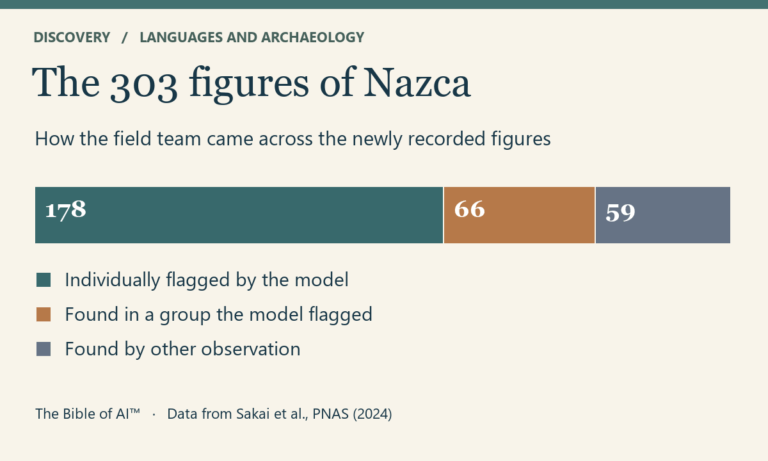
Read the article →: Who found the 303 new figures in the Nazca desert?From the air, a faint outline on the Nazca pampa can look like a figure or an accident of the desert surface. Deciding which outlines deserve a visit is half the work. In six months of fieldwork, archaeologists documented 303 previously unrecorded figurative geoglyphs. A model had marked 178 of them individually in aerial photographs. Another 66 came to light beside a figure it had flagged. The remaining 59 emerged through other field observations or through inspection of photographs outside the marked areas. Put those…
-
When a Greek inscription breaks, who supplies the missing letters?
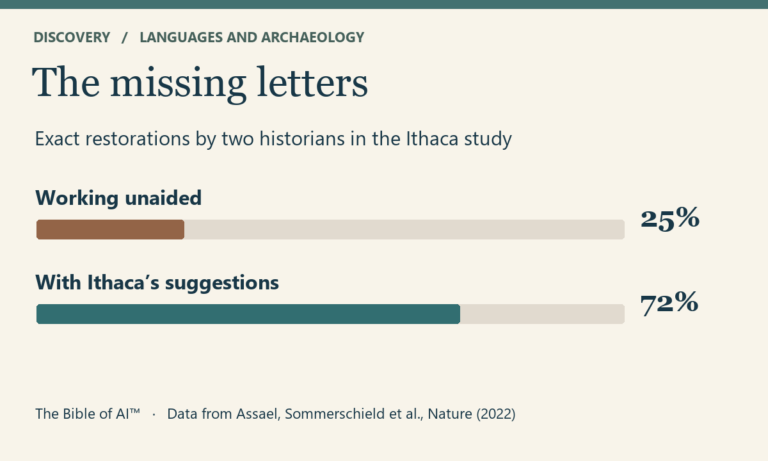
Read the article →: When a Greek inscription breaks, who supplies the missing letters?A piece of a Greek decree breaks away just where an official’s name should be. Two names fit the space. Which one belongs in the next edition? To find out whether a computer could help a historian make that choice, researchers hid letters in inscriptions whose wording was already known. Two specialists could search other Greek texts for similar phrases. When they also had twenty suggested readings from Ithaca, their accuracy in restoring the whole missing sequence rose from about one quarter to nearly three…