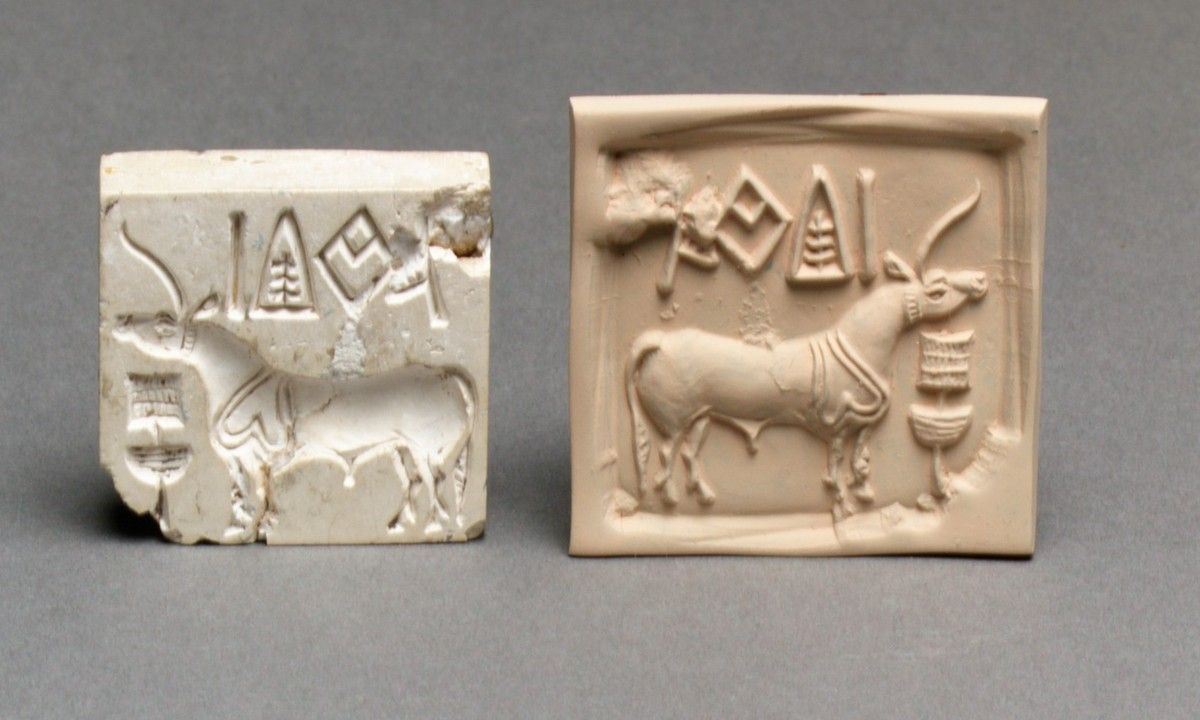
At the foot of a riverside staircase at Mohenjo-daro, excavators found a small stone seal bearing a one-horned animal and signs like those on seals from Harappa. A visitor today can pick out the animal. What the signs said to the person who pressed the seal into clay is still an open question. Nearly a century after the excavation, researchers tried an experiment with another Indus inscription. They covered up two signs whose shapes were known. Could a computer put them back? [1] [5]
How do you test a reading when nobody knows the answer?
Rakhal Das Banerji’s first clue to the age of the site was a different sort of stone. In his later account, the archaeologist recalled finding a small flint scraper at Mohenjo-daro in 1919, where a Buddhist stupa stood on the mound. At another site, Ghaibi Daro, he cut his finger on a scraper lodged in the sediment of a jar. The second find gave him a reason to take the first seriously: stone tools could belong to an earlier occupation. His 1922–23 excavation at Mohenjo-daro brought the inscribed seal to light. The city belonged to the Bronze Age. The Buddhist stupa was built over its ruins in the second century CE. [1] [2] [3]
By 1965, researchers had found a way to ask the signs a question that required no translation. A Soviet team led by Yuri Knorozov had begun using computers the previous year. Its preliminary report, published in Moscow, compared where signs occurred and which ones tended to occur together. A sign regularly found at the end of a line might serve a particular function. The team proposed connections with Dravidian languages. To turn a recurring ending into a spoken word, however, a researcher would still need evidence for its sound and meaning. [4]
In 2009, researchers used a Markov model to put the idea of neighbouring signs to a test. They took 1,548 complete lines from a catalogue, keeping one copy of each repeated text. The model learned how often one sign followed another. When given a gap, it could rank possible fillings by how well they fitted the surviving neighbours. In figure 4C of the paper, the researchers hid two signs in a known sequence. The model proposed a completion that matched an inscription already on record. The reader can compare the three rows of the figure. In the next example, the damage is ancient: there is a plausible completion, but the broken surface can no longer tell us whether it is right. [5]
How often did the right sign survive that narrowing of choices? In a larger test, the team withheld part of the catalogue and removed signs from the test inscriptions. It counted a success when the original sign appeared among the candidates making up 90% of the model’s predicted probability. This happened in about 74% of cases. More than one candidate could qualify. That distinction matters to a curator deciding whether to print a single restored sign on a label. [6]
What would it take to hear the language behind the seal?
Modern neural networks help at two points in this process. A 2025 study began with photographs. One network located the signs, another assigned each shape a catalogue identifier, and a third recognised motifs such as the animal. An archaeologist can go back from an identifier to the photograph and check the shape. A separate 2026 study illustrates what a network can learn from ordered identifiers. It compared recorded lines with altered ones, including lines whose final sign had been exchanged. In its published table, that substitution actually made the resulting lines more predictable on average. A sequence can look familiar to a model even when a modern researcher made it. [7] [8]
There is evidence that people really did translate between the Indus world and its trading partners. A cylinder seal in the Louvre names an interpreter of Meluhha, a region generally identified with the Indus civilisation. We can read the interpreter’s title in cuneiform. The seal gives us no corresponding line in Indus signs to set beside it. Such a pairing, or a reading that reliably predicts the words on newly discovered objects, would give scholars a way to test proposed sounds and meanings independently. [9] [10]
Return to the seal on the staircase. Its one-horned animal helped the excavator recognise a connection with Harappa. A missing sign on a comparable inscription might now be narrowed to a handful of shapes, and an intact parallel might settle which shape belonged there. The question the seal’s owner could have answered remains open: what word, if any, did that shape call to mind? [1] [5]
Sources and bibliography
- Archaeological Survey of India (1922–23). Annual Report, Western Circle, Sind, Mohen-jo-daro. Site 1 and the find on the staircase, §§ 3 and 7.
- The Asiatic Society (2023). The Discovery of Indus Valley Civilisation and Forgotten Report of an Archaeologist. Monthly Bulletin, July, pp. 41–42, including Banerji’s account of Ghaibi Daro.
- UNESCO World Heritage Centre. Archaeological Ruins at Moenjodaro. Description of the Bronze Age city and the later Buddhist stupa.
- Knorozov and colleagues (1965). Preliminary report on the investigation of the Proto-Indian texts. Introduction, in A. R. K. Zide and K. V. Zvelebil (eds.), The Soviet Decipherment of the Indus Valley Script: Translation and Critique (1976).
- Rao and colleagues (2009). A Markov model of the Indus script. Proceedings of the National Academy of Sciences 106, 13685–13690. Figure 4C–E and Methods. DOI 10.1073/pnas.0906237106.
- Yadav and colleagues (2010). Statistical Analysis of the Indus Script Using n-Grams. PLOS ONE 5, e9506. Cross-validation and figure 14.
- Dixit and colleagues (2025). Deep Learning in Archiving Indus Script and Motif Information. Journal of Computer Applications in Archaeology 8. Methods and table I. DOI 10.5334/jcaa.175.
- Tiwari (2026). Statistical Structure in Indus Sign Sequences. Proceedings of NLP4DH, pp. 314–319. Sections 4.7 and 5.4, table 4.
- Musée du Louvre. Cylinder seal of the interpreter of Meluhha. Département des Antiquités orientales, AO 22310. See the catalogue transcription.
- Possehl (2006). Shu-ilishu’s Cylinder Seal. Expedition 48(1). The interpreter and the identification of Meluhha with the Indus world.
Liked this post? Follow this blog to get more.