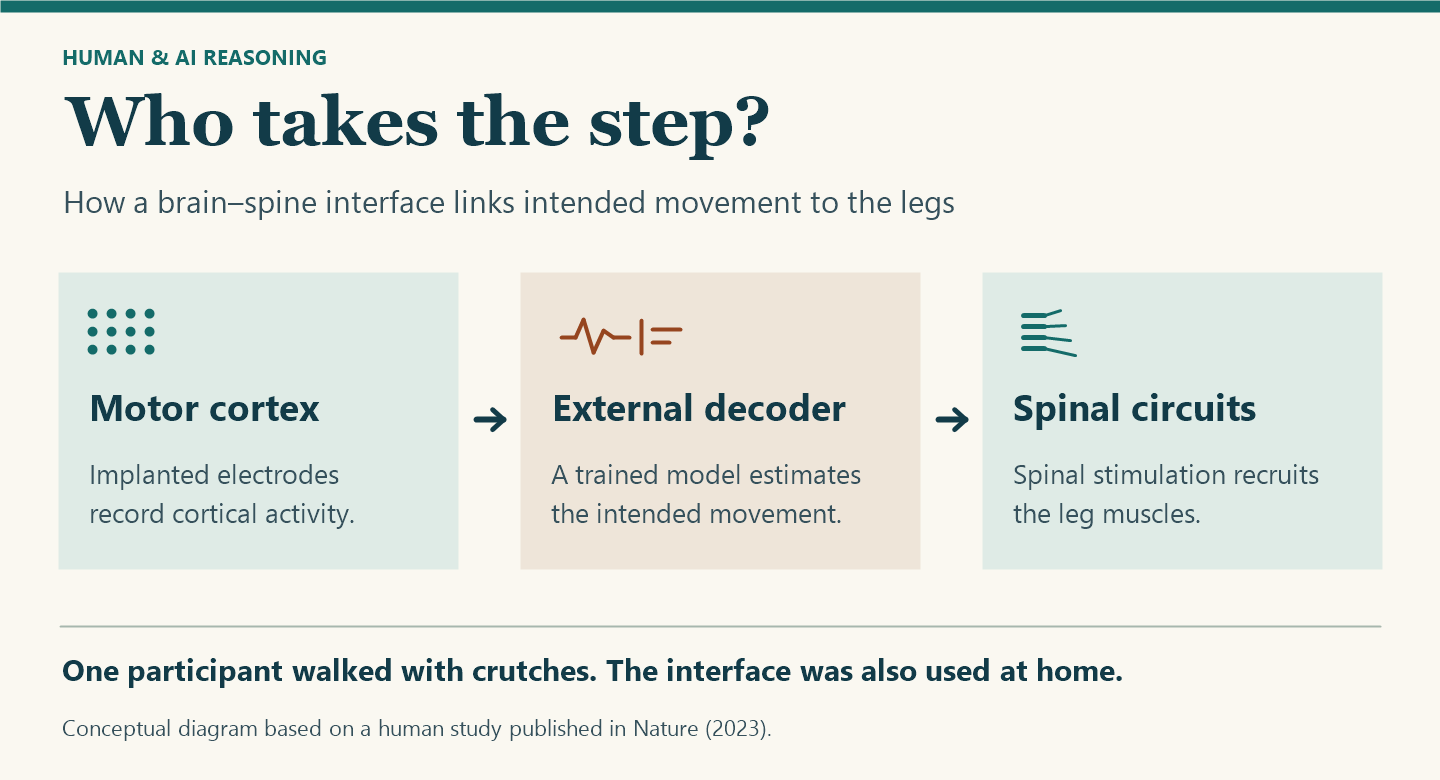
A man stands with his weight on two crutches and decides to take a step. The intention originates in his brain. Electrodes record the activity accompanying that intention, a computer estimates which movement he is attempting, and a second implant stimulates circuits in his spinal cord. His own muscles move his leg. Which part of walking has the technology restored?
A spinal cord injury can interrupt communication between the brain and the circuits that coordinate the legs. Some of those circuits and their connections to the muscles may still function below the injury. A brain–spine interface offers a route across the interruption. Two clinical studies show what this can mean for people with different injuries, and why the support a person needs belongs in any account of the outcome.
Abstract
When a person with a spinal cord injury decides to take a step, which part of that action can an implant restore? In Lausanne, an interface linked cortical activity to spinal stimulation, enabling one participant to walk with crutches. In Shanghai, three people with motor-complete spinal cord injuries walked with body weight support within two weeks of implantation. The decoders estimated intended movement, while spinal circuits and muscles produced the steps. Other devices divide the work differently. Neuralink is investigating control of digital devices in people with paralysis. A retinal prosthesis improved visual acuity in people with geographic atrophy, while a cortical implant allowed researchers to shape responses to stimulation in one blind participant. A total artificial heart regulates pumping in response to pressure. Across these studies, the contribution of artificial intelligence becomes clear when the function recovered, the assistance required and the decisions retained by the person are examined.
Walking with crutches in Lausanne
In 2023, researchers at NeuroRestore in Lausanne and at CEA–Clinatec in Grenoble reported the case of a man with a chronic, incomplete cervical spinal cord injury. Before entering the study, he had already received epidural spinal stimulation and intensive gait rehabilitation. The new interface added a link between implanted cortical recording devices and the spinal stimulator he already used. A decoder calibrated to his movements estimated what he intended to do and adjusted stimulation accordingly. [1]
He could stand, walk with crutches and climb stairs. He also used the system independently at home. The distinction between using the equipment independently and walking unaided matters to someone deciding whether the device would help them get from the kitchen to the front door. Over more than a year, the system remained usable, but its maintenance had a clinical cost. An infection required removal of one cortical implant 167 days after implantation. The other continued to function, and a replacement was subsequently implanted. [1]
Following rehabilitation, he could also walk overground with crutches when the interface was switched off. That observation poses a different question from whether switching the device on helps him take a particular step. The gains emerged during training in a person with an incomplete injury and previous experience of stimulation. The contribution of each element to the lasting change remains uncertain. [1]
Taking supported steps in Shanghai
In October 2026, a team at Fudan University and Zhongshan Hospital reported a study of three people whose injuries were classified as motor-complete. At enrolment, none could stand or step, even with braces, walking aids or physical assistance. Each received cortical recording electrodes and an epidural spinal stimulator. All three achieved voluntary lower-limb movement through the interface on the first day after surgery. Within two weeks, all three walked with assistance while a support system bore some of their body weight. [2]
Moving a leg on request, taking steps while body weight is supported, and walking independently at home place different demands on balance and strength. The Shanghai study establishes the first two outcomes during a training period of two to three weeks. Whether participants could sustain those gains at home, over months, requires further follow-up. Combining these three people with the Lausanne participant to calculate a single success rate would obscure differences in injury, assistance and observation time. [2]
What does the decoder learn?
The decoder learns a relationship between patterns of cortical activity and attempted movements. It can use that relationship to select or modulate stimulation before the person has completed the movement. An intended step still has to become a sequence of muscle contractions that bears weight and maintains balance. The Lausanne study illustrates the gap particularly well. In one recording, two decoded attempts produced neither the expected muscle activity nor a step. Counting those detections as successful steps would give the wrong answer. [1]
The same distinction applies when the signal controls a screen. Neuralink’s PRIME feasibility study evaluates an implanted interface for controlling external devices. On 25 November 2026, the company announced US regulatory authorisation to begin LINK, a pivotal trial of digital device control in people with severe paralysis due to amyotrophic lateral sclerosis. Whether a participant can select a target on a screen and whether they can walk across a room are separate clinical questions. Neuralink’s Blindsight programme concerns visual stimulation. At the time of this review, its public page invited interest in future trials, and we found no published human visual outcome for that device. [3] [4] [5]
What it means to replace a function
Other implants make the distinction between a useful function and the contribution of AI especially clear. In the PRIMA retinal prosthesis study, 38 people with geographic atrophy received a subretinal implant. Of the 32 assessed at twelve months, 26 gained at least two lines of visual acuity relative to baseline. There were also 26 serious adverse events related to the procedure or device in 19 participants. The study evaluated the complete visual prosthesis. A separate experiment involving a cortical implant in one blind participant tested a learning algorithm directly. It showed that a neural network could predict and help shape the cortical response to stimulation. Reading smaller letters and producing a particular pattern of neural activity are different achievements. [6] [7]
A total artificial heart provides another point of comparison. Researchers working with the CARMAT device analysed 1,842 cumulative days of automatic operation in ten patients. Pressure sensors allowed the controller to adjust beat rate and stroke volume. This is a substantial replacement of an organ’s pumping function. The study attributes that adjustment to pressure-based regulation and supplies no evidence that machine learning was responsible for it. [8]
Who decides when to move?
In the limited sense of a person incorporating electronics into the control of their own body, these studies give the term cyborg a concrete example. The person in Lausanne could choose when to get up. The decoder helped translate that choice into spinal stimulation. The resulting step still depended on living spinal circuits, muscles and physical support. This allocation of work matters more to the person using the interface than the label attached to it.
A longer-term test would ask whether a person could choose a destination at home and reach it reliably. It would record the distance, aids used, assistance from another person, falls and interruptions for recalibration or repair. Those observations would tell us what a laboratory demonstration leaves open. Can the person depend on the system when they want to go somewhere?
Selective review of human studies, a clinical trial registration and dated programme information. Evidence reviewed on 27 November 2026.
References
- Walking naturally after spinal cord injury using a brain–spine interface. Nature (2023).
- Restoration of volitional lower-limb movement after motor-complete spinal cord injury with brain-spine interface. Med (2026).
- PRIME early feasibility study, NCT06429735. ClinicalTrials.gov.
- Neuralink receives FDA approval to launch LINK pivotal study. Sponsor announcement, 25 November 2026.
- Visual prosthesis clinical programme. Neuralink.
- Subretinal photovoltaic implant to restore vision in geographic atrophy due to AMD. New England Journal of Medicine (online 2025).
- Deep learning-based control of electrically evoked activity in human visual cortex. Neuron (2026).
- First clinical experience with the pressure sensor-based autoregulation of blood flow in an artificial heart. ASAIO Journal.
Liked this post? Follow this blog to get more.