Learning · Reasoning · Understanding
How do people and AI systems arrive at conclusions—and what happens when they work together?
From the rules of logic to learned representations, this collection examines the evidence behind reasoning, emerging capabilities and human–AI collaboration. Each article connects a clear question with scientific studies, counterarguments and the limits of what is known.
Articles in the collection
-
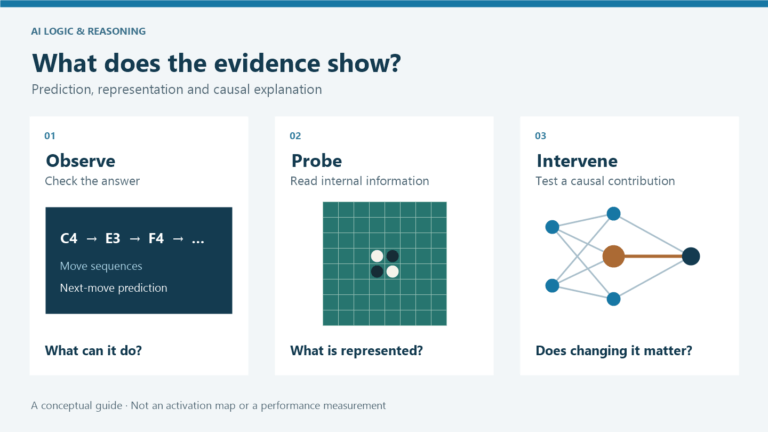
AI Logic and Reasoning: Past, Present and Future
Read the article →: AI Logic and Reasoning: Past, Present and FutureWhat would justify saying that an AI system reasons? This article follows the question from explicit symbolic procedures to learned representations, using Othello as a controlled setting in which a model’s predictions can be checked against a known world. It distinguishes successful behaviour, recoverable internal information and evidence of causal influence. The discussion examines why some apparent jumps in capability depend on the scoring method, what interventions can reveal about a model, and why a written chain of thought is not automatically a faithful explanation. Studies that support structured representations are read alongside work that tests their consistency and exposes dependence on training data. The final section considers human–AI collaboration as an empirical question: combining a person and a model does not guarantee a better result. Drawing on primary scientific studies, the article identifies useful standards for future evaluation without treating current findings as proof of general understanding or consciousness.
Articles are ordered by their original publication date. Each gives its own evidence-review date and references. New entries join this collection automatically; earlier assessments remain dated.