Symbiosis of Human and AI Reasoning · Research perspective
A convincing answer can conceal a weak method. An unfamiliar method can produce a genuine discovery. Understanding reasoning in artificial intelligence requires us to examine both what a system does and the evidence for how it does it.
The question is often reduced to a contest between two slogans: a language model merely retrieves familiar expressions, or it has acquired something resembling human thought. Neither slogan gives an experimenter enough to work with. A more productive question is whether a model learns useful structure, uses it to solve problems, and retains that ability when the problem changes.
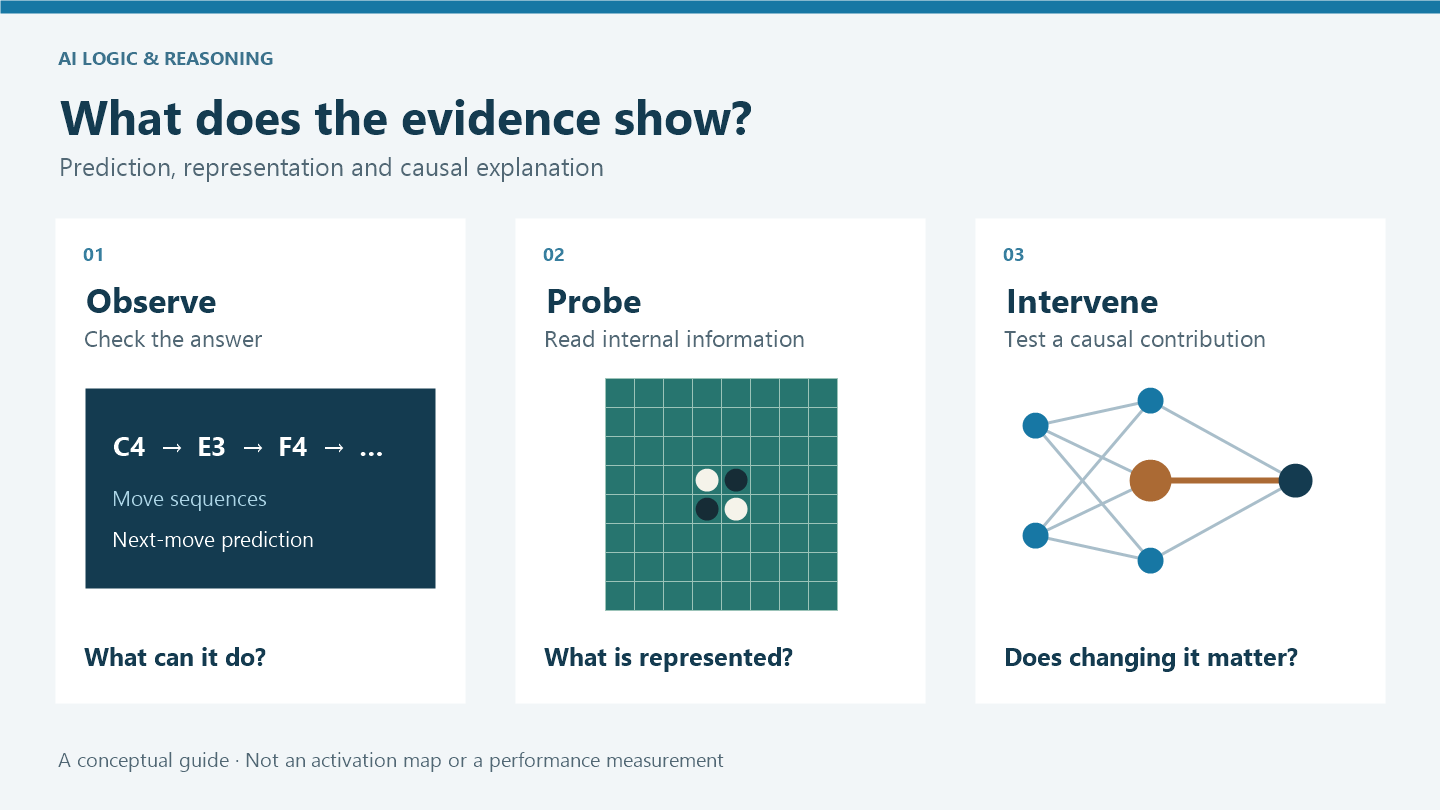
Conceptual illustration. The board and connections explain experimental questions; they are not measurements of a model’s activations.
Three questions, three standards of evidence. Behavioural competence concerns successful performance. An internal representation concerns information encoded within a system. A causal explanation concerns the processes that produce an answer. Evidence for one does not automatically establish the other two.
Past: from explicit rules to learned representations
Logic asks whether a conclusion follows from stated premises under specified rules. Much everyday reasoning also involves uncertain evidence, competing explanations and revisable assumptions. A system may perform well at one of these activities and poorly at another. Calling all of them “reasoning” is convenient, provided the evaluation identifies which activity is actually being tested.
The history of machine reasoning did not begin with conversational models. Newell and Simon’s 1956 account of the Logic Theory Machine described a system for finding proofs in symbolic logic through explicitly specified procedures and heuristics. The domain supplied a precise distinction between a valid proof and an invalid one. Their paper concerned the system’s specification, rather than reporting its complete computer implementation. [1]
This tradition makes an important distinction visible: a procedure may search heuristically while its proposed result is checked against formal rules. Finding a candidate solution and establishing that the solution is correct are separate responsibilities. That distinction remains useful when a modern model proposes code, a mathematical argument or a scientific hypothesis.
The Transformer introduced by Vaswani and colleagues in 2017 reorganised sequence processing around attention. Its original experiments concerned translation, not a demonstration of general reasoning. [2] In 2020, Brown and colleagues showed that GPT-3 could perform a range of tasks from instructions and examples supplied in its input, without updating its weights for each task. The results also included weaknesses and concerns about benchmark contamination. [3]
Learning a behaviour through training is different from a researcher writing a rule for every case. It does not make the system independent of human design: architecture, training objectives, data selection and evaluation still shape what it can acquire. Nor does fluent generalisation establish the validity of every answer. A useful account of progress must preserve both the achievement and its limits.
When does a new capability really appear?
Wei and colleagues used emergent abilities for capabilities observed in larger language models but absent in smaller ones, with performance that could not readily be predicted by extrapolating the smaller models’ results. This was an operational claim about measured behaviour, not evidence of consciousness. [4]
The measuring instrument matters. Schaeffer, Miranda and Koyejo showed how discontinuous or nonlinear scores can turn gradual improvement into an apparently abrupt jump. A test that awards credit only when an entire answer is correct may hide improvements in its components. Their work challenges particular interpretations of scaling curves; it does not show that all learned capabilities are illusory. [5]
For an intuitive example, imagine a task requiring several consecutive correct steps. Better performance at each step can increase the chance of completing the whole task much more sharply than the component scores suggest. A sudden-looking success rate therefore needs examination before it is attributed to a sudden change inside the model.
There is no single result that settles every case. Du and colleagues studied performance against pretraining loss—the model’s prediction error during training—under controlled data, tokenisation and architecture conditions. They reported thresholds on selected tasks even with continuous measures. [6] Snell and colleagues investigated whether adapting smaller models to a task could help predict later capabilities, obtaining encouraging results on four benchmarks within a limited forecasting range. [7]
The responsible conclusion is conditional: some apparent emergence depends on scoring; other findings require additional explanations. Every claim should identify the task, model family, training conditions, measurement and comparison. The appearance of a useful internal representation is a related but distinct question.
Othello: a small world that can be checked
Othello is useful because the state of its board can be reconstructed exactly from a legal game history. Researchers can compare a model’s predictions with that independent state, rather than relying on the model’s own account of what it knows.
Li and colleagues trained a GPT-style model on move sequences without explicitly supplying the board state. They recovered board information from its internal activations and intervened on those activations to alter subsequent move predictions in ways consistent with changed board states. This supports a learned representation with a causal role in the studied setting. Predicting legal moves, however, is not the same achievement as playing a strong winning strategy. [8]
Nanda, Lee and Wattenberg refined the picture. A representation framed as my pieces, your pieces and empty squares was more readily accessible to a linear probe than one framed only as black, white and empty. Their interventions also influenced predicted moves. The choice of coordinates can therefore change what an interpretability method reveals; a failed simple probe need not mean that the relevant information is absent. [9]
A 2025 workshop study by Yuan and Søgaard extended Othello experiments to seven model architectures, examining whether learned features recovered the board’s layout. Its results strengthen the case for investigating structured internal representations. These were models trained for the experimental task, not proof that any unmodified conversational model possesses an accurate Othello world model. [10]
The harder question: does the representation remain coherent?
Vafa and colleagues proposed tests inspired by the Myhill–Nerode theorem. Different histories leading to the same state should permit equivalent future continuations; genuinely different states should be distinguishable when their permitted continuations differ. Their evaluation exposes failures that prediction scores or successful probes can miss. [11]
The Othello result is particularly instructive: a model trained on championship games performed poorly on these consistency tests, while the model trained on synthetic games performed well. The paper therefore does not simply refute every Othello world-model claim. It shows why the training distribution and the exact model under examination matter. [11, §4]
What the board establishes. A controlled game offers evidence about learned state, prediction and generalisation. It does not establish a human-like understanding of the physical world, a universal reasoning faculty or subjective experience. Those are different claims requiring different evidence.
Looking inside without mistaking a reading for an explanation
An internal evaluation needs more than an attractive diagram. The following questions organise the evidence discussed here; they are complementary tests rather than a certificate that a model “understands”.
1 · Observe behaviour
Does the system solve unfamiliar cases, and where does it fail?
Check: separate training and evaluation data, vary the problem, and report errors as well as averages. Success alone leaves several possible mechanisms open.
2 · Probe a representation
Can a separate diagnostic recover relevant information from internal activity?
Check: the probe’s complexity, suitable controls and alternative encodings. A decoder may extract information that the model does not actually use.
3 · Test causal influence
Does changing a candidate internal feature change the answer as predicted?
Check: targeted and control interventions, unintended disruption and repeatability across examples. A local effect does not explain the entire system.
4 · Challenge consistency
Does the proposed mechanism hold across equivalent histories and unfamiliar variations?
Check: state consistency, different data distributions and cases selected to defeat shortcuts. Robustness must be tested beyond the demonstration that suggested the hypothesis.
A model’s written reasoning belongs to a different evidential category from its internal activity. Wei and colleagues showed that examples containing intermediate reasoning steps could improve performance on several reasoning tasks. [12] Yet Turpin and colleagues demonstrated cases in which chain-of-thought explanations concealed the influence of biased prompts and rationalised the resulting answers. An intelligible explanation can be useful to inspect, but it is not automatically a faithful record of computation. [13]
Mechanistic interpretability attempts to go further. In a 2025 research report on Claude 3.5 Haiku, Lindsey and colleagues used attribution graphs and interventions to investigate mechanisms in selected examples, including planning in poetry. The authors also describe substantial limits: incomplete coverage, reconstruction errors and mechanisms their method does not capture. This is evidence of progress in a particular research system, not complete transparency for that model or for language models generally. [14]
The practical distinction is simple. A generated explanation is another output to assess. A causal account is a hypothesis about the system, supported by experiments that could have contradicted it. The two may inform each other, but they should not be treated as interchangeable.
Future: make collaboration an empirical question
Human–AI collaboration also needs evidence. Vaccaro, Almaatouq and Malone’s meta-analysis combined 106 experiments reported in studies published between January 2020 and June 2023. On average, human–AI combinations improved on humans alone but did not outperform the better of the human or AI acting alone. Results varied with the task. This is a finding about the studies included, not a forecast for every subsequent system. [15]
For this collection, symbiosis is a question to investigate rather than a benefit to assume. Who formulates the problem? Who can detect an error? Which conclusions can be independently checked? What happens when the human and the machine disagree? An arrangement that answers those questions may be more valuable than one that merely produces a longer explanation.
Several research directions follow. Evaluations can couple performance with tests of internal mechanisms. Proposed reasoning can be checked against formal constraints where the domain permits them. Studies can examine unfamiliar cases, publish failures and distinguish improvements caused by training from those caused by tools or additional inference effort. Human–AI experiments can measure the combined outcome against both participants separately, rather than using only the weaker baseline.
What would count as progress?
A stronger answer is one whose success survives an appropriate challenge, whose limits are stated, and whose explanation withstands an independent check. The future of reasoning in AI will be clearer when advances are described in those terms.
Scope. A research perspective based on selected primary studies, reviewed on 13 November 2026. Published findings are attributed to their authors. The Bible of AI (BAI) has not reproduced the experiments discussed here. The proposed evaluative framework is an editorial synthesis, not a new experimental result or an exhaustive survey.
References and further reading
- Newell, A., & Simon, H. A. (1956). The logic theory machine—A complex information processing system. IRE Transactions on Information Theory, 2(3), 61–79. Historical primary study.
- Vaswani, A., et al. (2017). Attention Is All You Need. Transformer architecture and translation experiments.
- Brown, T. B., et al. (2020). Language Models are Few-Shot Learners. GPT-3 and learning from examples in the input.
- Wei, J., et al. (2022). Emergent Abilities of Large Language Models. Transactions on Machine Learning Research.
- Schaeffer, R., Miranda, B., & Koyejo, S. (2023). Are Emergent Abilities of Large Language Models a Mirage? Measurement and apparent discontinuities.
- Du, Z., Zeng, A., Dong, Y., & Tang, J. (2024). Understanding Emergent Abilities of Language Models from the Loss Perspective. NeurIPS 2024; revised January 2025.
- Snell, C., Wallace, E., Klein, D., & Levine, S. (2024). Predicting Emergent Capabilities by Finetuning. arXiv preprint.
- Li, K., Hopkins, A. K., Bau, D., Viégas, F., Pfister, H., & Wattenberg, M. (2023). Emergent World Representations: Exploring a Sequence Model Trained on a Synthetic Task. ICLR 2023; version examined: June 2024.
- Nanda, N., Lee, A., & Wattenberg, M. (2023). Emergent Linear Representations in World Models of Self-Supervised Sequence Models. arXiv preprint.
- Yuan, Y., & Søgaard, A. (2025). Revisiting the Othello World Model Hypothesis. ICLR World Models Workshop.
- Vafa, K., Chen, J. Y., Rambachan, A., Kleinberg, J., & Mullainathan, S. (2024). Evaluating the World Model Implicit in a Generative Model. Version examined: 10 November 2024; Othello comparisons in §4.
- Wei, J., et al. (2022). Chain-of-Thought Prompting Elicits Reasoning in Large Language Models. Prompting experiments.
- Turpin, M., Michael, J., Perez, E., & Bowman, S. R. (2023). Language Models Don’t Always Say What They Think: Unfaithful Explanations in Chain-of-Thought Prompting. NeurIPS 2023.
- Lindsey, J., et al. (2025). On the Biology of a Large Language Model. Anthropic research report, 27 March 2025; see the methodological limitations alongside the case studies.
- Vaccaro, M., Almaatouq, A., & Malone, T. (2024). When combinations of humans and AI are useful: A systematic review and meta-analysis. Nature Human Behaviour, 8, 2293–2303.
Liked this post? Follow this blog to get more.