Symbiosis of Human and AI Reasoning · Biohybrid computation
Living neural tissue can participate in computational tasks through electronic interfaces. These experiments raise a central scientific question: when a biohybrid system improves its performance, which components account for that improvement?
The answer may involve biological plasticity, adaptation of the digital readout, changes in the selection of stimulation patterns, or interactions among these processes. Biohybrid computation combines living and electronic components. Identifying those components, however, does not establish the mechanism responsible for improved performance.
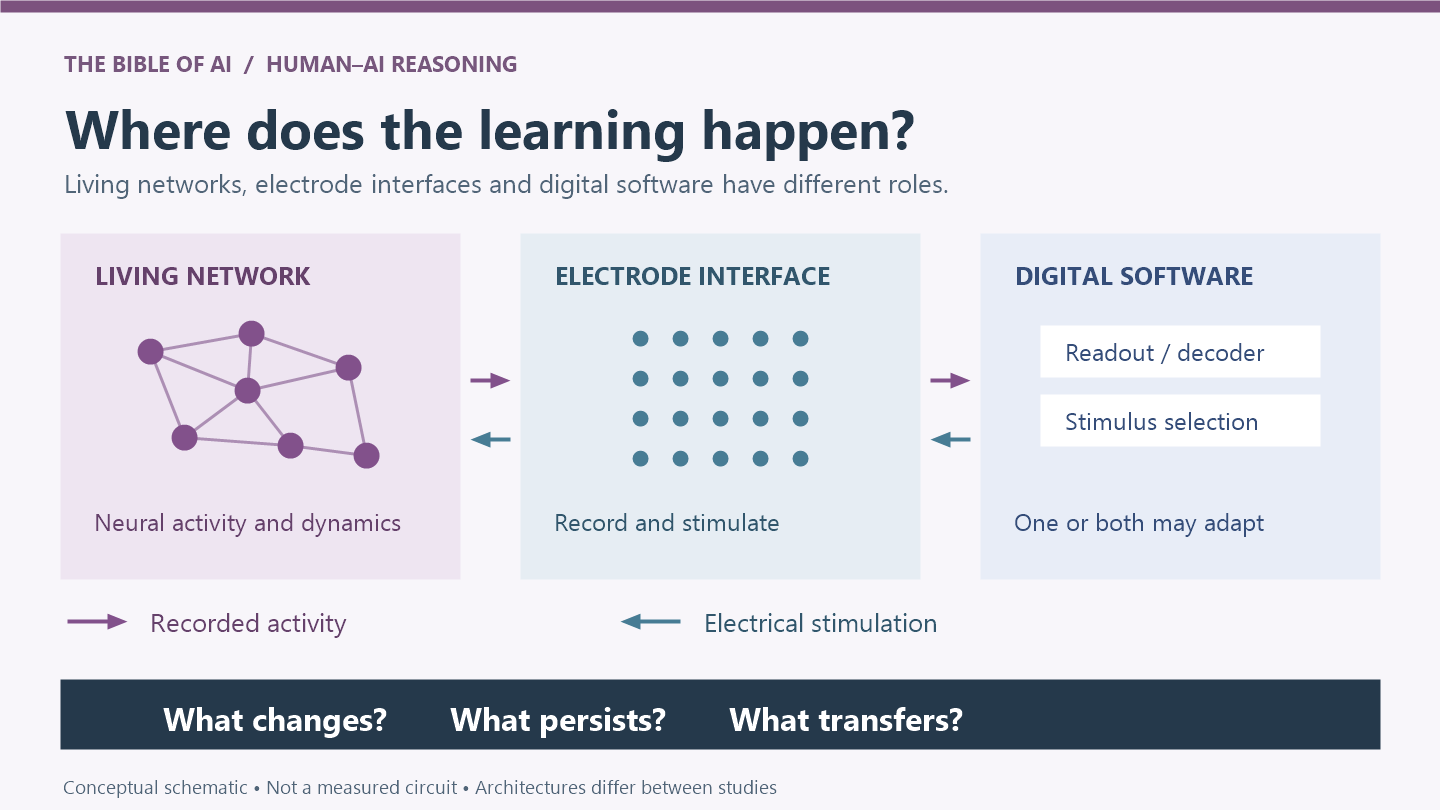
View the full-size diagram. Conceptual illustration. The cells, connections and arrows are explanatory symbols, not recordings, anatomical reconstructions or measured learning curves.
Biological material and experimental scope
These experiments use different biological preparations. A neuronal culture can be a relatively flat network grown on an electrode array. A neural organoid is a three-dimensional structure derived from stem cells that models selected features of neural development. Neither is equivalent to a complete brain. Human-derived cells identify a biological origin; they do not establish human cognition. The organoid-intelligence programme brings these preparations together with engineering and computation as a research agenda, rather than as a demonstrated general intelligence. [9]
The present question concerns living tissue connected to electronics outside an animal. Transplanting human-derived tissue into an animal, recording signals from a person’s brain and training a robot from video are related research directions, but each requires its own evidence. Combining them under one label would conceal important differences in what was actually tested.
Feedback and dependence on the neuronal preparation
In the 2022 DishBrain experiments, human-derived and mouse cortical neuronal cultures were connected to a simplified Pong environment. Electrical signals encoded aspects of the game, and recorded activity moved a paddle. The researchers reported improved performance during gameplay under feedback conditions, with poorer results when relevant feedback was absent. This supports a role for the interaction between neural activity and the consequences of its output in that experimental setting. It does not show that the cells saw a screen, understood a game or learned as a person does. [1]
A subsequent study illustrates the importance of the neuronal preparation. In 2025, Watmuff and colleagues examined a different human-derived neuronal preparation with unusually high excitatory activity. Untreated cultures showed no statistically significant learning over time; one carbamazepine treatment condition improved gameplay measures, with smaller effects than previously reported. This was a pharmacological study involving DishBrain’s developers, not an independent repetition of the original experiment. Its different preparation prevents a simple declaration that the earlier result was refuted. The result also cautions against assuming that improvement is a general property of neuronal cultures connected to electronic interfaces. [2]
Reservoir computing and the digital readout
Brainoware, reported in 2023, used a human brain organoid as a physical reservoir: incoming signals produced complex neural responses, which an external readout converted into predictions or classifications. The study demonstrated speaker classification from vowel recordings and nonlinear prediction, and reported changes in functional connectivity with training. A biological reservoir therefore need not be wholly static. Nevertheless, performance belongs to an arrangement that includes input encoding, living dynamics and a digital readout. It should not be attributed to the organoid alone, nor equated with understanding speech. [3]
A 2026 study by Sono and colleagues makes the division of labour particularly clear. Cultured rat cortical networks were incorporated into a feedback system that generated temporal patterns. The trained element was a linear decoder, with fixed feedback weights; the biological network supplied the dynamics. Structured cultures supported richer outputs than homogeneous preparations. The experiment involving chaotic target signals was a proof of concept, and tracking remained imperfect. This is a useful form of hybrid computation, but learning in the combined system is not, by itself, evidence that a particular biological learning rule was identified. [4]
Distinguishing sites of adaptation. A study should distinguish adjustments in the biological network, the digital decoder and the controller that chooses stimulation. A performance gain cannot be assigned to a particular component without appropriate controls.
Adaptive control and limits on retention
Robbins and colleagues’ 2026 study connected mouse cortical organoids to a simulated pole-balancing task. The study included 19 organoids from eight batches and evaluated a cycle’s 90th-percentile balancing duration. Repeated cycles within a preparation are not independent biological samples. A reinforcement-learning algorithm selected stimulation patterns. Adaptive training outperformed random or absent training, but the adaptive and random protocols also differed in their stimulation patterns. The comparison therefore does not isolate the selection algorithm alone. [5]
Blocking excitatory transmission impaired performance, which recovered after the blocking agents were removed. This supports biological involvement without uniquely identifying the mechanism of learning. Crucially, the authors report that improvements did not persist after the 45-minute rest period. The result supports short-term adaptation under the tested conditions; it does not establish durable memory or general reasoning. The artificial system’s role in selecting training signals remains part of the explanation. [5]
Interpreting claims of sentience
The original DishBrain paper’s use of “sentience” prompted a published critical letter arguing that the evidence did not justify the cognitive terminology. In their response, the researchers defended a technical interpretation grounded in their theoretical framework. These are opposing interpretations of the evidence, not two new experiments. Reporting both helps separate the observed performance from a contested account of what it means. Neither a performance increase nor an electrical response, on its own, demonstrates subjective experience. [6] [7]
Criteria for evaluating future studies
The following criteria provide a framework for evaluating future studies. They represent a synthesis of the methodological issues discussed here, rather than additional experimental findings.
1 · Locate the adaptation
Specify which biological and digital components change. Compare the complete system with suitable component controls. A useful ablation removes a proposed contribution while preserving the rest of the comparison as closely as possible.
2 · Test retention and transfer
Measure what remains after a pause and what survives a change of task. An improvement during repeated stimulation answers a different question from a retained skill that works on unfamiliar inputs.
3 · Count independent preparations
Report cultures or organoids, batches and repeated sessions separately. Many episodes from one preparation do not replace independent biological samples. Describe unsuccessful preparations and uncertainty as well as the best performance.
4 · Compare the complete system
Match tasks, information and evaluation conditions. Any efficiency claim should include electronics and the resources required to maintain the tissue. A component’s low energy demand is insufficient to establish an advantage for the entire system.
Research infrastructure and practical computation
The 2024 Neuroplatform report describes remote access to living neural preparations, electrophysiological interfaces and the equipment needed to maintain them. Such infrastructure can make experiments accessible to additional groups. Access and recorded activity, however, are not themselves demonstrations of robust learning or an independently reproduced computing advantage. A platform report should be judged for what it supplies, separately from the capabilities researchers may eventually establish with it. [8]
Responsible development should also address cell provenance, donor consent and oversight, alongside uncertainty about future biological capacities. The organoid-intelligence roadmap calls for ethics to accompany the research. Those responsibilities should not depend on publicity declaring either that a culture is conscious or that all future concerns have been settled. [9]
Assessing progress in biohybrid computation
A stronger demonstration of biohybrid computation would quantify the contribution of each component: what the living network contributes, what the software supplies, how long an improvement lasts and where it fails. The studies reviewed here make that investigation possible. Their value lies in the questions they allow us to test, while durable learning, broad transfer and practical superiority remain claims that require further evidence.
Scope. A selective research perspective with evidence reviewed on 13 November 2026. Experimental findings, critical correspondence, a platform report and a research roadmap are identified separately. The Bible of AI (BAI) has not reproduced these experiments. The evaluation questions are an editorial synthesis, not an exhaustive systematic review or new experimental results.
References and further reading
- Kagan, B. J., et al. (2022). In vitro neurons learn and exhibit sentience when embodied in a simulated game-world. Neuron, 110, 3952–3969.e8. Experimental study.
- Watmuff, B., et al. (2025). Drug treatment alters performance in a neural microphysiological system of information processing. Communications Biology, 8, 916. Experimental study.
- Cai, H., et al. (2023). Brain organoid reservoir computing for artificial intelligence. Nature Electronics, 6, 1032–1039. Experimental study.
- Sono, Y., et al. (2026). Online supervised learning of temporal patterns in biological neural networks under feedback control. PNAS, 123, e2521560123. Experimental study.
- Robbins, A., et al. (2026). Goal-directed learning in cortical organoids. Cell Reports, 45, 116984. Published article; supersedes the 2024 preprint.
- Balci, F., et al. (2023). A response to claims of emergent intelligence and sentience in a dish. Neuron, 111, 604–605. Critical letter.
- Kagan, B. J., et al. (2023). Scientific communication and the semantics of sentience. Neuron, 111, 606–607. Authors’ response.
- Jordan, F. D., et al. (2024). Open and remotely accessible Neuroplatform for research in wetware computing. Frontiers in Artificial Intelligence, 7, 1376042. Platform report.
- Smirnova, L., et al. (2023). Organoid intelligence (OI): the new frontier in biocomputing and intelligence-in-a-dish. Frontiers in Science, 1, 1017235. Research roadmap and ethical discussion.
Return to Symbiosis of Human and AI Reasoning
Related perspective: AI Logic and Reasoning: Past, Present and Future.
Liked this post? Follow this blog to get more.