Juan Antonio Lloret Egea, Director (BackGround) · AI and Society
Imagine a data centre is proposed outside your town. At the first public meeting, the engineer can explain how much power the building needs. A parent asks a different question. If the company leaves in ten years, who will pay for the new substation? Both questions belong at the same meeting. The parent needs an answer even if she never learns how a language model works.
What is at stake?
A town may welcome skilled jobs, a stronger electricity connection and additional tax revenue. The people who receive those benefits may live somewhere quite different from those who hear the cooling equipment at night. A business can decide where to invest its own money. The decision to commit public land, water or grid capacity calls for a public judgment about competing uses, including the option to reserve that capacity for homes or existing employers.
What does the evidence show?
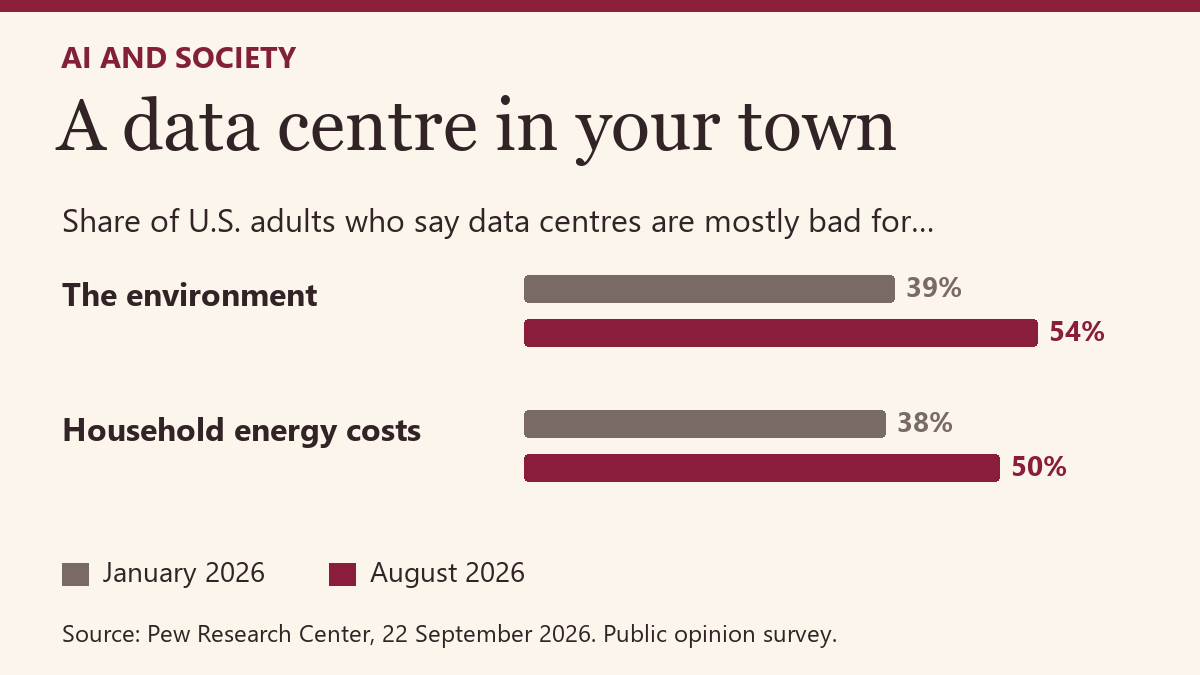
In a 2026 Pew Research Center survey of 10,548 U.S. adults, 54% said data centres were mostly bad for the environment, up from 39% in January. The share saying they were mostly bad for household energy costs rose from 38% to 50%. These answers describe how people saw the trade-offs. To establish what happened to electricity bills in a particular town, we would need its tariffs, metered demand and the regulator’s allocation of grid costs. Pew survey, question wording and methodology.
There is a material reason to ask. The International Energy Agency puts worldwide electricity consumption by data centres at about 485 terawatt-hours in 2025 and projects roughly 950 in 2030. Those figures cover data centres serving many purposes, including AI. The 2030 value is a projection. A global total cannot tell a town whether its substation can meet demand on the coldest evening of the year. For that, residents need a local grid assessment and a clear account of the assumptions behind it. International Energy Agency, Key Questions on Energy and AI.
Whose experience counts?
A public hearing at three on a working afternoon is open in principle. In practice, a shift worker, a parent without childcare and a tenant worried about the next rent increase may all be absent. The invitation can reach people who seldom attend hearings. They can be offered travel costs, accessible evidence and time to question an independent specialist. In its review of nearly 300 deliberative processes, the OECD describes ways to recruit representative groups and asks commissioning authorities to respond publicly to their recommendations. OECD, Innovative Citizen Participation and New Democratic Institutions.
Society has the final say in the democratic sense. Elected institutions must give reasons, protect people whose position loses the vote and remain answerable for the outcome. A poll can bring neglected concerns into the discussion. A nationwide majority cannot confer a permit on behalf of a particular community. Residents, too, should be able to change their minds when the evidence changes.
What would justify a decision?
Before granting a permit, the authority could publish a plain-language comparison of the project, a smaller installation and the existing use of the site. For each option, show the expected permanent jobs alongside temporary construction work, peak electricity demand alongside annual consumption, and seasonal water requirements alongside the supply available in a dry year. Identify who supplied each estimate and which figures an independent reviewer could verify.
The most revealing page may be the one about failure. Who finances the upgrade if the demand forecast proves too high? Who measures noise and water withdrawals once the equipment is running? State the threshold that triggers a restriction, the office residents can reach and the party responsible for restoring the site. A condition is worth little to a neighbour who cannot find the measurements or obtain a response.
What should we watch next?
When a project opens, compare the operator’s commitments with local measurements over a full seasonal cycle. Publish the differences, including any benefits that exceeded the forecast. Then return to the parent’s question. If the answer about the substation has changed, the public deserves to know who changed it, why and what remedy remains. That is a question a citizen can judge.
Cite this proposal
APA
Lloret Egea, J. A. (2026, November 14). Who gets to say yes to AI? A data centre in your town. La Biblia de la IA – The Bible of AI™. https://editorialia.com/2026/11/14/who-gets-to-say-yes-to-ai-a-data-centre-in-your-town/
MLA
Lloret Egea, Juan Antonio. “Who gets to say yes to AI? A data centre in your town.” La Biblia de la IA – The Bible of AI™, 14 Nov. 2026, https://editorialia.com/2026/11/14/who-gets-to-say-yes-to-ai-a-data-centre-in-your-town/.
Harvard
Lloret Egea, J.A. (2026) ‘Who gets to say yes to AI? A data centre in your town’, La Biblia de la IA – The Bible of AI™, 14 November. Available at https://editorialia.com/2026/11/14/who-gets-to-say-yes-to-ai-a-data-centre-in-your-town/.
Vancouver
Lloret Egea JA. Who gets to say yes to AI? A data centre in your town. La Biblia de la IA – The Bible of AI™ [Internet]. 2026 Nov 14. Available from https://editorialia.com/2026/11/14/who-gets-to-say-yes-to-ai-a-data-centre-in-your-town/.
Chicago
Lloret Egea, Juan Antonio. “Who gets to say yes to AI? A data centre in your town.” La Biblia de la IA – The Bible of AI™. November 14, 2026. https://editorialia.com/2026/11/14/who-gets-to-say-yes-to-ai-a-data-centre-in-your-town/.
IEEE
J. A. Lloret Egea, “Who gets to say yes to AI? A data centre in your town”, La Biblia de la IA – The Bible of AI™, Nov. 14, 2026. [Online]. Available: https://editorialia.com/2026/11/14/who-gets-to-say-yes-to-ai-a-data-centre-in-your-town/.
Liked this post? Follow this blog to get more.