A sheep without wool watches horses labour for a human master. She pities them. The horses reply that the same master makes warm clothing from her wool while she is left with none. The sheep runs away. The sheep and the horses tell a small story with an unusual question behind it: what language should these animals speak?
The story was composed in 1868 to illustrate a reconstruction of Proto-Indo-European. It is a modern fable, not a surviving prehistoric text. Later versions of the exercise make different linguistic choices, revealing how much a spoken performance depends on the reconstruction it follows. Artificial intelligence now offers ways to examine some of those choices.
A language remembered by its descendants
Proto-Indo-European, usually abbreviated PIE, names the reconstructed ancestor of the Indo-European language family. English, Spanish, Greek and Sanskrit belong to that family through different branches. Calling it a “mother language” describes this relationship. It does not make it the first language spoken by humanity or the ancestor of every language.
The comparative method begins with relationships among documented languages. Similar-looking words alone are insufficient: languages also borrow from one another. Linguists seek recurring correspondences in sounds and grammatical structures, then ask what earlier forms could explain them. A reconstructed word, conventionally marked with an asterisk, records an inference whose evidence can be examined.
This differs from reading an inscription whose surface survives. With PIE, there is no original written version of the fable waiting to settle a disputed vowel. Nor does the fluency of a modern recitation establish that its rhythm or every consonant reproduces ancient speech. The reconstruction supplies choices that a reader must turn into a performance.
A 2019 neural-network study investigated a narrower problem: whether the sounds around a segment could help predict its phonetic properties. It tested the method on modern German and applied it to the reconstructed PIE system. Such an approach can examine the consistency of proposed sound features. It does not recover a recorded voice, and success with a known language does not independently verify every inference about an unattested one.
What counts as a successful reconstruction?
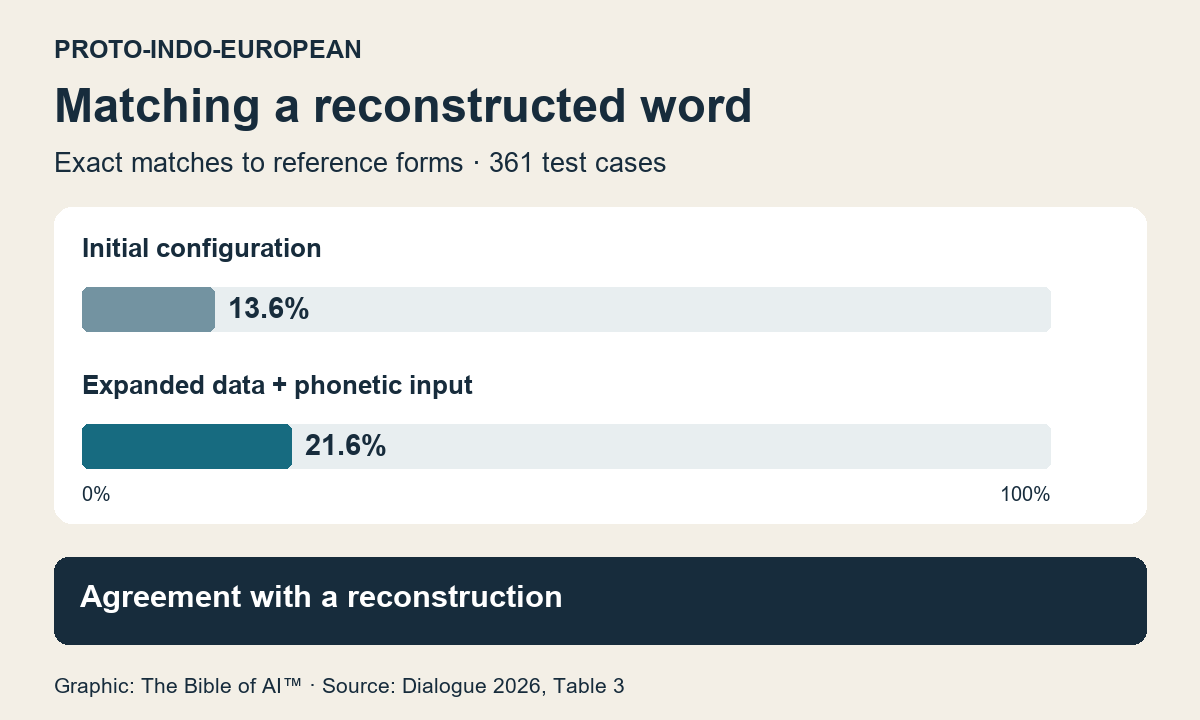
A 2026 experiment used ByT5 to propose PIE forms from related words labelled by language. It combined several lexical resources. The best configuration matched the reference form exactly in 21.6% of 361 test cases, compared with 13.6% for the initial configuration. Those targets are recorded reconstructions, not original PIE documents. The result measures agreement with that reference.
The distinction changes how we interpret an error. A spelling or notation difference can prevent an exact match; another prediction may be linguistically wrong. Either requires examination. The authors position the system as a source of candidates for specialists, with data quality and representation remaining central limitations.
There is a useful methodological comparison in a 2024 study of semisupervised reconstruction. Its model learns from both annotated and unannotated sets of related words, asking a proposed ancestral form also to account for its descendants. Its evaluations concerned Latin and Middle Chinese. They demonstrate how a reconstruction method can be tested, while leaving its performance on PIE as a separate question.
For a stronger historical claim, we would want a prediction to explain evidence that did not determine it. Imagine two proposed ancestral consonants that fit the same few words. If a model selects one, the next question is whether that choice predicts further correspondences across a carefully reserved set of words or another branch of the family. Related entries and copies of the same dictionary analysis must not quietly appear on both sides of the test. This is a proposed standard for evaluation, not a claim that every experiment described here has satisfied it.
The fable gives this technical problem a human scale. We can imagine its sheep speaking, but choosing a convincing voice is easier than establishing which features the evidence supports. AI can help make alternatives explicit and comparisons repeatable. Its historical value depends on whether those proposals survive linguistic scrutiny. The route back to the past runs through the descendants that remain available for comparison.
Liked this post? Follow this blog to get more.