In Sanskrit, Aupagava designates a descendant of someone named Upagu. Even the first vowel marks the relationship. Where the ancestor’s name begins with u, the descendant’s begins with au. Pāṇini’s grammar records the conditions for that change. In 2026, researchers used those rules to derive the word by computer. The unusual advantage of this experiment is that a Sanskrit scholar can judge both the answer and the route by which the computer reached it. [1]
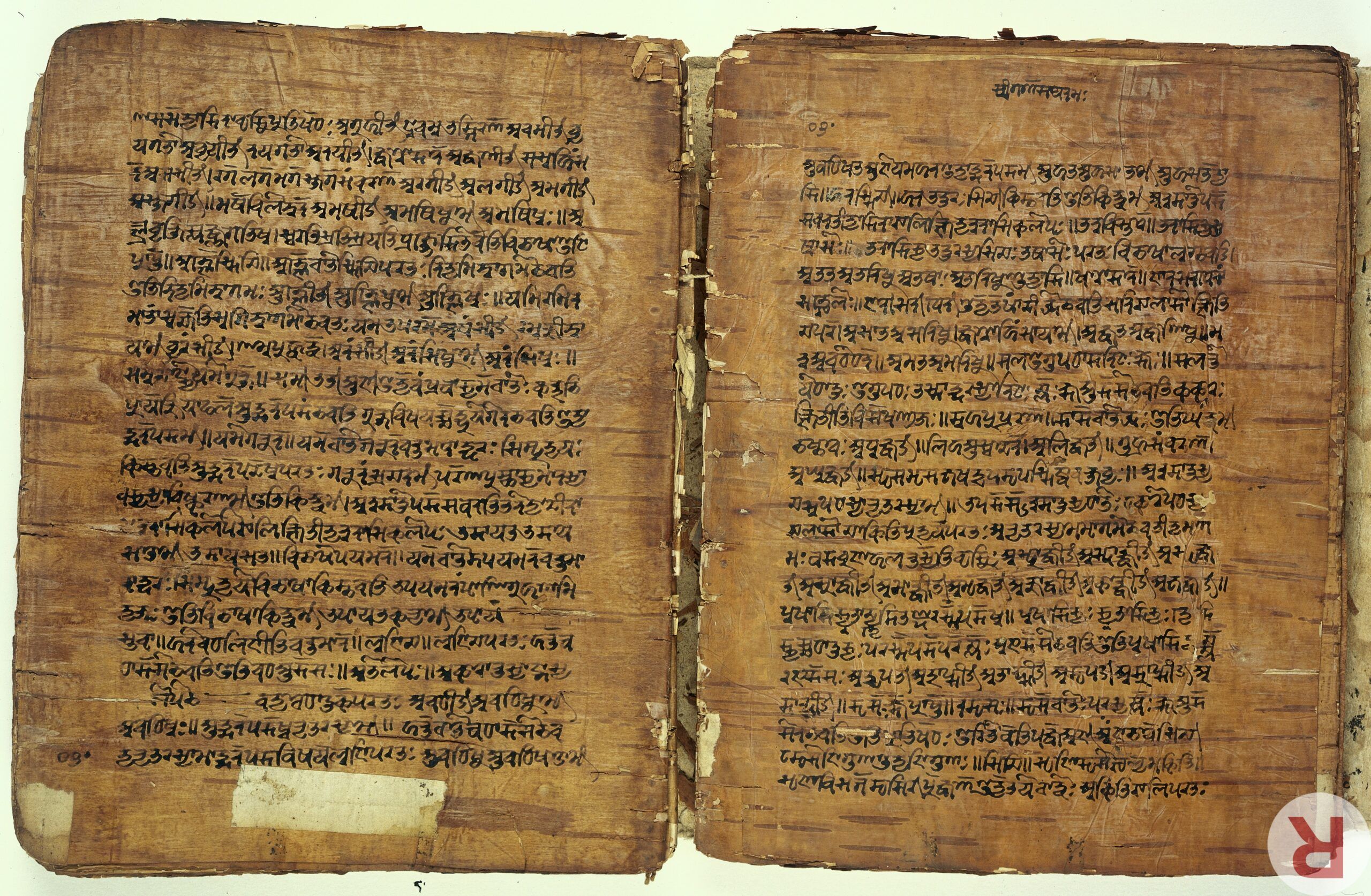

How a change of vowel expresses descent
Pāṇini composed the Aṣṭādhyāyī in ancient India around the middle of the first millennium BCE. Its eight chapters contain roughly four thousand compact rules. Some state a condition that continues to apply in the rules that follow. One such condition, tasya apatyam (4.1.92), specifies descent. To derive Aupagava, the researchers began with the name Upagu and specified the intended meaning, “a descendant of Upagu”. That meaning licenses the choice of a suffix. In the presence of this suffix, rule 7.2.117 requires the strengthened grade of the first vowel, which in this word changes u to au. Further sound changes at the junction of the name and suffix yield Aupagava. The relationship was supplied by the researchers. What the rules explain is how Sanskrit expresses it in a word. [1]
The 2026 study tested 175 traditional examples from the section dealing with descent. Sanskrit grammarians checked both the resulting forms and the sequences of operations. All 175 met both criteria. A deterministic procedure makes such a result open to scrutiny. Given the same starting information and the same interpretation of the rules, it reproduces the same derivation. Where a grammar permits a choice, a program can likewise reproduce a set of admissible alternatives. How well the procedure covers other parts of Sanskrit remains a separate empirical question. [1] [2]
What a learned model can recover
Reading an existing word reverses the problem. In a 2017 study, researchers trained a model to recognise pairs consisting of a base word and a derivative. The authors themselves use Upagu and Aupagava to illustrate a difficulty for the model. Removing an ending would leave the reader with the wrong initial vowel. Two further examples show why the ending alone can mislead. Both prāmukhya, from pramukha, and sodarya, from sodara, end in -ya. Only the first pair shows a change in the initial vowel. In the analysis reported by the authors, grammatical constraints narrowed 137 possible suffixes to at most four. Choosing among the remaining analyses could still require evidence about meaning and usage. This suggests a concrete use for neurosymbolic AI. Grammatical rules identify admissible analyses, and a learned model can use context to rank them. [3]
A more recent experiment shows why the final word and its explanation deserve separate scores. SGram-14B, a language model adapted from Qwen3-14B, returned a form accepted by the grammatical program Vidyut on 19,318 of 20,000 exercises. Given the root śudh, “to become pure”, and a suffix conventionally written kta, the model produced śudhita. The reference form was śuddha, “purified” or “pure”. The project’s technical report records the discrepancy. Its score measures agreement with the program on the final form. It leaves open which intermediate operation led the model astray. [2] [4]
That distinction matters to a reader of a manuscript. If Aupagava occurs in a passage, the change from u to au is one part of the reading for which a scholar can demand a precise grammatical account. Identifying the particular descendant meant by the writer would require evidence from the passage or from other historical witnesses.
Sources and bibliography
- H. Ayachit and P. Satuluri (2026). “Computational Modelling of the Apatyādhikāra in the Aṣṭādhyāyī.” Proceedings of the 8th International Sanskrit Computational Linguistics Symposium, pp. 222–237, especially §§ 4.2–4.4. Publication and full text.
- A. K. Prasad (2024). “A fast prakriyā generator.” Proceedings of the 7th International Sanskrit Computational Linguistics Symposium, pp. 84–101. Publication and full text.
- A. Krishna et al. (2017). “A Graph Based Semi-Supervised Approach for Analysis of Derivational Nouns in Sanskrit.” Proceedings of TextGraphs-11, pp. 66–75, especially §§ 4.4 and 6. Publication and full text.
- A. Lakkapragada (2026). Vidyut-Prakriya Bench and SGram-14B. Technical report and evaluation design. The accompanying error records document the example with śudh.
Liked this post? Follow this blog to get more.