After lunch, a member of staff places a small white seal on a table in the shared room. The residents are invited to spend time with it. Some may approach it; others may watch. An hour later, a member of staff announces that it is time to put the seal away. This was the arrangement in a study of PARO, a companion robot, in Japanese group homes for people with dementia. The timetable was straightforward. The human question beneath it is less easily settled: whose wishes determine whether the robot is welcome, and when the encounter should end? The group-home study and its session protocol.
The white fur and large dark eyes make PARO an inviting photograph. A photograph cannot tell us whether the person beside it wants company of this kind. Someone may enjoy holding a responsive object without believing it is alive. Someone else may find the same object childish, intrusive or simply uninteresting. A useful account of artificial intelligence in care has room for both responses. It begins with the person offered the seal, including the person who would prefer something else.
A response you can feel
PARO is a physical robot shaped like a baby seal. In the 2026 study, it was described as 57 centimetres long and weighing 2.55 kilograms. Sensors allow it to respond to speech and touch with movements, blinking and sounds. Its artificial intelligence adjusts aspects of its responses through interaction. It can move its flippers and neck, but it cannot crawl. The attraction is partly in that small exchange: a hand strokes the fur and something responds. These are capabilities of a machine. They do not establish that it understands a resident’s feelings or experiences affection. Description of the robot used in the trial.
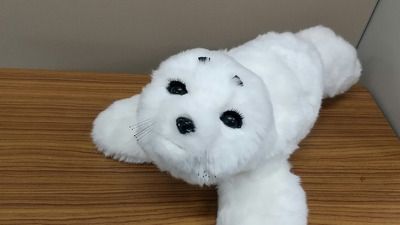
For a visitor, the exchange may look modest. For a resident who enjoys it, a few minutes of interest may matter in themselves. The scientific task is to describe that benefit accurately. Looking towards a robot, speaking to it, appearing pleased and feeling less lonely over time are different outcomes. A study that records one has not automatically demonstrated the others. This distinction helps preserve the value of a small welcome encounter without making promises about a person’s whole day.
What changes when the seal is switched on?
A large Australian trial published in 2017 offers an instructive comparison. It included 415 people with dementia across 28 long-term care facilities. Facilities were allocated to PARO, an identical-looking PARO with its robotic features disabled, or usual care. The two device groups received individual sessions lasting 15 minutes, three times a week, for ten weeks. Comparing the active robot with the inactive version helped distinguish the contribution of its responses from the appeal of a soft object.
Video observations found greater verbal and visual engagement with the active robot than with the inactive one. Some observed mood and agitation outcomes favoured PARO over usual care. However, the standardized agitation questionnaire found no difference between groups. The robot’s advantage over the inactive plush version was in engagement. Those findings support a specific possibility: responsive behaviour can help sustain an encounter. They do not justify describing PARO as generally superior to a comforting object for every outcome. The three-group trial and its different measures.
There is another reason to watch who is interacting with whom. A smaller Japanese study published in 2014 compared short encounters with PARO and a stuffed lion in residents’ rooms. Thirty residents were included in the behavioural analysis. They talked to PARO and laughed more frequently than with the lion. Yet residents in the mild-to-moderate dementia group talked more frequently to staff during the lion condition. A device can attract attention while changing how attention is shared with another person. This brief study does not establish lasting effects, but it makes the direction of the conversation visible. The room-based comparison of responses to PARO and a stuffed lion.
An afternoon in the shared room
The Japanese group-home trial published in February 2026 asked whether PARO could be useful with little active facilitation by caregivers. Six facilities were assigned to make the robot available once or three times a week for one month. Sessions lasted an hour, with one robot for every four or five participants. Staff helped people reach the device when necessary and intervened if someone monopolized it. They were otherwise asked to avoid directing the interaction. The study analysed 85 residents. Both groups had access to PARO; there was no group receiving usual care alone. Trial design, participants and intervention.
This arrangement matters to anyone picturing an autonomous robot taking over a room. People still organized access, announced its arrival, managed sharing and ended the session. The hour was a period of availability, not a verified hour of individual interaction for every resident. The authors could not objectively measure each person’s actual use. A person watching from a nearby seat and a person holding the seal could therefore contribute to the experience in quite different ways.
The more frequent schedule produced a statistically significant improvement in the questionnaire score for caregiver burden compared with the weekly schedule. The adjusted difference was −3.29 points, with a 95% confidence interval from −6.26 to −0.32. The difference in residents’ behavioural and psychological symptom severity was −1.98 points, with an interval from −4.10 to 0.15. That second result was not statistically significant. The uncertainty includes no difference. It would be misleading to report the trial as demonstrating that PARO reduced residents’ symptoms. Reported results for caregiver burden and symptom severity.
A reduction in the burden experienced by caregivers is worth taking seriously. It is nevertheless a report about caregivers’ experience, rather than a direct measurement of residents’ happiness, loneliness or freedom to choose. The study did not establish that reduced burden translated into better care. Its authors discuss that possibility as something requiring further research. For readers, the practical distinction is that an encouraging result for one person in a care relationship should not be silently assigned to the other.
The publication is recent; the fieldwork began in 2019 and stopped in March 2020 as the pandemic disrupted recruitment. The shortened study included fewer facilities and participants than planned and did not establish whether effects lasted. The paper also discloses that one co-author developed PARO and is technical director of the company associated with it; that author did not select sites, collect data or conduct the analysis. These details help readers judge the evidence behind an appealing device. Recruitment dates, limitations and disclosed interests.
The people who would rather decline
One entry requirement deserves particular attention. Residents in the group-home trial had to show no apparent aversion to PARO. Staff first considered reactions to animals or plush toys, then observed the response when the robot was introduced. People who displayed aversion were excluded from subsequent sessions. Family members or legal guardians provided consent, and verbal consent was confirmed with residents whenever possible. The findings therefore concern a selected group. They cannot tell us that a person who dislikes the robot would benefit from being persuaded to continue. Eligibility and consent procedures.
A separate 2026 survey gives that reservation a human voice. Among 116 respondents were eleven people living with dementia. After descriptions of different robots, those eleven were asked whether they would personally accept each type. Four said yes to PARO. Two comments described it as “too infantile” and “Not age-appropriate”. Seven said yes to a telepresence robot, which could support communication with other people. These were reported preferences in a small online survey, not outcomes after a trial of the devices. They are not estimates of what all people with dementia want. They do show why asking families and professionals alone leaves something essential unanswered. Participants’ own preferences in the social-robot design survey.
A refusal need not become a problem to be solved by a more persuasive introduction. It can be useful information about what would make an afternoon better for that person. Equally, enjoying the seal should not be dismissed because another resident dislikes it. Respecting adults means taking both enjoyment and objection seriously, without requiring either person to defend a preference on behalf of everyone with the same diagnosis.
Leaving room for another kind of company
The evidence supports offering a responsive object as one possible source of engagement for people who welcome it. It also gives care providers reasons to observe more than whether a session ran to schedule. Did the person approach willingly? Did interest continue? Did the encounter invite conversation with someone nearby? Was it easy to stop? These are questions arising from the limits and contrasts in the research, rather than a clinical protocol established by these trials.
The answer can be different on another afternoon. An invitation should leave room for a shorter encounter, another activity or ordinary human company. A family’s approval and a favourable average result cannot settle every subsequent moment for the resident. The responsibility for noticing comfort, reluctance and changing wishes remains with the people providing care.
The seal on the table offers a small, tangible example of what artificial intelligence may add to daily life. It can make an object responsive enough to become interesting, and sometimes welcome. The standard for its use should include what remains available when it is set aside. The resident who reaches for PARO and the resident who turns away should both be able to shape the afternoon that follows.
Liked this post? Follow this blog to get more.