Is that carved shape one sign, or two signs joined together? Before a computer can search for words on a rongorongo tablet, someone must make that decision. Change the transcription, and the machine receives a different problem, even though the wood has not changed.
Rongorongo, the undeciphered script of Rapa Nui, brings artificial intelligence to a particularly demanding boundary. There is no accepted continuous reading against which to mark a proposed translation. A 2026 computational study therefore asks a narrower question: how well does a simple syllabic hypothesis fit the available evidence?
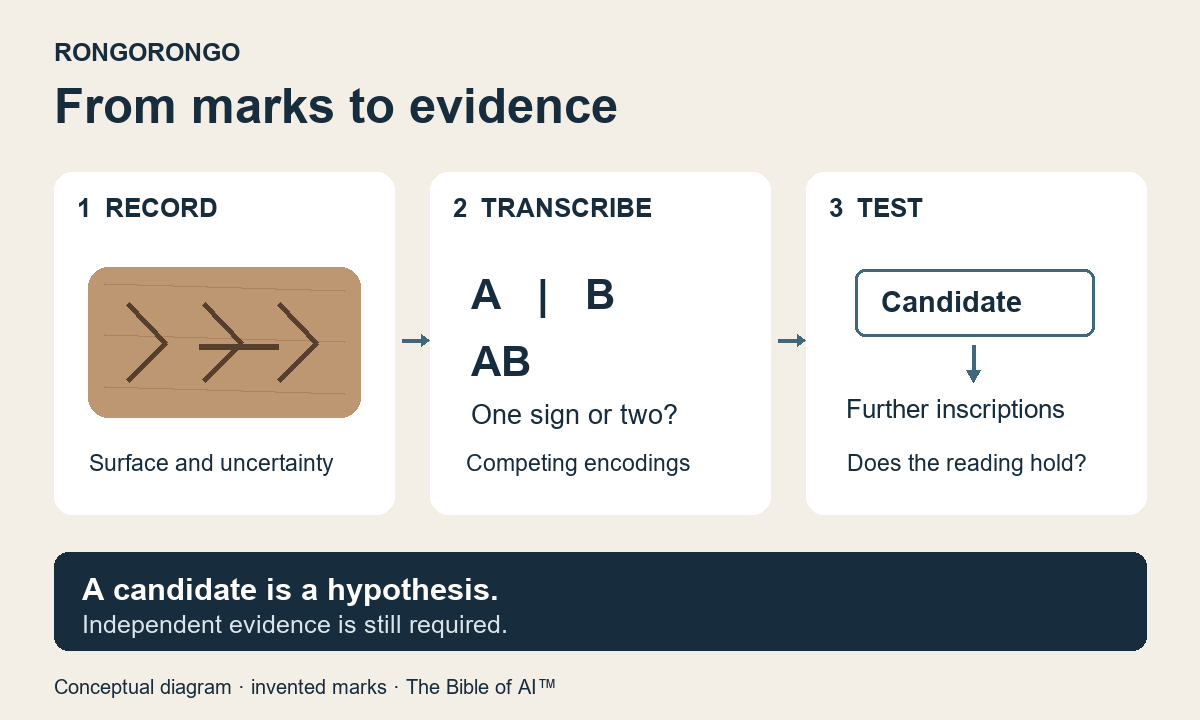
First establish what is on the wood
The Échancrée tablet, also known as tablet D, shows why recording an object can change the linguistic evidence. This is a separate study from the computational experiment on tablets A and B. A study first published online in 2021 combined structured light scanning with photogrammetry. Scanning supplied detailed surface geometry; photographs supplied texture. Examining the resulting three-dimensional model alongside the inscription allowed researchers to revise earlier drawings and transcriptions. These techniques document the surviving surface. They do not, by themselves, assign a sound or a meaning to a sign.
The material history raises a separate problem: what exactly has been dated? A 2024 radiocarbon study examined wood from four rongorongo objects in Rome. One yielded a mid-fifteenth-century date, while the others fell in the nineteenth century. The measurement dates the wood, not the act of carving. An early piece of timber can strengthen a historical investigation without independently establishing when its inscription was made.
Nor should an unread script be confused with an extinct language. Rapa Nui has a documented spoken language and grammar. The missing knowledge concerns how the inscriptions encode their message. Modern speech provides a possible comparison, but it cannot be assumed to reproduce every feature of the language or genre represented on the tablets.
A proposed reading must survive another test
The 2026 experiment uses a genetic algorithm: a search procedure that keeps and modifies candidate mappings according to a score. It tests a one-to-one correspondence between signs and Rapa Nui syllables, using numerical transliterations of tablets A and B, rather than recognising their carved images. Short sequences are compared with reference-language frequencies. Tests on artificially encoded, already readable texts provide a check with a known answer.
Performance changes when the reference corpus changes. On the real inscriptions, two transcription systems produce different results: one scores poorly; the other reaches an ambiguous region. Neither establishes a decipherment. The result challenges that particular combination of transcription and simple substitution. It does not eliminate every syllabic or mixed writing system.
Our proposed standard for a stronger claim is deliberately demanding. Fix the sign catalogue and proposed sound values before examining additional inscriptions. Record which passages were used to choose them, and which were reserved for testing. Then ask whether the same values explain those reserved passages without a succession of exceptions. Keep alternative readings visible wherever the surface is uncertain. These are criteria for a future test, not results already delivered by this experiment.
Consider an invented example: a proposed sign value seems to produce a recognisable word in one line. If every later occurrence needs a different explanation, the first match offers little support. If a fixed set of values repeatedly predicts plausible forms in material it was not designed to explain, the proposal becomes more useful. Even then, linguistic plausibility and historical interpretation require separate scrutiny.
For rongorongo, AI can make hypotheses more explicit and expose where they fail. Three-dimensional documentation can make the observations behind those hypotheses easier to inspect. Their shared contribution is a more accountable route from surviving marks to an argument about the past, while the reading itself remains an open question.
Liked this post? Follow this blog to get more.