Data Mining (Article)

R0:2860421906bee85cbfa5eadd287f7a8c-Data as the main focus of “State of the art of data science in Spanish language and its application in the field of Artificial Intelligence”

Data as the main focus of “State of the art of data science in Spanish language and its application in the field of Artificial Intelligence”

According to the results, there is an evidence of cultural bias for data science in Spanish language. The outcome of the consultation, which carried out on 12 April 2021, confirms that only 10 out of 23.771 datasets “speaks” Spanish.»

Data as the main focus of “State of the art of data science in Spanish language and its application in the field of Artificial Intelligence” Leer más »

R0:8477de576deaf0ef41a00ad9e17c7171-Partial Differential Equations is All You Need for Generating Neural Architectures -- A Theory for Physical Artificial Intelligence Systems

Partial Differential Equations is All You Need for Generating Neural Architectures — A Theory for Physical Artificial Intelligence Systems

In this work, we generalize the reaction-diffusion equation in statistical physics, Schrödinger equation in quantum mechanics, Helmholtz equation in paraxial optics into the neural partial differential equations (NPDE), which can be considered as the fundamental equations in the field of artificial intelligence research

Partial Differential Equations is All You Need for Generating Neural Architectures — A Theory for Physical Artificial Intelligence Systems Leer más »

Classification based on Topological Data Analysis

Classification based on Topological Data Analysis

Topological Data Analysis (TDA) is an emergent field that aims to discover topological information hidden in a dataset. TDA tools have been commonly used to create filters and topological descriptors to improve Machine Learning (ML) methods. This paper proposes an algorithm that applies TDA directly to multi-class classification problems, even imbalanced datasets, without any further ML stage

Classification based on Topological Data Analysis Leer más »

R0: dde004c79ac901067ab1189ea01b8ac7-Data Science: A First Introduction

Data Science: A First Introduction

The book is structured so that learners spend the first four chapters learning how to use the R programming language and Jupyter notebooks to load, wrangle/clean, and visualize data, while answering descriptive and exploratory data analysis questions. The remaining chapters illustrate how to solve four common problems in data science, which are useful for answering predictive and inferential data analysis questions[…]

Data Science: A First Introduction Leer más »

R0_fe33488e78e8d3bac711f1ffb6ea5a48-Bayesian-Data-Analysis-course

Bayesian Data Analysis: book & course

This book is intended to have three roles and to serve three associated audiences: an introductory text on Bayesian inference starting from first principles, a graduate text on effective current approaches to Bayesian modeling and computation in statistics and related fields, and a handbook of Bayesian methods in applied statistics for general users of and researchers in applied statistics. Although introductory in its early sections, the book is definitely not elementary in the sense of a first text in statistics

Bayesian Data Analysis: book & course Leer más »

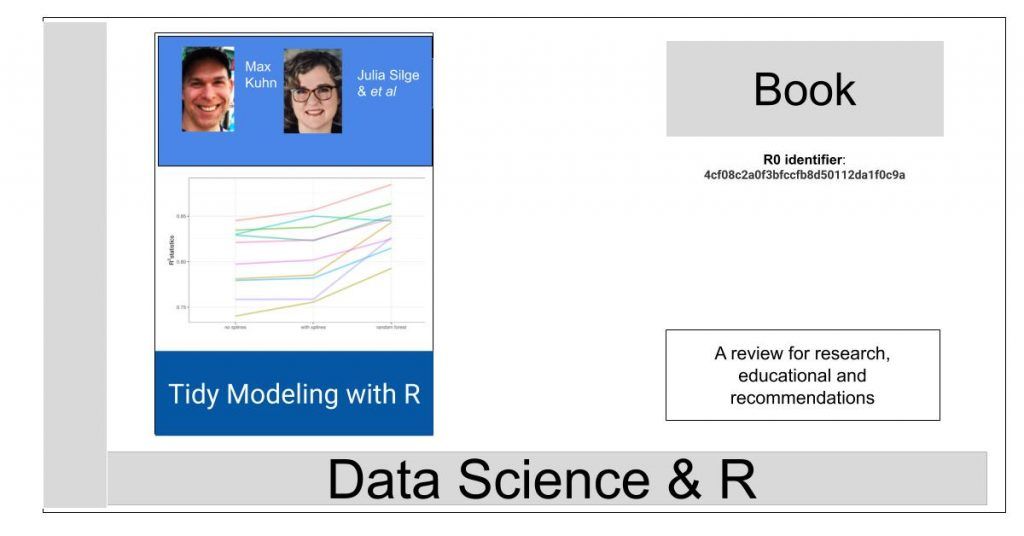
Tidy Modeling with R

Tidy Modeling with R

This book provides an introduction to how to use our software to create models. We focus on a dialect of R called the tidyverse that is designed to be a better interface for common tasks using R. If you’ve never heard of or used the tidyverse, Chapter 2 provides an introduction. In this book, we demonstrate how the tidyverse can be used to produce high quality models. The tools used to do this are referred to as the tidymodels packages

Tidy Modeling with R Leer más »

IEEE Use Case–Criteria for Addressing Ethical Challenges in Transparency, Accountability, and Privacy of CTA/CTT

IEEE Use Case–Criteria for Addressing Ethical Challenges in Transparency, Accountability, and Privacy of CTA/CTT

There are substantial public health benefits gained through successfully alerting individuals and relevant public health institutions of a person’s exposure to a communicable disease. Contact tracing techniques have been applied to epidemiology for centuries, traditionally involving a manual process of interview and follow-up. This is time-consuming, difficult, and dangerous work. Manual processes are also open to incomplete information because they rely on individuals being willing and able to remember and report all contact possibilities.

IEEE Use Case–Criteria for Addressing Ethical Challenges in Transparency, Accountability, and Privacy of CTA/CTT Leer más »