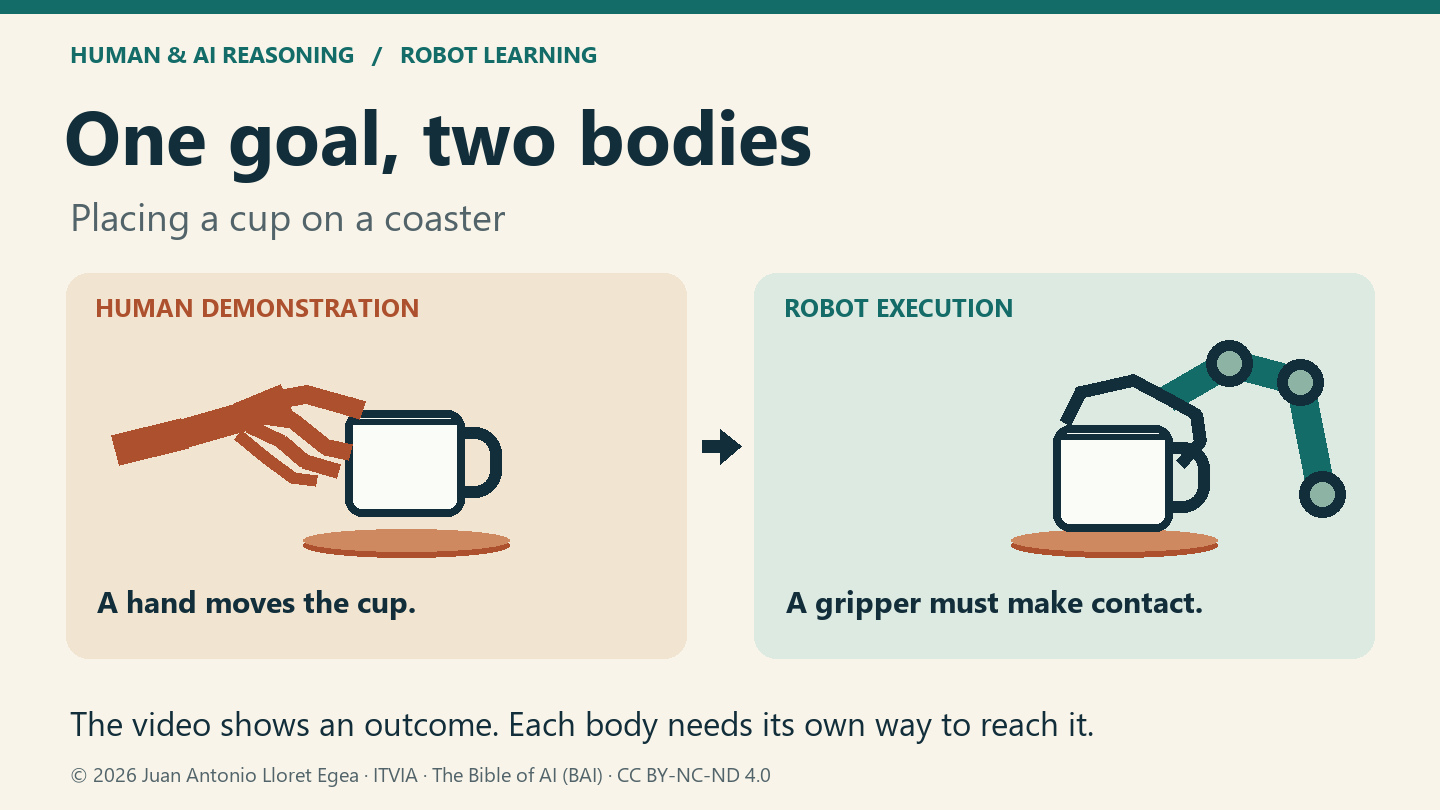
A person lifts a cup and sets it on a coaster. Which part of that demonstration should a robot repeat? If the coaster moves, tracing the same path through the air will put the cup in the wrong place. If the gripper has only two fingers, copying the hand posture may be impossible. Yet the demonstration still conveys something the robot can use: where the cup should end up relative to the coaster.
This is the problem of learning across bodies, often called cross-embodiment learning. A recording can show the sequence of events, where contact occurs and how an object moves. The commands sent to a robot’s motors are absent from a human video. Six experimental studies illustrate how researchers bridge that gap and what counts as evidence that a skill has transferred.
One demonstration can be the start of practice
In WHIRL, a robot observes a person performing a task, such as opening a drawer. The estimated hand motion supplies a starting point for the robot’s reach and grasp. The robot then tries variations. To assess an attempt, the system compares what happened in the two videos after visually removing the person and the robot. The movement of the drawer can then contribute to the comparison even though the two bodies look different. [1]
The authors tested 20 manipulation tasks and report one to two hours of training per task. Here, one-shot describes the number of human demonstrations. Improvement also draws on the physical consequences of the robot’s own attempts. That distinction matters wherever repeated practice is difficult: a drawer can be closed and tried again, whereas a dropped cup may break. [1]
What the hand teaches and what the controller supplies
MimicPlay assigns different jobs to the two sources of experience. Video of people freely handling objects trains a model to predict hand trajectories towards a goal. A second model learns from examples in which an operator controls the robot. It takes the plan inferred by the first model and uses the robot’s current observations to choose its next action. At test time, a demonstration can specify a longer sequence of activities. [2]
Across 14 physical manipulation tasks involving several steps, the authors report better task completion than with the comparison methods they tested. A change in the order of familiar actions is especially informative: a robot that can perform the familiar steps in a newly demonstrated sequence has acquired some flexibility in combining them. The experiment still draws on motor skills learned from teleoperation. A new ordering and a new grasp place different demands on the controller. [2]
Representing the relation between objects
ORION makes the cup-and-coaster example concrete. It extracts a sequence of graphs from a demonstration. The graphs identify objects, hand interactions and contact relations at selected moments. The system uses these relations to construct movements suited to the objects’ starting positions in the robot’s workspace. The authors tested tasks including placing a mug on a coaster and assembling parts of a toy boat. They report 74.4% average success across their physical evaluations, which included demonstrations with and without recorded depth. The colour-only examples came from several sources, including generated video. [3]
That figure has a specific boundary. The demonstration camera was assumed to be stationary, even when its viewpoint differed from the robot’s. The method represents goals through contact states and does not explicitly model the forces needed to maintain contact. Placing a cup on a coaster supplies such a state. Placing it near a coaster leaves many acceptable positions with no contact between the two. The choice of representation helps explain both a success and a foreseeable difficulty. [3]
When previous experience changes the value of a video
A study of vision–language–action models examined what a robot already needs to know for a human example to be useful. In one test, the robot data showed how to put eggs into cartons. Human demonstrations added a sorting rule based on egg colour. Adding human data during fine-tuning improved performance across the four generalisation scenarios the authors tested, with larger gains after more diverse robot pretraining. The egg example illustrates a practical human contribution: the demonstrator supplies a criterion for choosing a destination while the robot brings prior experience of moving eggs. [4]
A robot might still rely on a coincidental cue, such as the position of a carton. A stronger test of the inferred rule would exchange the cartons’ positions while preserving their intended roles, then check where each egg goes. This is a proposed test of the interpretation. It illustrates why a successful sort alone cannot identify the decision rule that produced it.
Two routes from video to action in 2026
The HumanEgo preprint describes a system that estimates the hand’s position relative to the objects using recordings from glasses with stereo tracking. With 30 minutes of human demonstrations per task, it achieved a reported mean success rate of 92.5% across four physical tasks, with 40 trials per task and randomised initial object positions. The method assumes that a grasped object stays fixed relative to the gripper. An object that slips can therefore invalidate the system’s estimate even if the gripper itself follows the intended path. [5]
RoboTryOn, a November 2026 preprint, takes another route. It synthesises video of a robot performing the demonstrated motion, then estimates which actions would produce that motion. Its evaluation included seven tasks for which the researchers had human examples and no task-specific teleoperation examples. Adding the converted examples to teleoperation data from four other tasks raised mean success on the seven tasks from 3.1% to 73.0% on OpenArm and from 1.0% to 46.9% on RB-Y1. Each policy was tested in 28 trials per task. Robot data also contributed to training the systems that generated the videos and estimated the actions. [6]
The two studies answer different questions. HumanEgo tests how much supervision can be recovered from instrumented human demonstrations on four tasks. RoboTryOn tests whether synthetic examples add useful training data for two robot designs. Their success rates have different denominators, task definitions and training conditions. The evidence for each approach lies in the comparisons within its own experiment.
What would count as learning the goal?
Return to the cup. Moving the coaster tests whether the robot can preserve the destination as the path changes. Rotating the handle tests whether it can choose a different grasp. Shifting the cup after grasping tests whether it can detect an error and recover. These are three distinct experiments. For each, the outcome should specify whether the cup was released, remained upright and came to rest on the coaster. A trajectory that looks right from the camera can still fail at the last contact.
The human contribution to this form of collaboration is partly a choice about what to demonstrate. Showing the same outcome from different starting positions can reveal which relation should be preserved. The robot contributes a physical test of that interpretation: it must find actions its own body can execute. The strongest evidence of transfer comes when the experiment changes a feature that could have misled the learner and the robot still achieves the intended result.
Selective review of six primary studies, with evidence considered through 14 November 2026. The proposed tests above are interpretive examples. The experimental results are those reported in the cited studies.
References
- Bahl, S., Gupta, A. & Pathak, D. (2022). Human-to-Robot Imitation in the Wild. Robotics: Science and Systems XVIII.
- Wang, C., et al. (2023). MimicPlay: Long-Horizon Imitation Learning by Watching Human Play. Conference on Robot Learning, PMLR 229, 201–221.
- Zhu, Y., Lim, A., Stone, P. & Zhu, Y. (2026). Vision-based manipulation from single human video with open-world object graphs. Autonomous Robots 50, 27.
- Kareer, S., et al. (2026). Emergence of Human to Robot Transfer in Vision-Language-Action Models. Robotics: Science and Systems XXII.
- Wang, Z., et al. (2026). HumanEgo: Zero-Shot Robot Learning from Minutes of Human Egocentric Videos. Preprint, arXiv:2605.24934, version 3.
- Lee, S., Jang, S., Kim, M. & Shin, J. (2026). Synthesizing Dexterous Robot Demonstrations from Human Videos via Virtual Try-On. Preprint, arXiv:2611.05163, version 3.
Liked this post? Follow this blog to get more.