Juan Antonio Lloret Egea, Director (BackGround) · AI and Society
Imagine opening the local paper and finding your photograph beneath a report of a theft. You were nowhere near it. Now imagine a letter from your car manufacturer: some welds may be missing, and your car needs an inspection. In the first case, you ring the editor. In the second, you ring the dealer. Nobody sends you to the printing press or asks you to take the matter up with the welding robot. Why should “the AI did it” be an acceptable answer?
As an engineer and a director, I want to know how a failure happened and who owes the person affected an answer. Those questions lead to different places. A machine may explain the failure. Responsibility belongs to the people or organisations whose decisions and duties the evidence establishes. A company, a public authority or a political organisation should not be able to make its own part in a decision disappear by calling it the work of AI.
The newsroom: who put that photograph beside your name?
In our imagined newspaper, the reporter gathered the story, someone selected the picture and wrote the caption, and an editor authorised publication. The publisher put its name on the paper. To find the error, the editor needs the original picture, the caption as submitted and the version that went to print. A perfectly genuine photograph can make a false accusation if it is attached to the wrong story. No detector for synthetic images would catch that mistake.
Now suppose software generated the picture and published it without a final human check. We should not invent a reporter who saw an image that no one reviewed. We can still ask who authorised automatic publication, what checks were required, and who could take the story down when you called. If the complaint is upheld, you are owed a correction that reaches the people who saw the accusation. The publisher can issue it in its own name while protecting a confidential source.
The assembly line: who stands behind the car?
When I buy a car, I do not expect anyone to have built it entirely by hand. Nor do I look for a watermark on the door saying “made by robots and AI”. I look for the manufacturer’s name. If there is a warning about the bodywork, the useful question is whether my car is safe to drive. Knowing which tools were used may help an engineer investigate. The car cannot answer for the defect, and the word “robot” gives the driver no one to call.
Take a joint that is meant to hold part of the body together in a crash. A design engineer specifies where the welds belong. A production team translates the drawing into instructions for the line. Quality staff test whether the parts that leave it meet the specification. If a weld is missing, comparing the drawing, the robot’s operating record and the inspected part can reveal where the three diverged. Those people have different duties. Finding a defect does not, by itself, establish that any particular engineer was negligent.
In July 2018, a routine inspection at Subaru’s Indiana plant found missing spot welds on a model-year 2019 Ascent, around the upright between the front and rear doors. Subaru traced the fault to the welding robots’ programming, corrected the program and used the robots’ records to identify the vehicles that needed checking. Its US recall covered 293 potentially affected vehicles. Subaru undertook to replace any car found to lack the welds. In its closing notice, it reported that all 293 passed inspection, including the nine already in customers’ hands. Calling these “293 defective cars” would tell a different and incorrect story. Subaru’s defect report to the US safety authority and its final inspection notice.
This was a documented programming fault; the report does not identify it as AI. That is why the comparison is useful. The robot supplied evidence. The manufacturer notified customers and arranged inspections. A related principle appears in European law: the manufacturer answers to the approval authority for conformity of production and must take appropriate corrective action when a vehicle does not conform. That duty does not settle who caused a particular collision. EU vehicle approval regulation, Articles 13–14.
What a watermark can tell a reader
There is one important difference between the photograph and the car. A convincing synthetic photograph can look like eyewitness evidence of something that never happened. Telling a reader how it was made matters. But a label saying “made with AI” does not tell the reader who chose to present it as evidence, whom to contact, or whether the publisher will correct the record. I would ask for an identifiable publisher as well as an honest account of how the picture was made.
EU law itself draws a distinction. Article 50 of the AI Act provides for machine-readable marking of certain synthetic outputs and for disclosure when someone uses a system to make a deepfake. Those are distinct obligations. For text generated or manipulated with AI and published on a matter of public interest, the Act provides an exception where there has been human review or editorial control and a person or organisation bears editorial responsibility. That exception for text is not a blanket exemption for the photograph beside it. AI Act, Article 50; European Commission guidance on scope and dates.
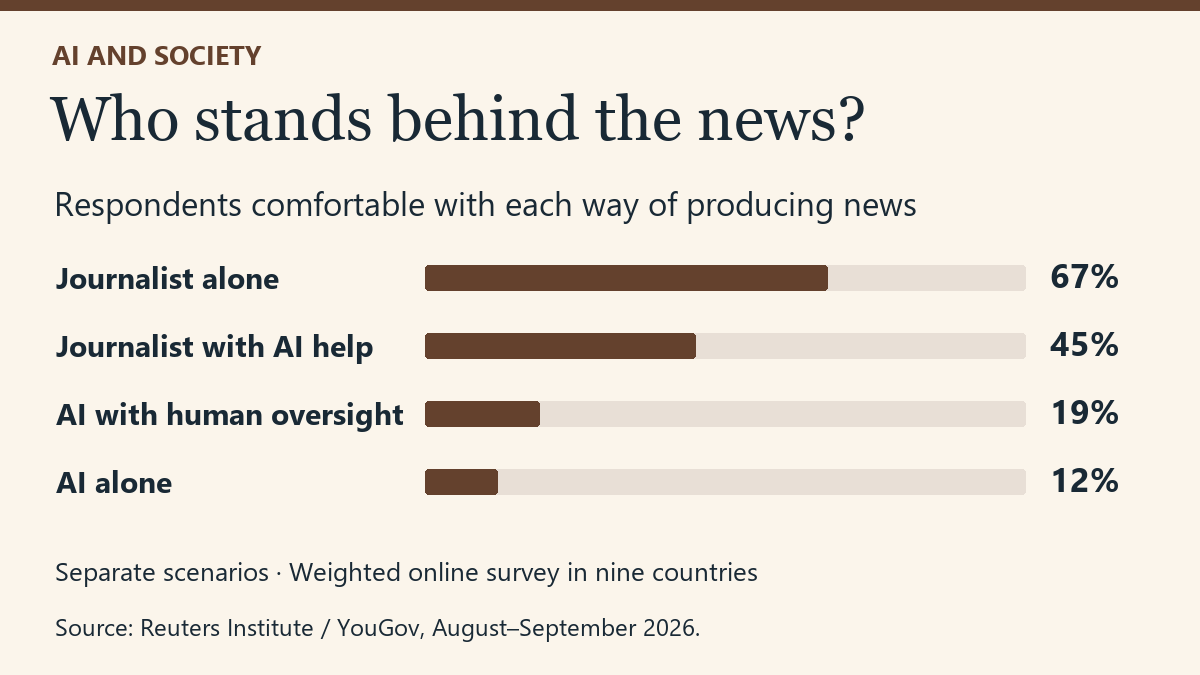
Readers also distinguish between a journalist using a tool and a system producing the news. The survey below asked how comfortable people felt in each situation. It did not ask them to assign legal liability.
Who stands behind the news?
Share of respondents who felt very or somewhat comfortable with each way of producing news. August–September 2026.
Compare with news produced by a journalist alone
Using the journalist-only result (67%) as the reference, reported comfort was 22 percentage points lower when a journalist led with AI assistance, 48 points lower when AI led with human oversight, and 55 points lower for AI alone. These differences compare survey responses; they do not measure the quality of the news.
Read the survey figures as a table
| Who makes the news? | Very or somewhat comfortable |
|---|---|
| A journalist, entirely | 67% |
| Mainly a journalist, with AI assistance | 45% |
| Mainly AI, with some human oversight | 19% |
| AI, entirely | 12% |
View the original chart
Whose publication was it?
If a user uploads a false video to YouTube or Facebook, the user who posted it and the platform that hosts it have taken different actions. What did the uploader claim? Was the material unlawful? What notice reached the platform, and how did it respond? Under the EU Digital Services Act, hosting services have a conditional exemption for material stored at a user’s request. A precise notice may establish knowledge of illegality; how promptly the service acts then matters. The Act does not impose general monitoring of every upload. A false claim is not necessarily unlawful, and neither party is automatically liable for the other’s conduct. Digital Services Act, Articles 6, 8 and 16.
Compare that with a business giving advice on its own website. In Moffatt v. Air Canada (2024 BCCRT 149, paragraphs 14 and 24–32), a traveller relied on the airline chatbot’s incorrect advice about claiming a bereavement fare after travel. British Columbia’s Civil Resolution Tribunal awarded damages for negligent misrepresentation. The tribunal examined the airline’s duty, the advice, the traveller’s reliance and the loss. It did not need to decide what kind of chatbot this was. The important distinction was whose advice the customer had received.
What the reader and the driver are owed
The reader should be able to open tomorrow’s paper and find the correction. The driver should be able to give the dealer a vehicle identification number and find out whether the car needs attention. For either answer to mean anything, somebody must have kept the evidence and somebody must have the authority to act on it.
That is the standard I would apply when AI is involved. Traceability lets us follow a photograph from its source to the printed page, or a weld from the drawing to the finished car. Auditability lets another person check those records and challenge the conclusion. A watermark may tell me how a picture was made. The publisher’s or manufacturer’s name tells me whom to ask. The real test of responsibility comes when that person or institution has to answer.
Cite this proposal
APA
Lloret Egea, J. A. (2026, November 14). Who answers for AI? Lessons from the newsroom and the assembly line. La Biblia de la IA – The Bible of AI™. https://editorialia.com/2026/11/14/who-answers-for-ai-lessons-from-the-newsroom-and-the-assembly-line/
MLA
Lloret Egea, Juan Antonio. “Who answers for AI? Lessons from the newsroom and the assembly line.” La Biblia de la IA – The Bible of AI™, 14 Nov. 2026, https://editorialia.com/2026/11/14/who-answers-for-ai-lessons-from-the-newsroom-and-the-assembly-line/.
Harvard
Lloret Egea, J.A. (2026) ‘Who answers for AI? Lessons from the newsroom and the assembly line’, La Biblia de la IA – The Bible of AI™, 14 November. Available at https://editorialia.com/2026/11/14/who-answers-for-ai-lessons-from-the-newsroom-and-the-assembly-line/.
Vancouver
Lloret Egea JA. Who answers for AI? Lessons from the newsroom and the assembly line. La Biblia de la IA – The Bible of AI™ [Internet]. 2026 Nov 14. Available from https://editorialia.com/2026/11/14/who-answers-for-ai-lessons-from-the-newsroom-and-the-assembly-line/.
Chicago
Lloret Egea, Juan Antonio. “Who answers for AI? Lessons from the newsroom and the assembly line.” La Biblia de la IA – The Bible of AI™. November 14, 2026. https://editorialia.com/2026/11/14/who-answers-for-ai-lessons-from-the-newsroom-and-the-assembly-line/.
IEEE
J. A. Lloret Egea, “Who answers for AI? Lessons from the newsroom and the assembly line”, La Biblia de la IA – The Bible of AI™, Nov. 14, 2026. [Online]. Available: https://editorialia.com/2026/11/14/who-answers-for-ai-lessons-from-the-newsroom-and-the-assembly-line/.
Liked this post? Follow this blog to get more.