NEUROSYMBOLIC INTELLIGENCE · PHYSICAL MODELS AND TESTABLE RELATIONS
A curve passes through a set of measurements. An AI writes down a compact equation for it. The expression may be easy to inspect and numerically convincing. What would justify treating it as a physical law?
Symbolic regression searches for mathematical expressions that describe data. Learning can guide that search, while explicit constraints rule out some candidates. A pendulum makes the distinction tangible: the units can reject an impossible expression, yet leave several incompatible predictions standing.
A period, a length and an assumption
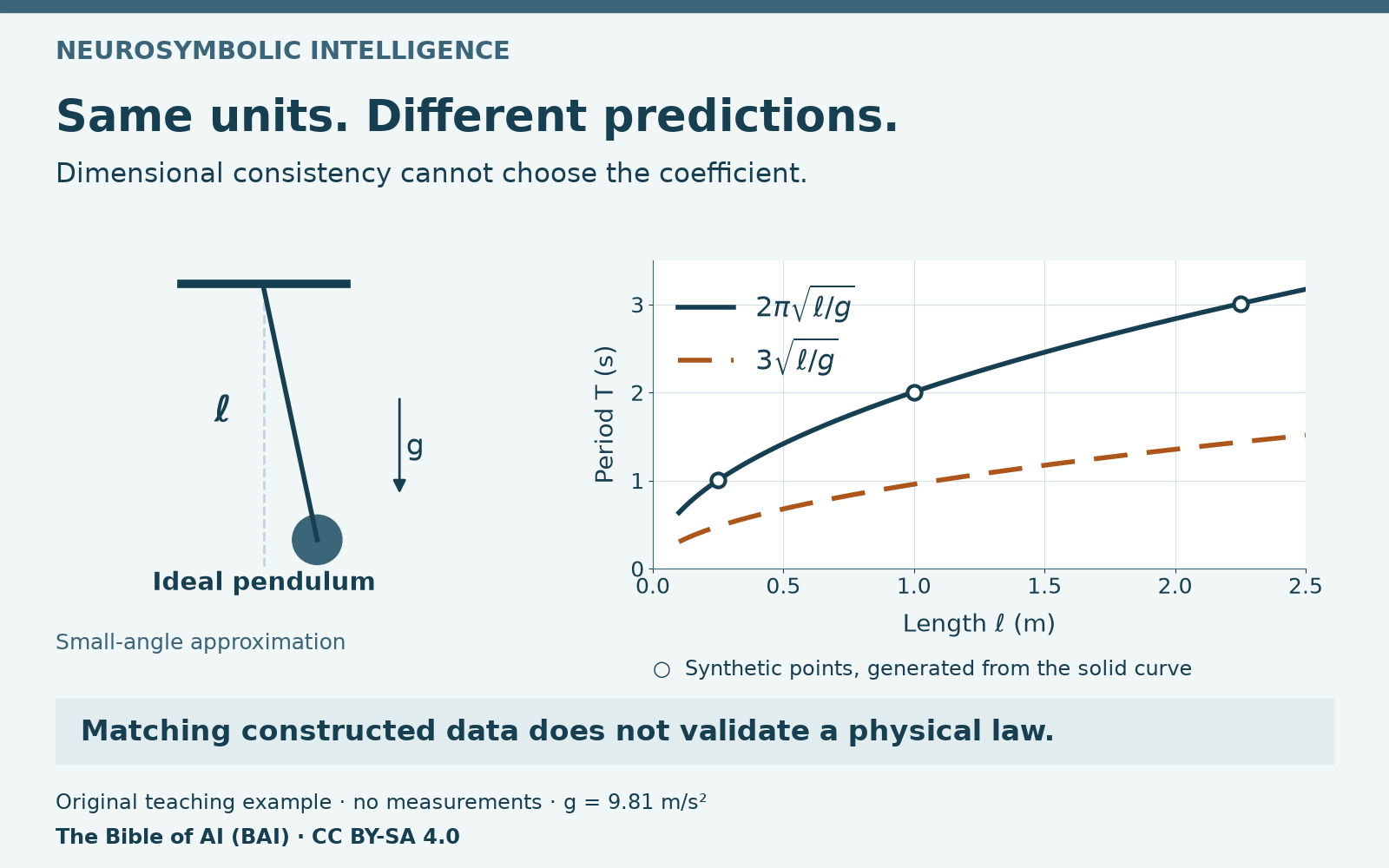
Consider an ideal simple pendulum: a point mass, a massless inextensible suspension, negligible friction and a uniform gravitational field. In the small-angle approximation, its period is T = 2π√(l/g), where l is the length and g the magnitude of gravitational acceleration. The approximation matters: this expression is not an exact account of a pendulum released at an arbitrary angle. [1]
For our teaching example, set g = 9.81 m/s² and generate three periods from that formula. Compare them with a deliberately different candidate, T = 3√(l/g). Both expressions have units of time.
| Length l (m) | 2π√(l/g) (s) | 3√(l/g) (s) |
|---|---|---|
| 0.25 | 1.003 | 0.479 |
| 1.00 | 2.006 | 0.958 |
| 2.25 | 3.009 | 1.437 |
The second candidate fails this numerical comparison. The first matches by construction: we used it to generate the points. That agreement checks our illustration, not nature. Even perfect recovery of a formula used to make a dataset is a different achievement from establishing a new empirical relation.
What the units can reject
Write the more general candidate as T = c√(l/g), with c dimensionless. Since l/g has dimensions of time squared, its square root has dimensions of time. Dimensional consistency admits every value of c; it cannot select 2π.
Now propose T = cl/g, keeping c dimensionless. The right-hand side has dimensions of time squared, so the equation fails this check. Giving c dimensions of inverse time would remove that particular inconsistency. It would also change the hypothesis by introducing another dimensional parameter. A rejection therefore depends on the declared quantities, not just the appearance of a formula.
This distinction is practical. A model fitted to numerical values in metres can conceal a unit mistake until the same observations are expressed in centimetres. A proper comparison transforms the values and their units together. Keeping the numbers while silently changing their meaning tests a different problem.
The missing variable has no units
The release angle exposes another limit. It is dimensionless when expressed in radians. A relation of the form T = √(l/g) F(θ₀), where θ₀ is the release angle and F a dimensionless function, passes the same dimensional test. Dimensional analysis alone cannot tell us to omit that dependence.
The small-angle formula describes a regime in which the amplitude dependence can be neglected to the required accuracy. A convincing fit within that regime does not establish the same accuracy at larger amplitudes. [1] If the observations never vary the release angle, the dataset may offer little opportunity to discover why that assumption matters.
A useful evaluation must therefore ask which conditions were varied and which were fixed. More points along the same restricted curve do not necessarily test the missing condition. The question is whether new observations can distinguish the remaining explanations.
Rules inside the search
Φ-SO provides a research example of constraints acting during equation construction. A recurrent neural network proposes symbols, and dimensional rules restrict admissible choices. Reinforcement learning guides the search towards expressions that fit the data. The symbolic constraint has a specific role; it does not certify the resulting expression as a law. [2, Section III]
Its 2023 study starts from a 120-equation collection but lists four exclusions in the evaluation procedure: 116 equations remain, with five trials at each noise level. The methods also disclose use of dimensional information and differences affecting some comparisons. These conditions matter before interpreting a performance ranking. [2, Section IV.1]
AI Feynman 2.0, published in 2020, offers a complementary route. It uses properties of a fitted neural network to identify structure that simplifies symbolic search, and balances numerical accuracy against expression complexity. [3] Neither example makes a language model a prerequisite for equation discovery. Classical symbolic search and neural guidance are distinct contributions.
Reading a recovery rate
The August 2026 NestyNet-SR preprint reports recovery of all 120 benchmark equations without added noise. Under its statistical selection procedure, recovery falls to 54 of 120 at a Gaussian noise level σ/σy = 0.1. This is noise scaled to the target values’ standard deviation, not a 10% error on every observation. [4, Section XI.1 and Table 4]
The evaluation checks recovered structure by refitting constants on noiseless data. A separate experiment supplies exact function values and gradients to a component tested on 115 eligible equations; it recovers 88. The 120-equation procedure excludes that component. These are different evaluations. [4, Section XI.2 and Table 5]
These are results reported in a preprint, not experiments reproduced for this article. They illustrate how a recovery claim depends on the supplied information and scoring procedure. They do not show that an AI has established 120 new laws of nature.
What would support a physical law?
An empirical claim needs observations independent of the construction used to produce the candidate. Measurements should carry uncertainty, and competing expressions should face conditions that can separate their predictions. The declared domain matters as much as the fitted coefficients: changing amplitude, material, scale or environment may reveal a boundary that the original data never tested.
Novelty is a further question. Recovering a known relation, finding a useful approximation and identifying a previously unknown regularity deserve different descriptions. A claim about a causal mechanism requires evidence beyond predictive fit. Even a successful physical law remains open to refinement when its domain is enlarged.
The earlier articles examined deduction in geometry, constraints on an action and checks on an extracted record. Here the candidate is a model of a physical phenomenon. Its mathematical consistency can be inspected while its empirical adequacy remains unsettled.
A deterministic unit check can repeat the same decision on the same declared inputs. The search that produced those inputs may be stochastic, and their physical interpretation may be wrong. The useful result is an equation accompanied by its variables, assumptions, supporting observations and unresolved alternatives. That gives another investigator something precise to test.
Sources and image credit
- OpenStax. University Physics, Volume 1, Section 15.4: Pendulums. Reference for the small-angle model and its assumptions; no textbook figure reproduced.
- Deep Symbolic Regression for Physics Guided by Units Constraints: Toward the Automated Discovery of Physical Laws. The Astrophysical Journal, 959, 99 (2023). DOI. Method checked in arXiv:2303.03192v2, 9 October 2023.
- AI Feynman 2.0: Pareto-optimal symbolic regression exploiting graph modularity. NeurIPS 33 (2020).
- NestyNet. III. Symbolic Regression from Analytic Neural Surrogates. arXiv:2608.21051v2, 25 August 2026. Preprint. Version record.
Image and example: original scientific illustration and synthetic numerical comparison for The Bible of AI (BAI), CC BY-SA 4.0. The arithmetic and dimensional reasoning in the teaching example have been checked; the research evaluations have not been independently reproduced. Sources consulted on 21 November 2026.
Liked this post? Follow this blog to get more.