A reader runs a fingertip over a Braille cell and feels a letter. In the Bristol experiment, a tactile sensor crossed the raised dots, a computer encoded their pattern, and living tissue responded to electrical stimulation. By the time the signal reached the tissue, how much of the letter could a computer already identify?
Abstract
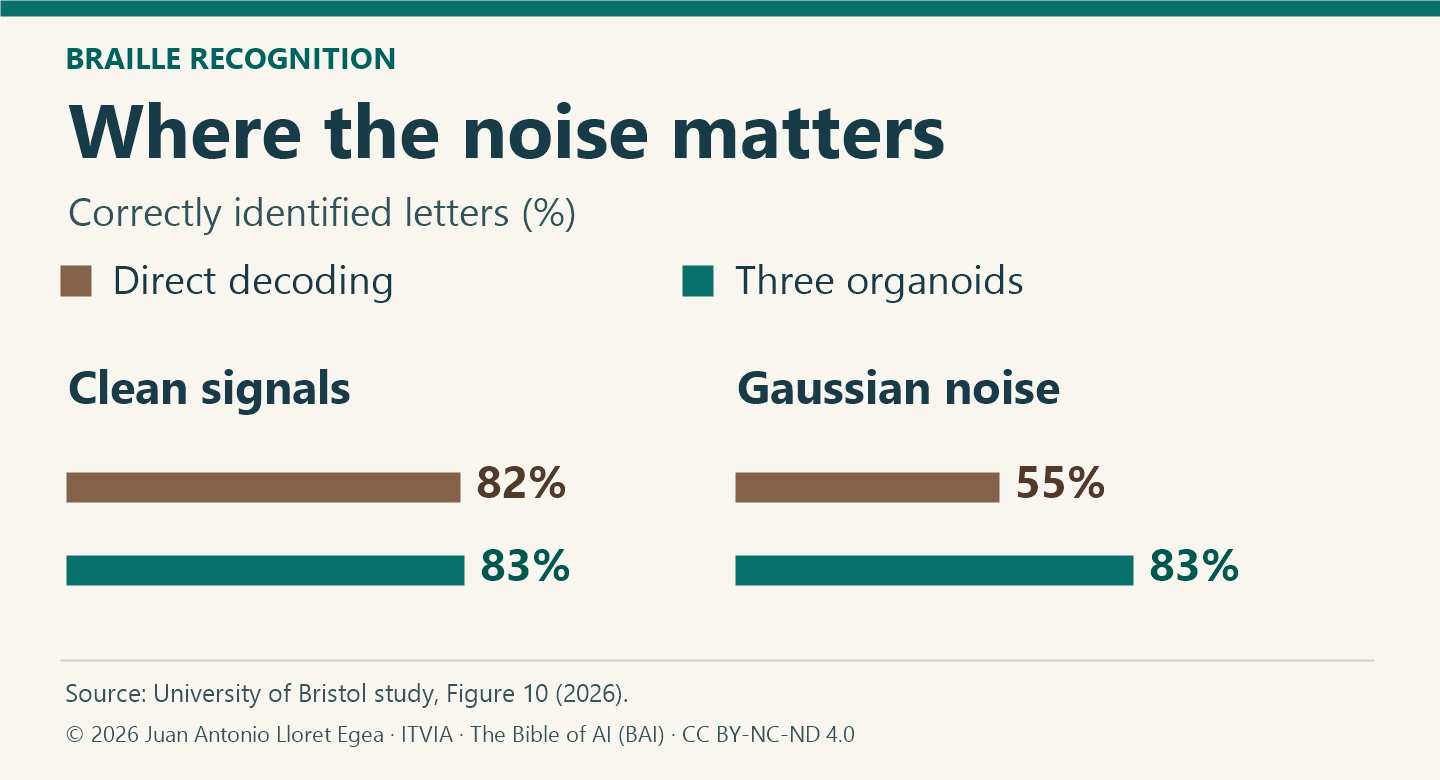
A tactile sensor moving across a Braille letter gives a computer several opportunities to identify it. The signal already carries information about the raised dots when it reaches living tissue. A University of Bristol team compared two routes from this signal to a letter. One supplied the encoded stimulus directly to a digital classifier. The other supplied the electrical responses of three human forebrain organoids. Across the alphabet, the classifier identified 82% of letters from clean stimulation patterns and 83% from the organoid responses. A wider difference emerged when the researchers added Gaussian noise to selected features before classification. Accuracy fell to 55% with direct decoding and remained at 83% with three organoids. The experiment shows how a change of representation can affect the recovery of letter identity under interference. It leaves open how much of that resilience depends on living tissue and whether it transfers to unfamiliar tactile tasks.
Where the letter enters the experiment
Consider two Braille letters that differ by a single dot. A sensor sliding across either letter will register changes as it makes contact. Where and when each change occurs can help distinguish the two letters. At the University of Bristol, researchers converted these tactile events into a pattern of electrical stimulation across eight channels. They had already made an important design choice by deciding which details of contact to preserve. [1]
Using FinalSpark’s Neuroplatform, the researchers delivered the encoded pattern to human forebrain organoids, three-dimensional preparations of living neural tissue. Electrodes recorded the response. A support vector machine, a classifier trained on labelled examples, used those recordings to assign one of 26 letters. The experiment ran in an open loop. A correct or incorrect prediction supplied no feedback to teach the tissue the alphabet. The Bristol repository makes the encoded inputs and the separate and combined organoid responses available for analysis. [1] [2] [3]
What the direct comparison reveals
Using eight recording channels from one organoid, the classifier identified about 61% of letters. Pooling the responses of three organoids gave it 24 measurements and raised accuracy to 83%. The three preparations received the same encoded input in parallel. A computer brought their measurements together. That arrangement matters because a gain from pooling several recordings can arise whenever each adds information that the others miss. [1] [2]
The most informative comparison took the tissue out of the signal path. The researchers gave the same kind of classifier the 32 numbers describing the electrical stimulus and used the same cross-validation procedure. It identified 82% of letters. Under clean conditions, the one-percentage-point gap gives little reason to attribute letter recognition itself to the organoids. What the recordings establish is that much of the information distinguishing the letters survived its passage through living tissue. [1]
When some of the measurements become unreliable
The researchers then disturbed selected values on the two routes to the classifier. With Gaussian noise, direct decoding fell to 55%, while decoding from three organoids reached 83%. The size of the difference depended on the disturbance. When selected values were missing, the corresponding scores were 59% and 72%. With unusually large values, they were 65% and 68%. This was a test of damage to the numerical representation available to the classifier. The original tactile recordings were held fixed throughout. [1]
Why might the second route withstand some disturbances better? Each organoid can respond a little differently to the same stimulus. If a distinguishing feature of a letter appears across several recordings, losing a value in one recording may still leave enough evidence in the others. That explanation is plausible. The experiment did not establish how much of the advantage arose from complementary biological responses, the arrangement of the channels or the way interference affected these very different measurements. [1]
What would count as learning?
In a previous study, Brainoware used an organoid as a biological reservoir for tasks including speech recognition. Our earlier article on living neurons and silicon asked where learning takes place when both tissue and software can change. The Braille experiment sharpens that question. A computer can learn to attach letter labels to recordings even if the tissue has never been told that two examples represent the same letter. A correct label establishes something about the complete instrument. It cannot establish that the tissue experienced touch or understood a word. [4] [5]
A useful next test would give a digital system the same number of output channels, expose both routes to identical disturbances at the tactile sensor, and evaluate them on previously unseen dot patterns. Those comparisons would help establish which advantage belongs to living tissue and how far it travels beyond the experimental alphabet. For now, the strongest finding is also the most precise. After three organoids responded to an encoded letter, a trained classifier could still recover its identity remarkably often when some of its measurements became unreliable.
Sources
- Encoding tactile stimuli for Braille recognition with organoids. Frontiers in Artificial Intelligence, 2026. The direct comparison appears in Figure 10.
- Encoded tactile inputs and organoid responses for Braille recognition. University of Bristol Research Data Repository, 2026.
- Open and remotely accessible Neuroplatform for research in wetware computing. Frontiers in Artificial Intelligence, 2024.
- Brain organoid reservoir computing for artificial intelligence. Nature Electronics, 2023.
- Living Neurons and Silicon: Where Does the Learning Happen? The Bible of AI, 2026.
Liked this post? Follow this blog to get more.