Juan Antonio Lloret Egea, Director (BackGround) · AI and Society
A society that can build intelligent machines but cannot secure the conditions of a decent life has confused capability with progress. Safe water, food, housing, healthcare, education and enforceable rights should determine what we ask technology to achieve. AI deserves public confidence when its benefits reach people’s lives.
Public priorities must guide science and AI even when industrial returns and military demands pull in other directions. The test is concrete: does a service become safer, more accessible or more effective, and who remains excluded? Governments should answer before asking the public to accept its consequences.
What people need
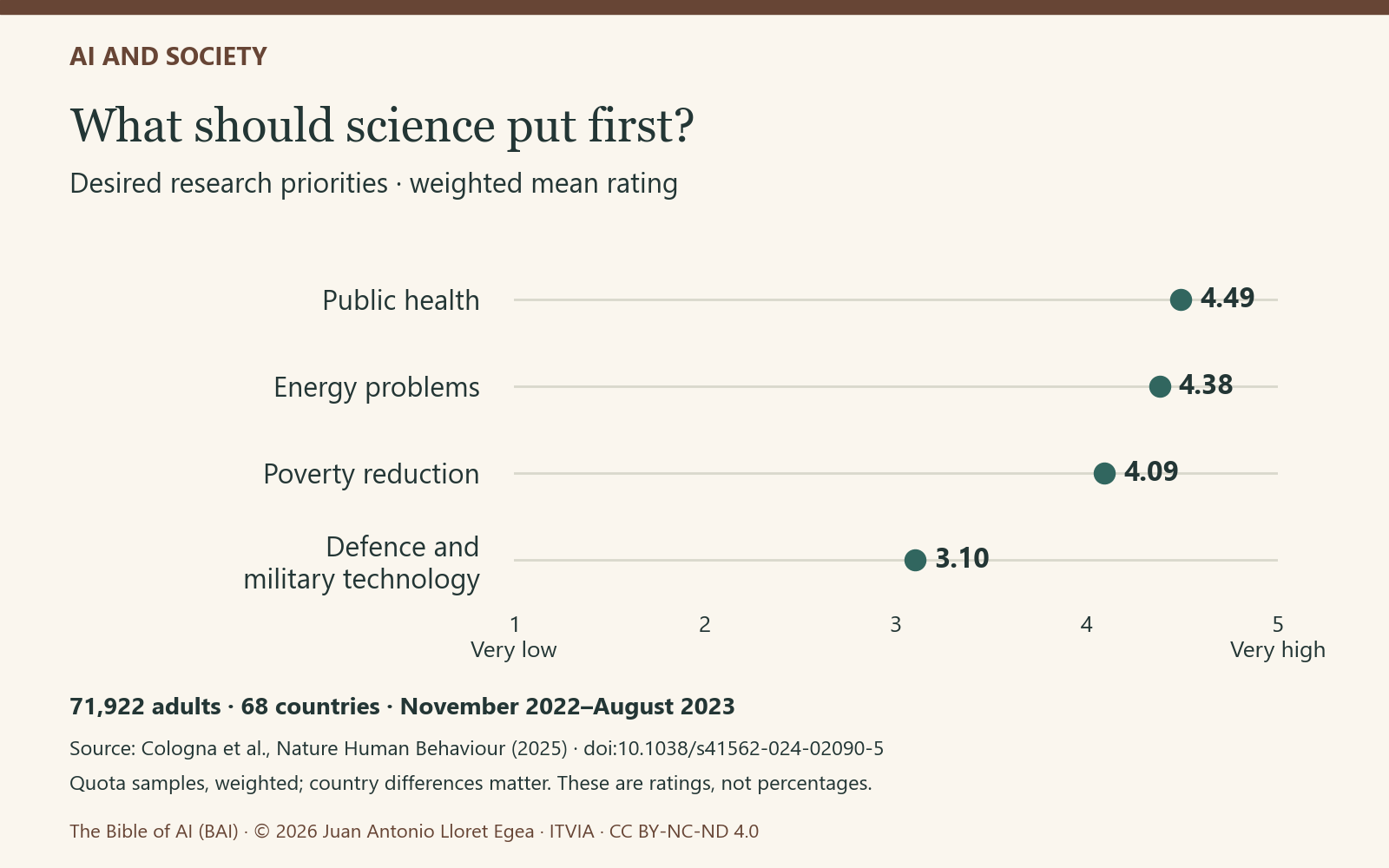
A 2025 study of 71,922 adults across 68 countries found that respondents gave health, energy and poverty reduction higher priority than military research. These are weighted preferences about science, not evidence that AI delivers those benefits. The study used quota samples, and national differences were substantial. Cologna and colleagues, Nature Human Behaviour.
Spain also faces an investment gap: R&D expenditure was 1.50% of GDP in 2024, against 2.26% across the EU. These totals cover all sectors, not AI alone, and measure spending rather than social benefit. INE; Eurostat.
Public priorities are not uniform. In the spring 2026 Eurobarometer, 63% of respondents in Spain selected employment, social affairs and public health among their priorities for EU spending, compared with 41% across the EU. Security and defence were selected by 23% in Spain and 38% across the EU. Up to four answers were permitted: these are preferences, not budget shares or endorsements of AI. Welfare and security cannot simply be treated as mutually exclusive. Eurobarometer 105, question QE3ab.
These priorities provide a starting point for public investment. A faster diagnosis matters when it is reliable and leads to appropriate care. An educational assistant must help pupils learn. A welfare service must help people obtain support without creating another obstacle between them and a person who can resolve their problem.
What discovery makes possible
AlphaFold’s advances in predicting protein structures demonstrate the scientific value of AI. The 2024 Nobel Prize in Chemistry recognised Demis Hassabis and John Jumper, of Google DeepMind, for structure prediction, alongside David Baker for computational protein design. A predicted structure can guide research; it does not establish a treatment’s safety, effectiveness or accessibility. The Royal Swedish Academy of Sciences’ announcement.
Our Biographies collection traces the foundations of such capabilities: Shannon’s work on reliable communication, Kilby’s integrated circuit, and Mead and Mahowald’s silicon retina. Each addressed a specific problem. Reliable transmission does not make a message true; responding to light does not amount to understanding a scene.
The same precision guides Horizons of Electronics: its humanoid carrying experiments distinguish success under test conditions from readiness for everyday use. In AI’s Human Mirror, a father with amyotrophic lateral sclerosis uses an experimental brain implant to communicate. He can correct words and stop recording. The benefit includes his control over the conversation. The evidence concerns one participant with trained assistance, not a treatment available to every family.
Competence carries responsibility
Good intentions cannot make technology harmless. A US study found that an algorithm using healthcare expenditure as a substitute for medical need underestimated the needs of Black patients. Unequal access to care had shaped the spending records on which it relied. Choosing an apparently useful measure reproduced an injustice. Obermeyer and colleagues, Science (2019).
Scientific achievement offers no moral exemption either. Fritz Haber contributed to ammonia synthesis, essential to fertiliser production, and played a leading role in chemical warfare. Responsibility belongs throughout the chain of discovery, development and use. OPCW: Chemistry for War or Peace?
I want engineers, scientists, clinicians and humanists to have real influence over public decisions, alongside the people affected. Leaders must understand enough to challenge a supplier, recognise uncertainty and stop an unsuitable deployment. Expertise must remain answerable to democratic institutions. Neither a polished presentation nor an academic title can substitute for evidence and responsibility.
The Director’s view: the law of the lever
For a simple lever with perpendicular forces, balance requires the force on each side multiplied by its distance from the pivot to be equal. Strength and position both matter. The physical principle. As a metaphor for technological choices, it exposes a problem: useful knowledge can exert too little influence over the purposes it serves.
On the left, place scientific advance and society’s ability to direct it: knowledge supplies the force; education, participation and capable public institutions extend its reach. On the right, place military applications and the pressures of commercial exploitation, production and financial return. Money, procurement and access to political authority can give those pressures a long arm.
A viable economy and legitimate security needs matter, but public priorities must govern how these technologies enter essential services. The balance I advocate protects decisions from capture by corporate, partisan or military interests. Healthcare, education and social welfare should receive the clearest, most demonstrable gains.
That requires gradual adoption: a defined use, limited initial exposure, independent evaluation, correction and expansion only when the evidence warrants it. Researchers and institutions can learn at each stage, and AI systems can be improved before wider use. Small steps cannot guarantee safety; they can help reveal failures before they become widespread or irreversible. A limited trial is acceptable only with safeguards proportionate to the possible harm.
Science supplies the force. Society must decide what it is used to lift.
Liked this post? Follow this blog to get more.