What would you want your daughter to remember about your voice? Perhaps the way you stretch her name when you call her from another room, or the particular rise at the end of a question that she knows is really a joke. A father living with amyotrophic lateral sclerosis (ALS) faced a version of that question. His daughter had little memory of how he sounded when he could still talk to her easily. He wanted her to hear something of that voice again.
He described another pleasure to the team at the University of California, Davis. He could look into his wife’s eyes as she heard the familiar sound and see it bring back a memory. The voice came from a loudspeaker. The words were ones he had just tried to say. Between the two stood a computer, and on its screen was a choice with an unusually human purpose. If the machine had picked the wrong word, he could change it. Read the participant’s account at UC Davis.
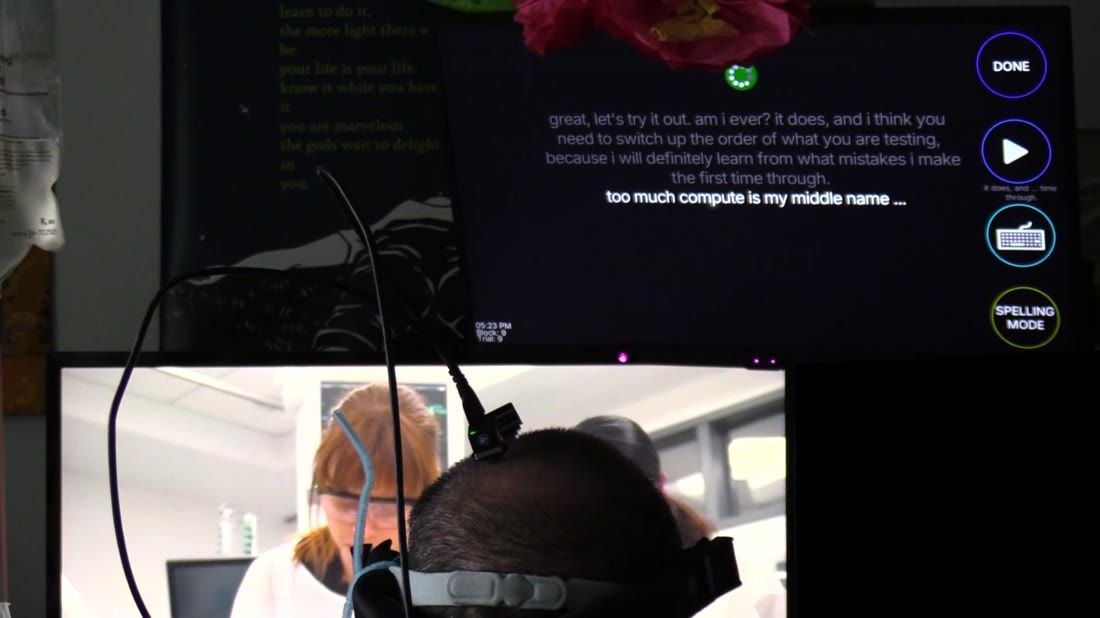
Whose sentence comes out of the speaker?
ALS can leave someone with plenty to say while the muscles needed for speech grow too weak for others to make out the words. In this clinical trial, four small arrays of electrodes were placed in the part of the participant’s brain involved in moving the muscles used for speech. When he tried to say something, the electrodes picked up patterns of activity. A computer trained on his attempts estimated the words he meant, and he could watch them appear on a screen.
There were two quite different pieces of work here. One program had to work out which words he was trying to form. Another could read the sentence aloud in a synthetic voice made to resemble his own before ALS affected his speech. A convincing voice can lend authority to a badly chosen word. That is why the modest-looking correction screen in the research footage deserves as much attention as the sound. With his gaze he could select a correction. He could then choose to let the room hear the sentence. Read the team’s first clinical report.
The day he made a joke about the machine
One of the most telling records of the trial is a conversation the researchers released with the participant’s consent. He uses the equipment to joke with a researcher about how it decodes speech. There is a small liberty in being able to tease the people who built a device while using that very device. A menu of prewritten requests could let someone ask for a drink or a change of position. It is harder for anyone else to prepare the joke you are about to make. Watch the exchange in Supplementary Video 2 (MP4).
At home, a trained care partner connected the recording equipment and started the computers. The participant and his care partners put that preparation at about twenty minutes. Once connected, he could operate the system without a researcher beside him. He used it for family conversations, messages and work. He could also turn on a privacy setting that stopped the system recording data. Those stretches of his day are missing from the researchers’ analysis for a very good reason. He had chosen to keep them to himself.
What counts as getting it right?
On a test, a researcher can give someone a sentence and compare every word that comes back with the one on the screen. In that setting the team reported more than 99% word accuracy. At the dinner table nobody else has a copy of the sentence a father means to say. The researchers did something more appropriate to that situation. They asked the speaker to judge how well the system had understood him.
Across nearly two years, he produced more than 183,000 sentences, at an average of 56 words a minute. He judged 92% of sentences at least mostly correct. That category allows mistakes. A single wrong word can reverse a perfectly fluent sentence, especially if the missing word is “no”. The study gives unusually substantial evidence about the daily life of one person. A second family considering the technology still needs to know how it would work with a different voice, home, budget and level of support. Read the home-use study in Nature Medicine.
What a family can use today
The implanted system is investigational. It involved surgery, external connections, research computers and someone trained to set them up. For a family whose conversations are becoming difficult today, a useful place to begin is with the person who is losing speech. What would they most like to do again? Speak privately on the telephone? Interrupt a story at the right moment? Say a grandchild’s name in a familiar voice? Each answer points towards a different kind of help.
Someone who can type might try having a phone speak their own words aloud. Apple’s Live Speech, for example, can speak typed text during an in-person conversation or a call on compatible devices. Someone for whom typing has become tiring might choose letters with their eyes on a speech-generating device, or point to a low-tech board with a partner. A speech-language professional can help try different ways of selecting words as movement changes. A letter board also works when a battery runs out. Apple’s guide to Live Speech · Communication aids from the American Speech-Language-Hearing Association.
There is something everyone at the table can do, whether the next sentence comes from a letter board, a phone or an experimental implant. Leave the speaker time to finish. A family might never count the words per minute. They will know the difference between guessing what Dad probably wants to say and hearing him deliver his own punchline.
Liked this post? Follow this blog to get more.