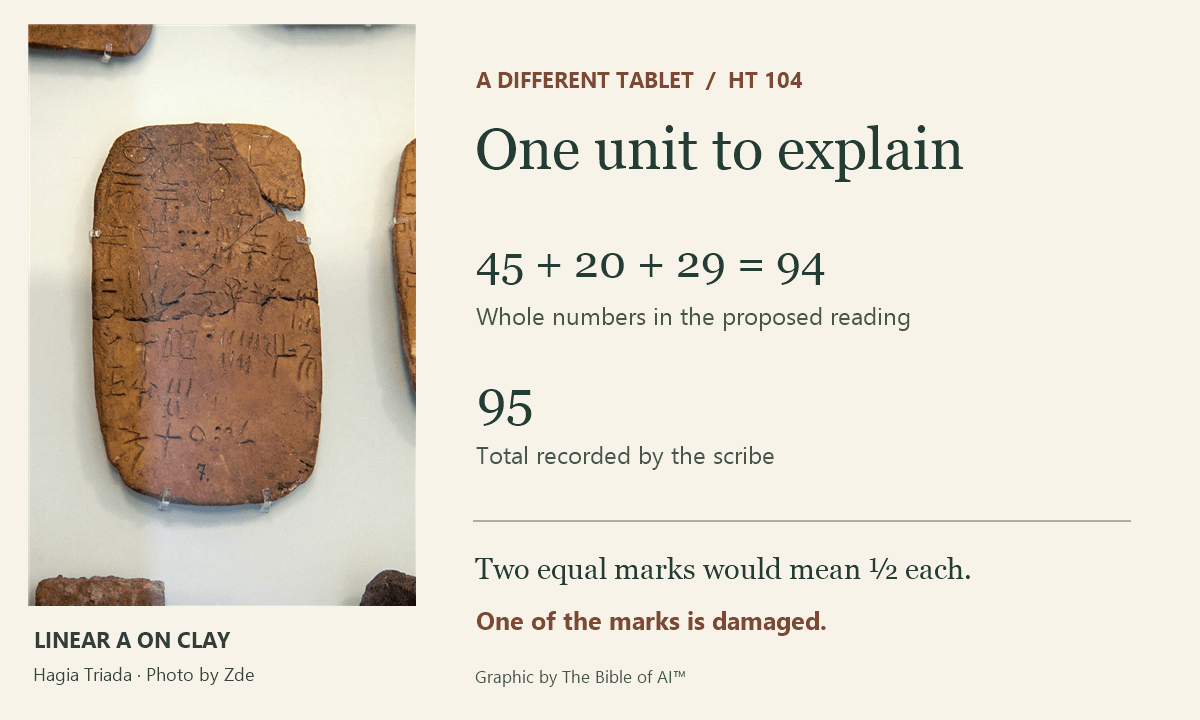
A scribe at Hagia Triada in Bronze Age Crete recorded three quantities and a total of 95. On the usual reading of the clay tablet, the whole numbers are 45, 20 and 29. That makes 94. The fractions beside the first two entries must account for the missing unit. If the scribe wrote the same fraction twice, each was a half. But the clay is damaged beside the second entry. Can a computer help us choose between readings when both sums come out right? [1] [2]

Two ways to make one
The tablet, catalogued as HT 104, is written in Linear A. Its language remains undeciphered, but the layout of its accounts lets scholars recognise numerals and the place where a scribe wrote the total. Scholars call the fraction sign beside 45 J. If the damaged entry reads 20 plus another J, the account contains two Js. Together they must make one. [1] [2]
A study of the inscription in Kadmos offers a second reading. There is room beside the second J for another sign, known as E. Suppose J meant a quarter and E a half. The scribe would then have entered 45 and a quarter, 20 and three quarters, and 29. That also makes 95. The total survives on the clay. The extra E is a proposed restoration, and the total alone cannot tell us whether it was ever there. [2]
What could a computer test across other tablets?
If one account balances either way, others might help narrow the choice. A University of Bologna team used a form of symbolic AI called constraint programming. They gave the computer rules for how fraction signs could be combined and asked it to list the sets of values that obeyed them. The team fixed three values in advance, including J at one half and E at one quarter. So the half assigned to J was a starting assumption. The value of another sign, D, was an open question. [3]
One run yielded 3,794,740 ways to assign values to twelve signs. To rank them, the researchers considered how often the signs appeared and whether different combinations would give a scribe several ways to write the same amount. In the two highest-ranked solutions, D meant one sixth. A 2026 study in Pasiphae drew on a wider selection of inscriptions and argued for one third. Its author acknowledged that no single new inscription settled the question. [3] [4]
The difference comes into focus in one inscription where D appears four times in a row. Under one of the Bologna team’s rules, a group of fractions in a single numeral must add up to less than one. Four sixths make two thirds and fit. Four thirds make one and a third, so that reading had already dropped out before the ranking began. But did the scribe mean the four marks as one number? The researchers note that scribes sometimes set down amounts one after another without totalling them. How the marks were grouped matters as much as how we add them. [3]
Could the later evidence break the tie? The Bologna study points to a clue in Linear B, the later script used on Crete to write Mycenaean Greek. The shape of a pair of Ds in Linear A matches a Linear B sign worth one third of the main unit for weighing wool. Two sixths would give just that amount. How far this supports the reading depends on whether the scribes who adapted the sign kept its value as well as its shape. [3]
How can we check a proposed reading?
Even in Linear B, where the language is known, it matters who supplies the answer. On a wool account from Knossos, KN Dp 1061, only the end of a word survives. The editors supply the missing syllable in brackets, [to]-sa. A neural network also ranked to first. If an intact sign had been hidden for a test, uncovering it would settle the matter. Here the sign itself is gone. What we can check is the model’s agreement with the editors. [5] [6]
In the collection’s article on the sheep fable, even the reference word has to be reconstructed. Latin ovis and English ewe are cognates, words inherited from a common ancestor. Both help linguists reconstruct the Proto-Indo-European word for ‘sheep’. A recent study favours one initial consonant, written *h₂, and explains why another, *h₃, also fits the surviving evidence. The asterisk marks a reconstructed sound. [7] [8]
The ByT5 model takes sets of cognate words documented in descendant languages of Proto-Indo-European, each labelled by language, and proposes an ancestral form for each set. Its best configuration matched the scholarly reference exactly in 21.6% of 361 test cases. The word ‘sheep’ illustrates the limit of that measure. A dictionary can choose one initial consonant for its entry even when the evidence still allows two. On HT 104, choosing a half for J has a similar effect. It settles the calculation while the clay still allows a second reading. [2] [3] [8] [9] Read the companion article on the sheep fable.
What would settle the value of D?
In our opinion, the most useful evidence would be a Cretan account that allows an independent check on the value of D. Imagine a scribe who used D just once and left a clear total. If we knew all the other quantities in the same unit, we could subtract them from the total and see what was left for D. A remainder of one sixth would support the Bologna reading. One third would favour its rival. A different remainder would give us reason to reconsider both. The computer has helped turn a disputed sign into a question another piece of clay could answer.
Sources and bibliography
- SigLA, The Signs of Linear A. HT 104, Haghia Triada. Digital catalogue, drawing and sign groups. Late Minoan IB.
- Again on Linear A Metrograms J and E. Kadmos 51 (2012), 27–32. See pp. 28–29 for the damaged third line of HT 104 and the alternative restorations.
- The mathematical values of fraction signs in the Linear A script: A computational, statistical and typological approach. Journal of Archaeological Science 125 (2021), 105214. See constraint 4, tables 1 and 8, and the discussion of D.
- Linear A fractions: new values, new views. Pasiphae 20 (2026), 353–390. The opening pages and note 2 specify the evidential approach and the proposed value of D.
- PA-I-TO Epigraphic Project. KN Dp 1061. Edition, photograph and commentary on the wool account from Knossos.
- Restoring Mycenaean Linear B ‘A&B’ series tablets using supervised and transfer learning. Proceedings of the 1st Workshop on Machine Learning for Ancient Languages (2024), 115–129. Appendix, table 1, gives the ranked predictions for KN Dp 1061.
- Linguistics Research Center, University of Texas at Austin. Indo-European Lexicon, entry for ‘ewe, sheep’. Attested forms arranged by language and branch.
- Indeterminacy in etymology: Reconstructing the PIE word for ‘sheep’ with notes also on Tocharian B ās ‘goat’ and PIE *h₂éwis ‘bird’. Contemporary Studies in Linguistics I (2025), 5–12. Competing reconstructions of the initial consonant.
- Towards Neural PIE Reconstruction from Heterogeneous Cognate Data. Proceedings of Dialogue 2026, 163–170. Sections 3–4 describe the inputs and the test set. Table 3 reports exact matches.
Liked this post? Follow this blog to get more.