Ciencia de Datos | 🇬🇧 Data Science

https://editorialia.com/wp-content/uploads/2020/06/the-art-of-machine-learning-algorithms-data-r.jpg

The Art of Machine Learning (Algorithms + Data + R)

I wrote this book because: • ML is not a recipe. It is not a matter of knowing the syntax and mechanics of various software packages.• ML is an art, not a science. (Hence the title of this book). • One does not have to be a math whiz or know advanced math in orer to use ML effectively, but one does need to understand the concepts well — the Why? and How? of ML methods

https://editorialia.com/wp-content/uploads/2020/06/best-practives-in-dataviz_-an-r-perspective.jpg

Best Practices in Dataviz: An R Perspective

By the end of this you will have had a whirlwind tour of the very tip of the data visualization best-practices iceberg. We will go over a broad range of topics generally applicable to data science usecases but not dive too deep into any single one. One thing to keep in mind the whole time is none of this is absolutely set in stone, most often in the real world you have to bend or break some of these rules to do what you want.

https://editorialia.com/wp-content/uploads/2020/05/techdispatch-1_2020_-contact-tracing-with-mobile-applications-2.jpg

TechDispatch #1/2020: Contact Tracing with Mobile Applications

In public health, contact tracing is the process to identify individuals who have been in contact with infected persons. Proximity tracing with smartphone applications and sensors could support contact tracing. It involves processing of sensitive personal data.

https://editorialia.com/wp-content/uploads/2020/05/a-socio-technical-framework-for-digital-contact-tracing-2.jpg

A socio-technical framework for digital contact tracing

In their efforts to tackle the COVID-19 crisis, decision makers are considering the development and use of smartphone applications for contact tracing. Even though these applications differ in technology and methods, there is an increasing concern about their implications for privacy and human rights. Here we propose a framework to evaluate their suitability in terms of impact on the users, employed technology and governance methods.

https://editorialia.com/wp-content/uploads/2020/05/cumplimiento_normativo_y_seguridad_ti_en_iot-3.jpg

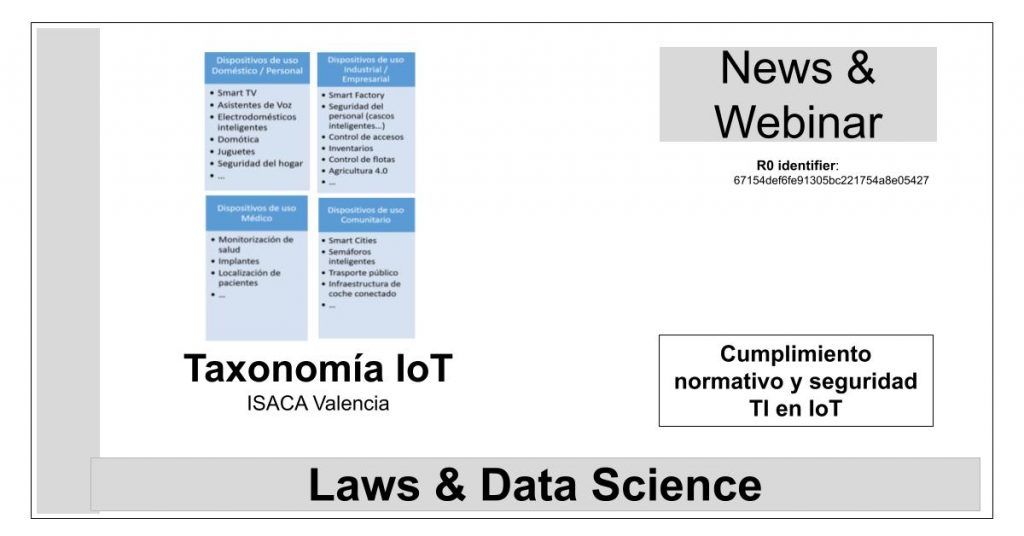
Cumplimiento normativo y seguridad TI en IoT

La conectividad y el tratamiento masivo de datos son dos pilares esenciales para el desarrollo de estos sistemas, los cuales, a su vez, introducen riesgos de seguridad y privacidad que deben ser tratados adecuadamente.

https://editorialia.com/wp-content/uploads/2020/05/european-data-supervisor-2019-1.jpg

The European Data Protection Supervisor, 2019 Annual Report a year of transition

With new legislation on data protection in the EU now in place, our greatest challenge moving into 2020 is to ensure that this legislation produces the promised results. This includes ensuring that new rules on ePrivacy remain firmly on the EU agenda. Awareness of the issues surrounding data protection and privacy and the importance of rotecting these fundamental rights is at an all time high and we cannot allow this momentum to decline.

https://editorialia.com/wp-content/uploads/2020/06/data-structures-succinctly-part-2.jpg

Data Structures Succinctly Part 2

Data Structures Succinctly Part 2 is your concise guide to skip lists, hash tables, heaps, priority queues, AVL trees, and B-trees. As with the first book, you’ll learn how the structures behave, how to interact with them, and their performance limitations. Starting with skip lists and hash tables, and then moving to complex AVL trees and B-trees, author Robert Horvick explains what each structure’s methods and classes are, the algorithms behind them, and what is necessary to keep them valid.

https://editorialia.com/wp-content/uploads/2020/06/data-structuressuccinctly-part-1.jpg

Data Structures Succinctly Part 1

Data Structures Succinctly Part 1 is your first step to a better understanding of the different types of data structures, how they behave, and how to interact with them. Starting with simple linked lists and arrays, and then moving to more complex structures like binary search trees and sets, author Robert Horvick explains what each structure’s methods and classes are and the algorithms behind them. Horvick goes a step further to detail their operational and resource complexity, ensuring that you have a clear understanding of what using a specific data structure entails.