A new programming language asks people to learn a different way of building software. What does it give them in return? This collection follows the people designing languages for work where Rust and C++ are already serious choices. Each profile starts with a problem that mattered to its designer and follows it all the way to the executable.
Discover the founder’s background, the public code, how memory is managed and which machines can run the result. For each performance claim, follow the workload, the comparison program and the conditions of the measurement. The profiles also trace funding, maintenance, documented use and the part AI tools played in development.
Language profiles
-
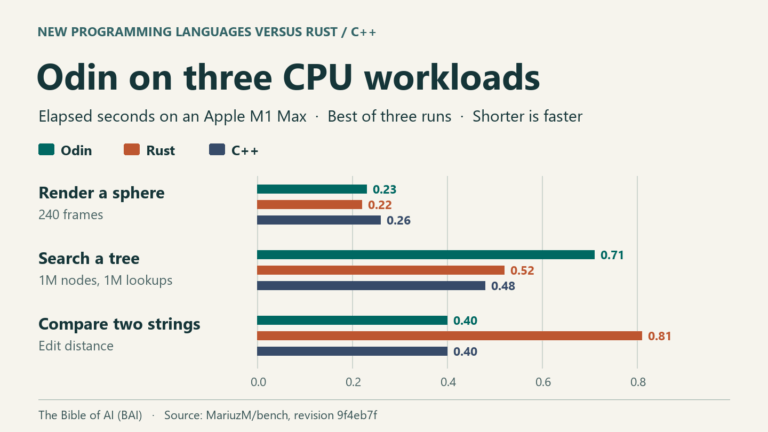
Odin versus Rust and C++ in the making of EmberGen
Read the language profile →: Odin versus Rust and C++ in the making of EmberGenAn artist nudges a plume of smoke and sees it change shape. Ginger Bill created Odin. JangaFX’s technical cofounder, known as “mv”, chose it for EmberGen after building two of its graphics libraries. Three CPU experiments show how Odin compares with Rust and C++ when drawing an image, searching a tree and comparing two strings.
-
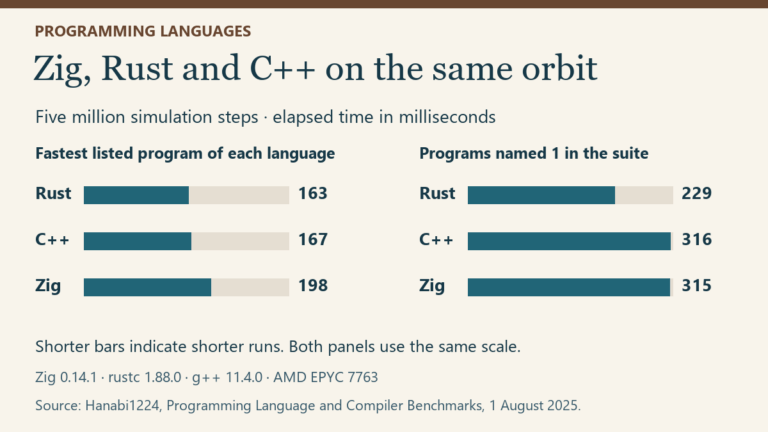
Zig versus Rust and C++: who decides where the memory goes?
Read the language profile →: Zig versus Rust and C++: who decides where the memory goes?Bun chose Zig and later moved to Rust. The team building the Roc compiler went the other way. What did each see that the other could afford to live without? Their accounts, a working terminal and a timed comparison with C++ reveal where Zig gives a team control over memory, and which mistakes the team must catch for itself.
-
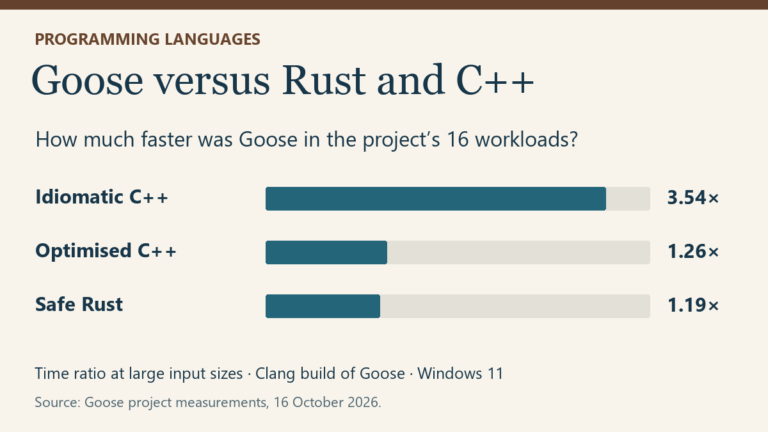
Goose versus Rust and C++: the case for keeping data in place
Read the language profile →: Goose versus Rust and C++: the case for keeping data in placeGoose lets a growing array keep its address and a whole group of objects disappear when their work is done. Wouter van Oortmerssen’s language turns those ideas into measurable savings on some workloads. The gap narrows when Rust and C++ use equally careful layouts. We follow the designer from Amiga compilers to FlatBuffers, examine how Claude Fable helped build Goose, and read the figures behind its strongest claims.