New Programming Languages versus Rust / C++
An artist nudges the source of a plume of smoke and watches it curl in a different direction. In EmberGen, the interval between that gesture and the next image matters. Ginger Bill created Odin in 2016. At JangaFX, the technical cofounder who writes as “mv” chose the language for EmberGen. He had already built two of the libraries that connected Odin to graphics hardware. His account explains that choice. Three CPU experiments let us ask a different question. How do Odin, Rust and C++ perform on the same job?
The creator
Ginger Bill
- First experiment
- The designer tried extending C with a preprocessor. Frustration with that approach and with C++ led to a separate language. Its earliest form resembled Pascal.
- Professional setting
- Handmade Seattle introduces Ginger Bill as the creator of Odin and a physicist at JangaFX. The studio’s technical cofounder, known as “mv”, made the adoption decision for EmberGen.
The project’s history · Conference profile · The adoption decision.
Why JangaFX placed the bet
In a 2022 discussion, JangaFX’s technical cofounder wrote under the name “mv”. With a background in computational fluid dynamics, he had supported Odin almost from the beginning. Before EmberGen, he wrote and maintained odin-glfw and odin-gl, two libraries that let Odin programs open a window and communicate with OpenGL. Their functionality later became part of Odin’s maintained collection of external libraries. He traced his choice of Odin for the studio’s main product to that earlier work. What looked like an unfamiliar language from outside the company was familiar ground for the person building the simulator. The technical cofounder’s account.
There was still a risk. A large C++ team can draw on colleagues, libraries and debuggers accumulated over decades. A small team adopting a young language may have to supply an essential piece itself. In this case it already had. Later, a JangaFX engineer with a C and C++ background reported becoming productive in about a week, with the language designer available to answer questions. The same engineer described difficulties inspecting variables in a debugger in 2022. Both observations belong to that team and that period. The studio’s documented rationale was its engineer’s experience with Odin. A controlled trial of three versions of EmberGen would be separate evidence. An engineer’s production experience.
What the artist sees and what the graphics processor does
EmberGen lets an artist adjust an emitter, force or obstacle and see how a volume of smoke evolves. The studio released the tool in November 2019. EmberGen uses the artist’s graphics processor for simulation and rendering. The host application must still translate an edit into work, manage resources and deliver the result to the screen. Waiting for any one of those stages can spoil the sense of working live. Knowing the language of the host application tells us only part of what determines that delay. Studio history · EmberGen’s simulation and rendering.
The artists working on EVE Online describe a result a player can see. They used EmberGen to shape volumetric clouds, then developed their own compression to fit the exported data into the game. They also shipped lower-resolution textures for graphics cards with less memory. A studio can adopt an Odin-built tool, gain a faster way to author an effect and keep its own technology for presenting that effect to players. Counting every user of EmberGen as a developer writing Odin would confuse two different communities. The EVE Online production account.
What happens to yesterday’s particle positions?
Imagine an array of particles. Each particle has a position, a velocity and a colour. A pass that updates only positions and velocities may gain little from bringing colour data into the processor’s cache. Odin can express a structure of arrays directly. The fields are stored in separate sequences, so a pass can read the ones it needs in order. Rust or C++ can use the same arrangement. The attraction in Odin is that the layout is part of the language and the code can still describe a particle as a unit. Whether the change helps depends on which fields the next pass reads. Odin’s guide to data layout.
Now imagine keeping a view of the old positions while the array grows. In Odin a view carries an address and a length. The team must ensure the underlying storage remains valid. It can reserve space or give short-lived work its own allocator through the procedure’s context. Bounds checks help detect an invalid index. They cannot establish that the memory still belongs to the array. Safe Rust can reject a borrow that would survive a conflicting mutation. In C++, an owning container can release its memory automatically, while a separate pointer can still become invalid when the container reallocates. A team choosing among the three is also deciding which mistakes the compiler will help it catch. Odin’s memory model · Rust borrowing · C++ resource management.
From source to a program that runs
On a desktop, the compiler checks the program’s types, uses LLVM to generate code for the target processor and links the result into an executable or a library. A colleague can run that executable on a compatible system with its required libraries. Odin supplies bindings to established graphics interfaces, so the application can call them directly. The November 2026 release also added Android build and packaging support. A compiler target tells us where programs can be built. EmberGen’s own distribution and graphics requirements determine where the product can run. Build and platform requirements · November release notes · EmberGen requirements.
Three jobs on the same processor
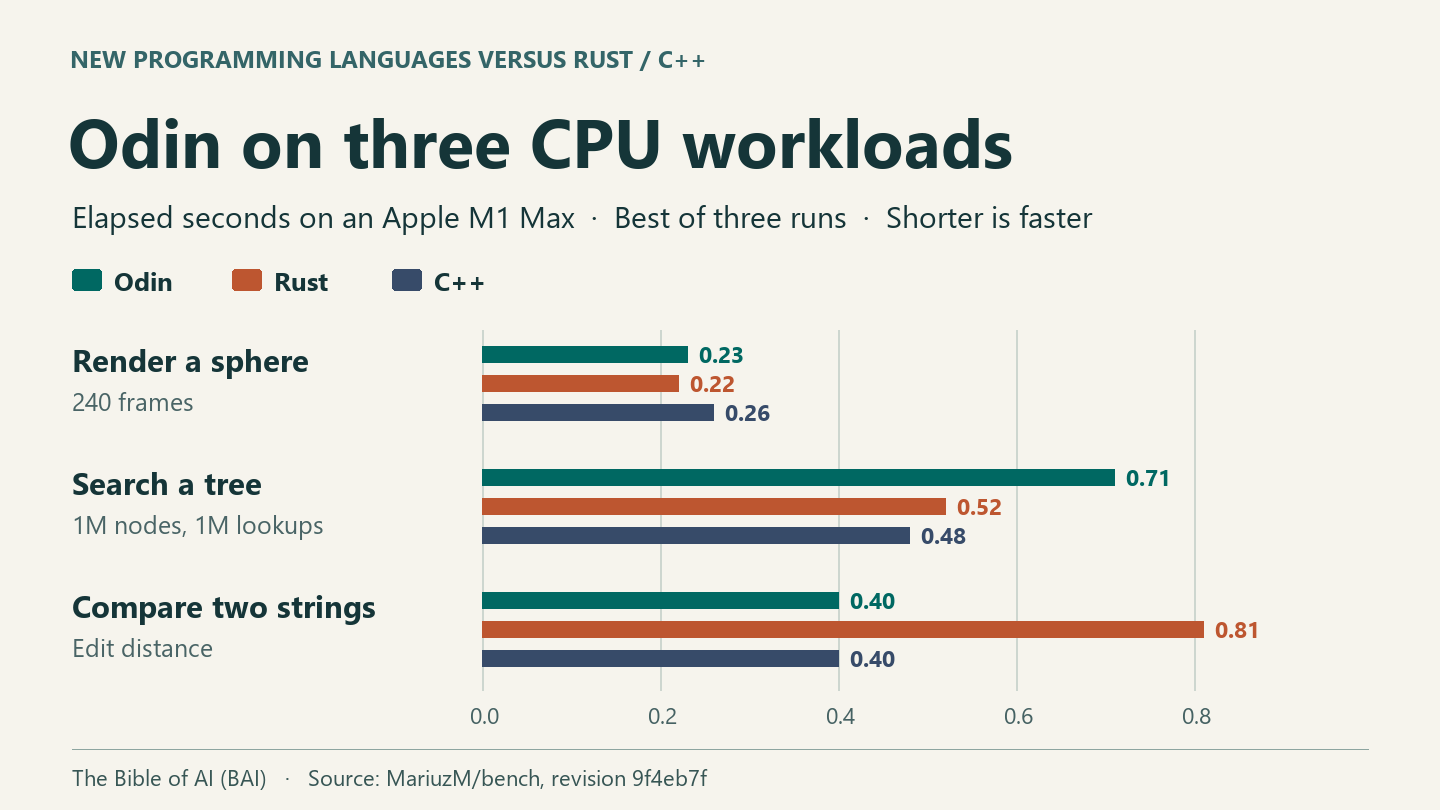
An independent suite ran implementations of the same small tasks on an Apple M1 Max with 64 GB of memory under macOS 15.7.7. The table uses the shortest of three elapsed times. The runner checks that the programs return matching checksums. The builds used Odin dev-2026-08-nightly (512e33e) with speed optimisation, Rust 1.97.1 with optimisation enabled and Apple Clang 17.0.0 for C++17 with high optimisation, native CPU targeting and floating-point contraction disabled. Machine and compilers · Timing and verification method.
| Processor workload | Odin | Rust | C++ |
|---|---|---|---|
| Render a sphere, 240 frames | 0.23 | 0.22 | 0.26 |
| Build and search a tree | 0.71 | 0.52 | 0.48 |
| Compare two 16,000-symbol strings | 0.40 | 0.81 | 0.40 |
The sphere is drawn in software on the CPU. A hundredth of a second separates the Rust and Odin entries over all 240 frames, at the precision reported. The published minima give no distribution from which to decide how repeatable that margin is. The string comparison asks how many edits it takes to turn one sequence into another. Here Odin and C++ both take 0.40 seconds and Rust takes 0.81. A different part of the same suite gives all three 0.26 seconds for a hash table. Each result belongs to a particular program and input. Workloads and complete results.
The tree exposes a difference that a timing table hides. All three programs insert a million keys, then perform a million lookups. Rust owns the nodes in boxes and drops them when the tree goes out of scope. The published C++ and Odin routines leave their individually allocated nodes for the operating system to reclaim when the process ends. Since the timer covers the whole process, the cleanup work differs. The figures are accurate for those programs, but they leave open how much of the gap comes from allocation, traversal or cleanup. Odin program · Rust program · C++ program.
Who else has chosen Odin?
Dihedron Software describes building Blick, its nonlinear video editor, in Odin, with native graphics interfaces on Windows and macOS. The released game CAT & ONION provides a second example outside JangaFX. These projects document adoption by developers outside the company that makes EmberGen. They also give a more concrete picture of its following than a popularity count would. A video editor, a game and a simulation tool establish adoption in creative software. They leave adoption across the wider industry an open question. Blick’s project account · Released games using Odin.
The compiler, libraries and issue history are public. The project lists community sponsorship, and JangaFX employed the designer during the period documented by the conference. For a team maintaining an application, the release notes are worth reading alongside those signs of support. The November edition calls out breaking changes. On AI assistance, the designer has publicly asked documentation contributors to explain work they understand and has criticised low-quality language-model output. That exchange concerns documentation. The materials reviewed here give no basis for estimating how much, if any, of the compiler or EmberGen was written with AI assistance. Public development · Project support · Release notes · Documentation discussion.
The measurement an artist would recognise
The strongest case for Odin in EmberGen is the continuity between the people, the graphics libraries and the tool they shipped. For a studio considering the same choice, the decisive experiment would start with a scene and an edit an artist makes a hundred times a day. Keep the graphics card, shader, resolution and output quality fixed. Measure the time from moving a control to seeing the updated smoke, including the slowest frames, and record CPU preparation and GPU execution separately. That experiment could tell a studio whether changing the host language would give its artists time back. The published CPU results and EmberGen’s production history answer different parts of that question.
Liked this post? Follow this blog to get more.