A camera watches a sunlit doorway for an hour. For most of that hour the frame, the floor and the far wall stay as they were. Then a dark coat crosses the threshold. How much computing does it take to notice that one crossing, and how much electricity does the camera spend waiting for it?
An event camera gives a chip a different kind of input. Each pixel can signal when its view grows brighter or darker. A spiking processor can use those signals to update the parts of a network connected to the change. Experiments with Speck and Intel’s Loihi 2 show where this can save energy in machine vision. They also show why an engineer choosing a processor needs to know how often the scene changes and how costly a missed detection would be. [2] [3] [4]
From the edge of a coat to a decision
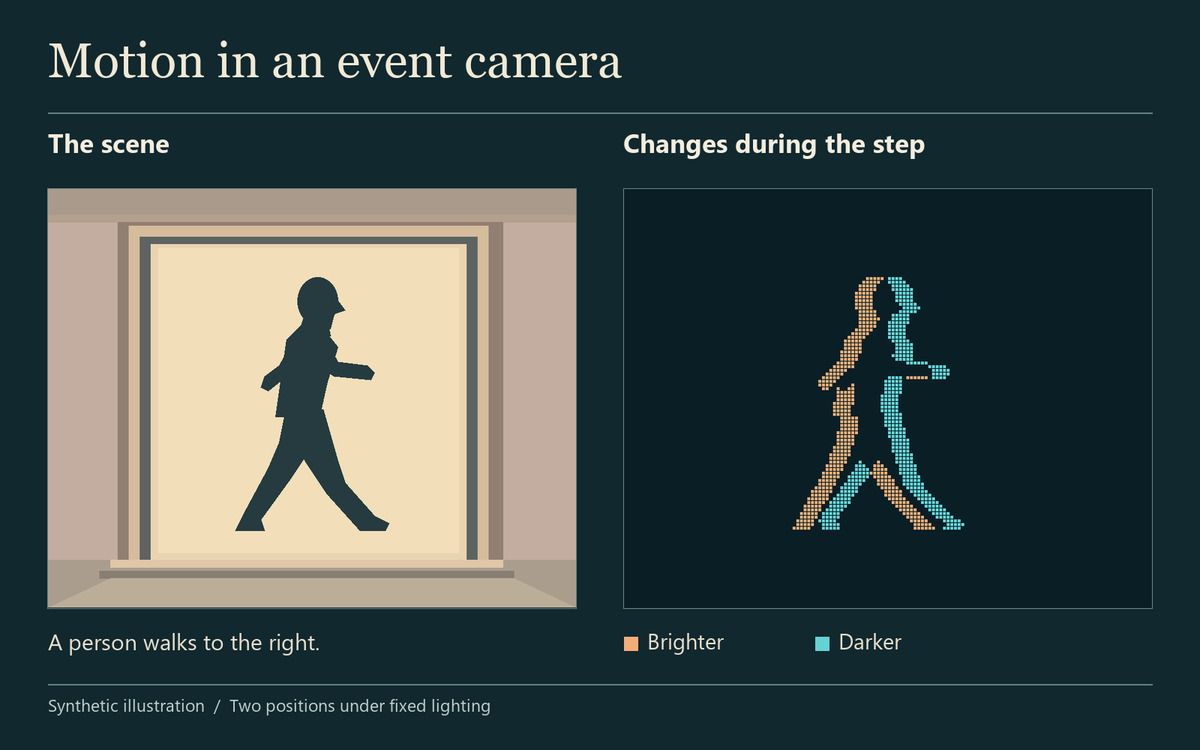
Take one pixel just ahead of the coat. A moment ago it looked at the bright wall. As the coat covers it, the local light level falls. Once the change in log intensity crosses a threshold, the sensor reports the pixel’s position, the time and the sign of the change. At the trailing edge, the wall comes back into view and the sign reverses. Under steady light the doorframe contributes little traffic. A flickering lamp or a shaking camera can make much of the same scene generate events at once. [2]
Inside a spiking network, an arriving signal changes the state of the artificial neurons it reaches, according to the weights of their connections. A neuron can retain evidence from earlier events and emit a spike when its accumulated state crosses a threshold. Later layers can combine many such signals into a decision about a gesture or an object. The threshold at the pixel describes a change in light. The threshold inside the network acts on learned evidence. A single brightening pixel cannot identify a person. [2] [3]
Carver Mead’s 1990 paper explored how electronic circuits could exploit physical principles also used in biological information processing. Today, digital chips can implement spiking networks too. Our article on resistive memory followed the energy cost of moving weights to an arithmetic unit. Here the saving can come a step earlier, when an unchanged part of a scene triggers little work in the first place. Speck, for example, uses on-chip static RAM. [1] [3]
Speck measures the price of waiting
Speck integrates a vision sensor and a spiking processor on the same die. At a supply voltage of 1.2 V, its designers report typical resting power of 0.42 mW for the processor and 0.15 mW for the vision sensor. For their DVS128 Gesture test they replayed recorded events into the processor. With the baseline network they report 9.5 mW and 81% classification accuracy. With a network trained to filter part of the input, the figures were 3.8 mW and 90%. Table 1 reports processor power. The live camera was outside that measurement, and the authors sampled 100 recordings per dataset for the power and latency evaluation. [3]
One attractive figure deserves a closer look. The reported gesture latency of less than 0.1 ms starts at the last input event and ends when the result appears. A person still needs time to perform enough of a gesture for the classifier to recognise it. A doorway alarm would start its clock when the person first crossed the threshold. [3]
Loihi 2 faces a different test
A 2026 object-detection study compared spiking models on a single Loihi 2 chip with conventional neural networks on other processors. Its tunnel-inspection experiment offers a particularly clear comparison. The two Model-2 implementations examined the same defect-detection task. The authors distinguished the extra energy drawn during inference from their platform estimate including baseline consumption. [4]
| Measure | Loihi 2 | Jetson Orin Nano |
|---|---|---|
| Dynamic energy per inference | 6.2 mJ | 12.03 mJ |
| Total energy per inference | 20.5 mJ | 32.41 mJ |
| Samples per second | 122 | 208 |
| Detection score ([email protected]) | 0.82 | 0.87 |
Loihi 2 used less energy per inference. The Orin processed more samples in a second and scored higher for detection. The score averages precision across classes with a predicted box counted as a match when its overlap with the reference box reaches the specified threshold. These are operating points for two trained implementations with different task quality. A factory that needs the higher detection score would have to repeat the comparison at its acceptance threshold. The tunnel figures also concern a different task and measuring setup from the gesture experiment. [4]
The hour that matters to an AI device
Engineers can already work with a Speck development kit. At a larger scale, Intel built Hala Point using Loihi 2 processors for research at Sandia National Laboratories. These systems address different questions. The kit can follow a stream from a live sensor. The larger installation allows researchers to study how spiking networks behave as they grow. Neither benchmark above measured a complete doorway detector over a working day. [3] [4] [6] [7]
To test the doorway, give an event-driven device and a well-tuned conventional camera system the same field of view, lighting and response deadline. Label the crossings independently. Include an empty corridor, a busy interval, a person moving slowly and a period of flickering light. Meter the supply to each complete device, including sensing, preprocessing and the decision output. Count timely detections, missed crossings and false alarms alongside joules per hour. Report the energy again at matched detection quality. The NeuroBench framework makes the same broader point about evaluating hardware together with the task it performs. [5]
What the chip does between events is part of its performance. A long quiet interval rewards a low resting draw. A busy interval tests how much work each event sets in motion and whether the device can keep up. The case for neuromorphic vision is strongest where the whole detector spends less energy waiting and still recognises the change that matters in time.
Sources and scope
Evidence reviewed on 16 November 2026. The gesture and tunnel measurements come from separate experiments. The doorway figure, the one-hour calculation and the proposed field test illustrate how to interpret those results.
- Mead, C. (1990). Neuromorphic electronic systems. Proceedings of the IEEE, 78, 1629–1636. The original argument for using circuit physics to represent biological computation.
- Lichtsteiner, P., Posch, C. & Delbruck, T. (2008). A 128 × 128 120 dB 15 μs latency asynchronous temporal contrast vision sensor. IEEE Journal of Solid-State Circuits, 43, 566–576. Pixel operation and the representation of brightness changes.
- Yao, M., Richter, O., Zhao, G. et al. (2024). Spike-based dynamic computing with asynchronous sensing-computing neuromorphic chip. Nature Communications, 15, 4464. Table 1 and the chip evaluation methods define the power boundary and the latency interval.
- Gamage, U. G. W. K. N. et al. (2026). Real-time frame- and event-based object detection with spiking neural networks on edge neuromorphic hardware. Neurocomputing, article 133820. Open manuscript, §§6.3–6.6 and Table 7.
- Yik, J., Van den Berghe, K., den Blanken, D. et al. (2025). The neurobench framework for benchmarking neuromorphic computing algorithms and systems. Nature Communications, 16, 1545. System benchmarks connect task quality to hardware measurements.
- SynSense. Speck development kit manual. Documentation for working with the integrated event sensor and spiking processor.
- Intel (17 April 2024). Hala Point neuromorphic research system. The announcement identifies the Loihi 2 platform and its research deployment at Sandia.
Liked this post? Follow this blog to get more.