TheSociety

https://editorialia.com/wp-content/uploads/2020/06/covid-19-and-contact-tracing-.jpg

Covid-19 and contact tracing apps

Multi-presenter format with exciting Speakers from the current European ICT research projects AI4EU (www.ai4eu.eu) and Helios (helios-social.com/) as well as Guest Speakers.

https://editorialia.com/wp-content/uploads/2020/05/techdispatch-1_2020_-contact-tracing-with-mobile-applications-2.jpg

TechDispatch #1/2020: Contact Tracing with Mobile Applications

In public health, contact tracing is the process to identify individuals who have been in contact with infected persons. Proximity tracing with smartphone applications and sensors could support contact tracing. It involves processing of sensitive personal data.

https://editorialia.com/wp-content/uploads/2020/05/a-socio-technical-framework-for-digital-contact-tracing-2.jpg

A socio-technical framework for digital contact tracing

In their efforts to tackle the COVID-19 crisis, decision makers are considering the development and use of smartphone applications for contact tracing. Even though these applications differ in technology and methods, there is an increasing concern about their implications for privacy and human rights. Here we propose a framework to evaluate their suitability in terms of impact on the users, employed technology and governance methods.

https://editorialia.com/wp-content/uploads/2020/05/european-data-supervisor-2019-1.jpg

The European Data Protection Supervisor, 2019 Annual Report a year of transition

With new legislation on data protection in the EU now in place, our greatest challenge moving into 2020 is to ensure that this legislation produces the promised results. This includes ensuring that new rules on ePrivacy remain firmly on the EU agenda. Awareness of the issues surrounding data protection and privacy and the importance of rotecting these fundamental rights is at an all time high and we cannot allow this momentum to decline.

https://editorialia.com/wp-content/uploads/2020/06/artificial-intelligence-in-society.jpg

Artificial Intelligence in Society

“The artificial intelligence (AI) landscape has evolved significantly from 1950 when Alan Turing first posed the question of whether machines can think. Today, AI is transforming societies and economies. It promises to generate productivity gains, improve well-being and help address global challenges, such as climate change, resource scarcity and health crises. Yet, as AI applications are adopted around the world, their use can raise questions and challenges related to human values, fairness, human determination, privacy, safety and accountability, among others. This report helps build a shared understanding of AI in the present and near-term by mapping the AI technical, economic, use case and policy landscape and identifying major public policy considerations. It is also intended to help co-ordination and consistency with discussions in other national and international fora”. (OECD)

https://editorialia.com/wp-content/uploads/2020/02/image-11.png

A European strategy for data

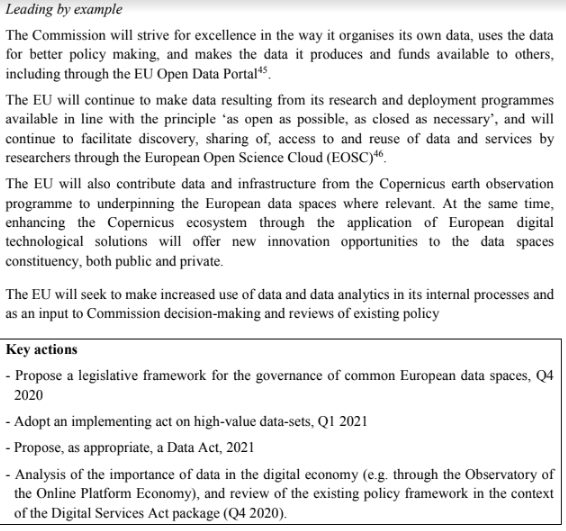
The EU can become a leading role model for a society empowered by data to make better decisions -in business and the public sector. To fulfil this ambition, the EU can build on a strong legal framework – in terms of data protection, fundamental rights, safety and cybersecurity and its internal market with competitive companies of all sizes and varied industrial base.
In the period 2021-2027, the Commission will invest in a High Impact Project on European data spaces and federated cloud infrastructures.

WHITE PAPER On Artificial Intelligence – A European approach to excellence and trust

The purpose of this White Paper is to set out policy options on how to achieve these objectives. It does not address the development and use of AI for military purposes.The Commission invites Member States, other European institutions, and all stakeholders, including industry, social partners, civil society organisations, researchers, the public in general and any interested party, to react to the options and to contribute to the Commission’s future decision-making in this domain.