A piece breaks off a stone decree. What disappears with it could be a routine greeting, the name of the official who proposed the measure, or the one word that tells us who had to pay. A reader of ancient Greek can understand every surviving letter and still have good reasons for supplying two different words. How could anyone tell whether a computer had helped that reader make a better choice?
The team behind Ithaca found a way to put the question to a test. They could take inscriptions for which an edition already recorded the text, hide a run of characters and keep the answer for comparison. For once, the broken edge had a witness. That simple difference between a test inscription and a genuinely broken one matters more than any single percentage in the resulting study in Nature.
What the stone still tells us
Imagine a line near the top of a public decree. The surviving words may suggest that the missing name belongs to an official. The space available limits how many letters the name could have. Another decree from the same city might use the same formula. An epigrapher brings those clues together and records the proposed restoration in brackets. Those brackets tell the next reader something essential about the evidence. A photograph might settle a disagreement about a surviving stroke. It cannot show a stroke that has broken away.
Ithaca learned from transcriptions of ancient Greek inscriptions. It offers possible completions and can also suggest a region and a date. A model can compare recurring combinations across a body of writing far larger than one person could keep in mind. Its input also carries earlier scholars’ choices about what they saw, how they transcribed it and how they dated it. An apparently excellent match may repeat a convention that an editor needs to question.
What counted as a correct restoration?
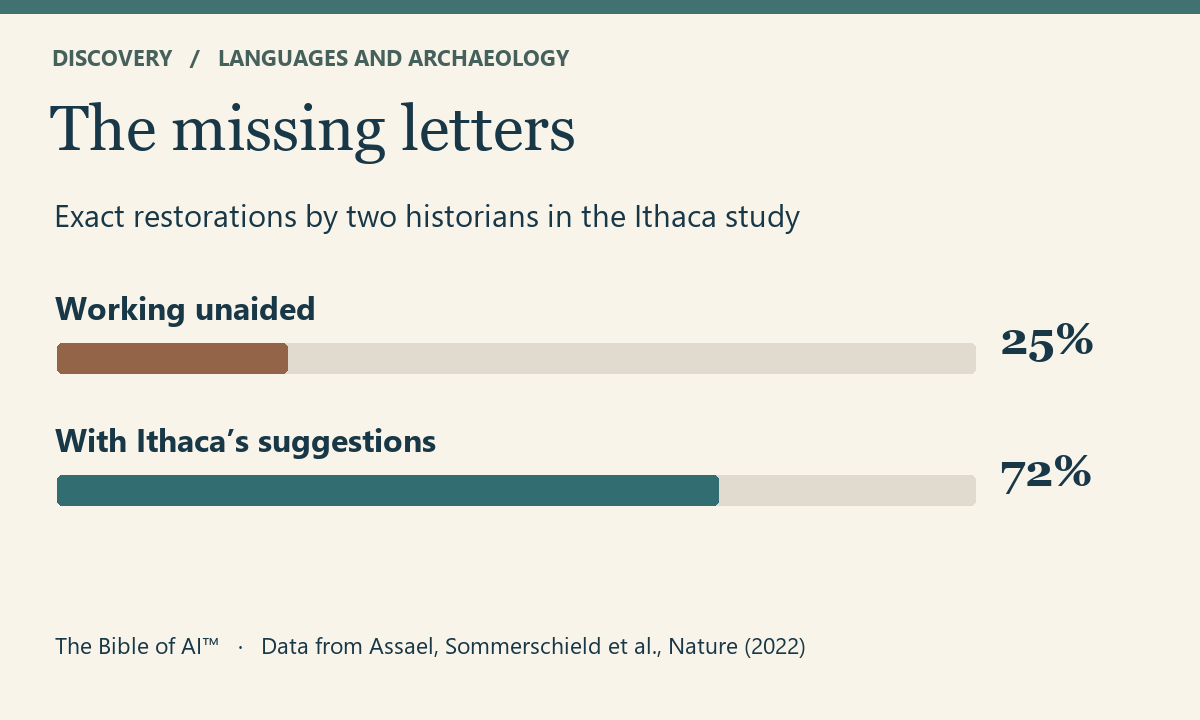
Two graduate researchers specialising in Greek history and inscriptions could look up parallel expressions in a collection of texts. Their score for restoring every missing character was 25.3%. When they could also consult Ithaca’s twenty highest-ranked suggestions, it rose to 71.7%. Each gap length, from one to ten characters, carried equal weight in those scores. The model scored 61.8% on the wider test set. The comparison with the two readers tells us what the suggestions contributed in this experiment. A new inscription offers no such answer sheet.
A familiar name illustrates the danger. If two public officials had names differing by one letter, the more frequently attested one might be the model’s first suggestion. The less frequent official might still be the one whose career fits the decree. A good edition would let a reader inspect both the rival readings and the reason for preferring one. The Oxford team’s account explains why the researchers put collaboration at the centre of the experiment.
Ancient Greek was already readable. The achievement here is subtler, and useful every time a stone reaches us damaged. Ithaca gives a scholar more readings worth investigating. The published argument still has to lead back to this stone, its surviving letters and the historical setting in which someone chose to carve them.
Liked this post? Follow this blog to get more.