Barley is coming up in the fields outside Babylon. That much a reader can make out in line 120 of an ancient hymn. But what has happened to the meadows? The answer turns on the shape of a cuneiform sign impressed in a clay tablet from Sippar. Other copies preserve other parts of the poem. For this word, the editors had to look closely at a single surviving witness.
The hymn was written in Akkadian and praised Babylon, its god Marduk and the people of the city. It survived in pieces scattered across museum collections. A digital library helped scholars recognise passages from the same work. Their critical edition in Iraq estimates that about two-thirds of a poem perhaps 250 lines long can now be read, at least in part. The passage about the spring brought by the Euphrates is among them.
Which pieces belong together?
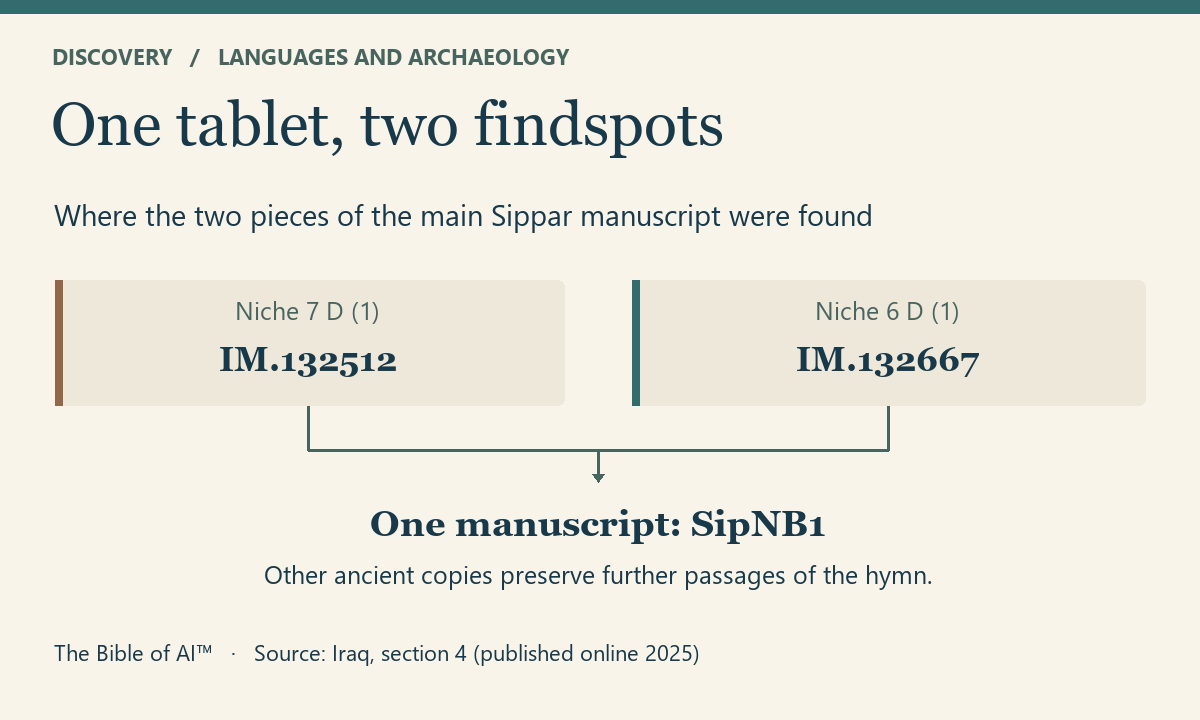
The excavation record puts fragment IM.132512 in one niche of the library at Sippar and IM.132667 in another. They fit together. A scholar could identify those pieces as parts of one object even without knowing the poem’s title. A different sort of discovery becomes possible when a scribe has copied a poem onto a second tablet. The edges need never meet. A few words shared by both copies can reveal that one continues beyond the point where the other breaks off.
A scholar might recognise an overlap from memory or find it in a printed concordance. The electronic Babylonian Library makes another kind of search possible. Specialists have entered transliterations, writing the signs in a standard notation that can be searched across museum collections. The university’s account credits its AI-assisted platform with helping the team find further copies of the hymn. A separate study of fragment matching explains one way such searches work. Short strings of characters that recur in two transcriptions can bring a promising pair to the top of a list, even when parts of the text are missing. An expression used in many hymns could also turn up a match. The surrounding lines are what make a candidate worth keeping.
What did the meadows look like?
Return to line 120. In the Sippar copy the disputed sign looks more like šu than ku. A written n in the same word offers a second clue. Together they led the editors to read šunmurā, giving a picture of meadows made radiant as the barley sprouts. Their commentary records the alternative reading, kunmurā. Readers can compare the passage in the digital edition of the hymn. The difference between those readings comes down to marks that can still be examined on the clay.
Some of the surviving copies are school exercises. Their scribes preserved evidence about the poem that its verses alone could never supply. The poem praises the respect shown to foreign priests who lived in Babylon. What a city said about itself in a hymn is one kind of evidence. What someone chose to copy on a school tablet is another. Those exercises show that the city’s portrait of itself once had readers in the classroom.
Liked this post? Follow this blog to get more.