A hand closes around a hollow eggshell. Before lifting it, the person has to judge whether the fingers have made contact. As the grip tightens, the person must also judge how much force the shell will bear. A sensor can help with either task. What matters is where its signal goes and who can act on it.
A bidirectional brain–computer interface carries information both ways. A decoder translates recorded brain activity into a movement command. Sensors on a robotic hand or a hand orthosis can send information about contact back to the user through stimulation of the sensory cortex. A controller can also use a sensor reading to adjust grip force automatically. Six human studies help trace the contributions of perception, movement and automatic assistance.
What does contact feel like?
For a tactile signal to guide action, the person must be able to interpret it. In a 2016 study, a participant with a spinal cord injury felt sensations in particular parts of the hand when researchers stimulated the corresponding region of the somatosensory cortex. Some sensations felt like pressure. Their perceived intensity changed with stimulation amplitude. The participant’s reports showed that the signal could convey where contact occurred and how strong it felt. A separate experiment was needed to establish whether that information could change a grasp. [1]
A later study asked what spatial detail the signal could carry. Two participants distinguished the orientation of edges evoked on their fingers. Accuracy varied across fingers, and similar shapes could be confused. This matters when an object is beginning to tilt. Knowing that a fingertip is touching something provides one cue. Knowing the orientation of the contact could help the person decide which way to move. Whether that cue prevents a particular object from slipping is a question for a manipulation task. [2]
From first contact to lifting an object
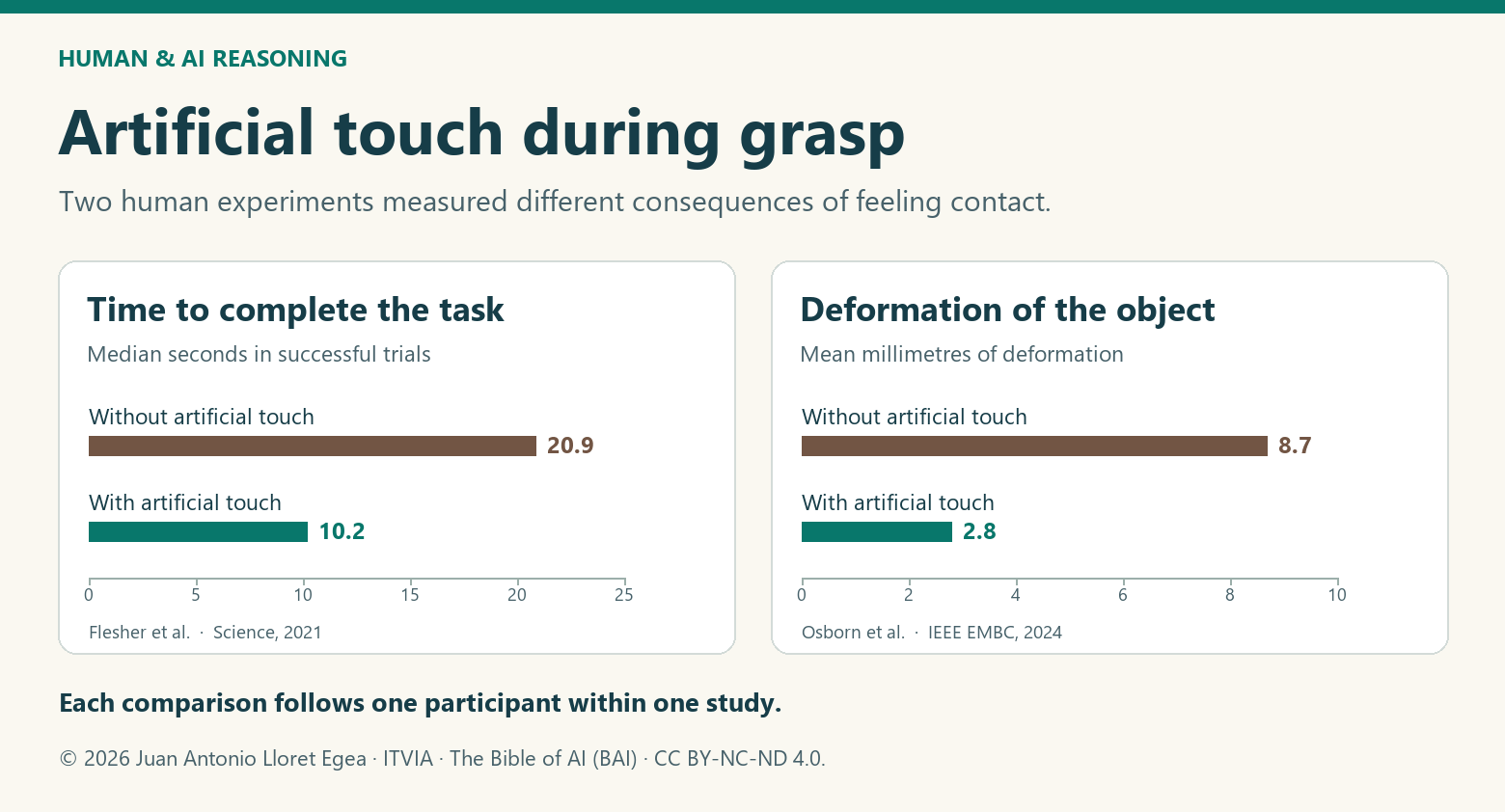
In an experiment with a brain-controlled robotic arm, a participant with tetraplegia could see the arm and the object. The researchers added a tactile signal on some trials. Among trials completed successfully, the median time fell from 20.9 seconds with vision alone to 10.2 seconds with vision and artificial touch. Most of the time gained was between first contact and lifting the object. The participant could already reach the object under visual guidance. The added information was particularly useful when deciding whether the grip was secure enough to lift. [3]
Speed answers only part of the question. A fast grasp can damage a delicate object. In a separate study, a participant using a robotic hand tried to grasp a deformable object without crushing it. Mean deformation was 8.7 millimetres without cortical force feedback and 2.8 millimetres with it. Here the object itself provided a measure of how the grasp changed. The two experiments used different tasks, so their results are best read in their original units. [4]
Who controlled the force on the eggshell?
A 2026 study examined grip force and contact detection in separate experiments. A participant with tetraplegia used an orthosis fitted to his own hand. A neural decoder detected his intention to grasp. A controller trained by reinforcement learning could then adjust the orthosis to keep the applied force within the prescribed limit. During the force-control test, the participant could see a live force trace while the hand and eggshell were hidden from view. Across five sessions per condition, mean success was 87% with the automatic regulator active and 27% with it inactive. This comparison measures the contribution of the regulator. [5]
In another test, the regulator remained available and the participant had to decide whether an eggshell was actually in his grasp before lifting his arm. With vision occluded, his decisions were correct on every trial with cortical feedback and at chance level without it. Here the tactile signal informed the person’s decision to lift. The two experiments give distinct meanings to the everyday expression holding an egg successfully. [5]
How long does the signal remain available?
Five people with spinal cord injury took part in a study of implanted sensory arrays over periods ranging from two to ten years. In the participant followed for a decade, 60% of the electrodes could still evoke tactile sensations at the ten-year assessment. The investigators also recorded occasional sensations that briefly outlasted stimulation. That percentage describes electrodes in one person. Establishing how often someone can use those sensations to handle objects independently at home requires different observations, including how much help is needed to set up the equipment. [6]
What would establish shared control?
Consider an unfamiliar object whose stiffness the user cannot judge by sight. A useful experiment would vary the availability of the contact signal and the automatic regulation of force independently. Keeping the object, visual information and opportunities for practice comparable would allow four conditions to be tested. Recording contact judgements, excessive force, damage and time to lift would reveal where either contribution makes a difference. Failed attempts would matter just as much as successful ones.
This proposed test follows from a limit of the present evidence. Several studies report repeated trials in one person. Those trials can reveal a reliable change within a task, while the size of the benefit for another person or another device remains an open question. The evidence is most informative when it identifies which part of the grasp changed. The user might feel contact sooner, judge more confidently when to lift, or rely on the controller to ease the pressure before the shell breaks.
Selective review of six primary studies published between 2016 and 2026. Evidence reviewed on 17 November 2026. The four-condition comparison above is proposed as a future experiment.
References
- Flesher, S. N., et al. (2016). Intracortical microstimulation of human somatosensory cortex. Science Translational Medicine.
- Valle, G., et al. (2025). Tactile edges and motion via patterned microstimulation of the human somatosensory cortex. Science.
- Flesher, S. N., et al. (2021). A brain-computer interface that evokes tactile sensations improves robotic arm control. Science.
- Osborn, L. E., et al. (2024). Artificial touch feedback using microstimulation of human somatosensory cortex to convey grip force from a robotic hand. 46th Annual International Conference of the IEEE Engineering in Medicine and Biology Society.
- Chandrasekaran, S., et al. (2026). A neuroprosthesis for restoring hand movement and sensation in a person with complete tetraplegia. Nature Medicine.
- Greenspon, C. M., et al. (2026). Long-term safety and efficacy of intracortical microstimulation in humans. Science Translational Medicine.
Liked this post? Follow this blog to get more.