A language model is halfway through answering a question. The accelerator working on the next word needs a calculation from an expert stored on another chip. Until that result returns, the model cannot finish this step. How much sooner would the answer appear if the link between the chips were faster?
Huawei’s Atlas 960E brings that question into the design of the computer itself. Its optical links carry the numbers that accelerators exchange, and its UnifiedBus lets them address memory across physical nodes. Huawei has announced the system for its Ascend 960 family and expects the Ascend 960DT accelerator in the first quarter of 2027. An earlier machine, CloudMatrix384, offers a way to understand which benefits a reader should look for when the new hardware is tested. [1] [2] [3]
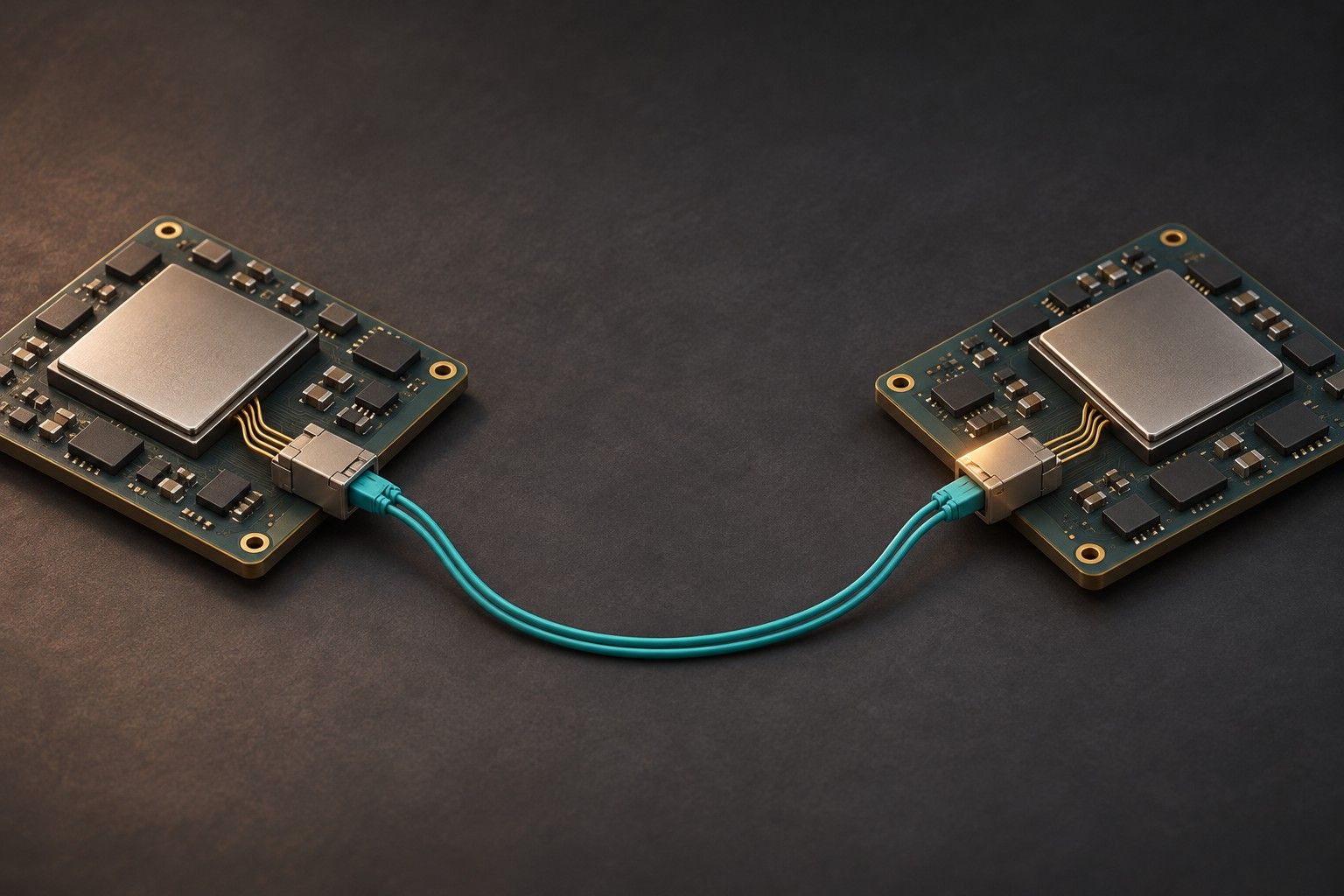
What travels to a remote expert?
A token is a unit of text. By the time it reaches an expert inside a mixture-of-experts model, it is represented by a vector of numbers. A router chooses which experts should process that vector. If an expert is on another accelerator, the system sends the vector there, applies the expert’s learned weights locally and returns its contribution. The model combines the contributions before continuing. Keeping the expert’s weights in place makes it possible to distribute a model across many chips. It also makes timely delivery of these much smaller messages essential. [3]
The traffic changes with the text. Several requests can select the same expert at once, leaving one destination busy while others have spare capacity. A wider link helps when messages are queuing for transmission. It does less for a token waiting behind a long queue of calculations at the expert. Scheduling matters, too. For DeepSeek-V3 training, the developers arranged independent calculations to run while other data were in transit. Only the part of the transfer that still holds up the next calculation directly adds to elapsed time. [3] [4]
From an electrical trace to a fibre
At the sending end, an electrical signal reaches an optical engine, which encodes the data on light. The receiving end converts it back to an electrical signal. With near-packaged optics, Huawei places the Hi-ONE optical engine close to the electronics. Shortening the high-speed electrical path gives the signal less distance over which to degrade before conversion. Light carries the message across the optical span. The receiving accelerator performs the expert’s arithmetic. That division of labour complements the earlier Horizons article on performing calculations with light. [1] [2]
UnifiedBus answers a different question: how does one processor refer to data held by another? A common address space lets software identify memory across nodes. Its physical location still matters. A remote read has to traverse the interconnect, and simultaneous requests can contend for the same path. Huawei specifies up to 4,096 neural processing units in one Atlas 960E SuperPoD. Its separate figure of up to one million NPUs refers to a SuperCluster linking multiple systems. Both figures describe the scale of the announced designs. Token latency has to be measured under load. [1] [2]
One model, two different experiences of speed
In 2025 the CloudMatrix-Infer team published decoding measurements for DeepSeek-R1 on CloudMatrix384, a system built with Ascend 910 accelerators. Its serving software used INT8 quantization, including for expert dispatch, to reduce the amount of data transmitted. The following rows use the same prompt length of 4,096 tokens and output length of 256 tokens. The team varied the batch size to meet different latency targets. Decoding is the stage that generates the answer after the prompt has been processed. [3]
| Batch size | Time per output token | Output tokens/s per NPU |
|---|---|---|
| 96 | 49.4 ms | 1,943 |
| 24 | 24.6 ms | 974 |
| 8 | 14.9 ms | 538 |
At the smallest batch, a person following the answer would see successive tokens arrive sooner. At the largest batch, the same accelerator generated more tokens each second across the requests it served. Both readings of “faster” are valid. Each answers a different question. These are measurements by the team that built the serving system. The batching policy, numerical precision, memory and communication software all contributed. The experiment did not vary the optical link, and it ran on the earlier CloudMatrix384. [3]
What would count as a gain on the Atlas 960E?
Start with a service that promises a maximum wait for the first token and a maximum interval between later tokens. Run the same model, at the same output quality, on the same mix of requests. Then increase the accelerator count and record how many requests the system completes within both limits. A breakdown of time spent waiting for expert messages would show whether communication was the obstacle. To isolate the optical engine’s contribution, a comparison would also have to hold the rest of the system constant or measure the competing links under equivalent traffic.
Energy poses a second test. Divide the electricity used over the run by the useful output tokens delivered under those service limits. State whether the meter covers the nodes, switches, optical engines and cooling. A link can consume less energy for each bit it moves while the whole installation draws more power to serve more people. The useful result for AI is the amount of work completed at the promised response time for each joule spent.
A faster link makes a model faster when the next required calculation is waiting on data that the link can deliver sooner. The Atlas 960E gives Huawei a way to shorten that wait. The remaining question is how often it occurs in a real workload and whether removing it improves the experience of an individual user, the capacity of the service, or both.
Sources and scope
Evidence checked on 17 November 2026. Huawei’s announcements describe the proposed system and availability. The decoding figures come from an earlier platform. We found no independent workload measurement for the Ascend 960DT on Atlas 960E that establishes a latency or energy advantage.
- Huawei. Advancing the Agentic World, Building a Solid Silicon Foundation. HUAWEI CONNECT, 17 September 2026. Product schedule, Hi-ONE and the distinction between SuperPoD and SuperCluster. Read the announcement.
- Huawei. Huawei Launches the World’s First NPO-based SuperPoD – the Atlas 960E SuperPoD. HUAWEI CONNECT, September 2026. Manufacturer’s description of unified memory addressing and the configuration of one supernode. Read the system description.
- Zuo, P., et al. Serving Large Language Models on Huawei CloudMatrix384. arXiv:2506.12708, v3, 2025. Expert dispatch and combination, serving configuration and Table 4 on decoding latency and throughput. Read the study and data.
- DeepSeek-AI. DeepSeek-V3 Technical Report. arXiv:2412.19437, v2, 2025. Section 3.2 and Figure 4 on overlapping computation and communication during training. Read the technical report.
Liked this post? Follow this blog to get more.