A hieroglyph printed in a modern book can look different from the same sign copied by hand or cut into stone. For a computer, the difficulty begins before any question of meaning: where does one sign end, which way should the line be read, and which entry in a sign list does the image represent?
Research on Egyptian hieroglyph recognition addresses this material diversity. Its immediate contribution is to turn images into records that specialists can check, compare and search. Ancient Egyptian already has a scholarly tradition of reading and interpretation; these systems assist that work at the level of the visible signs.
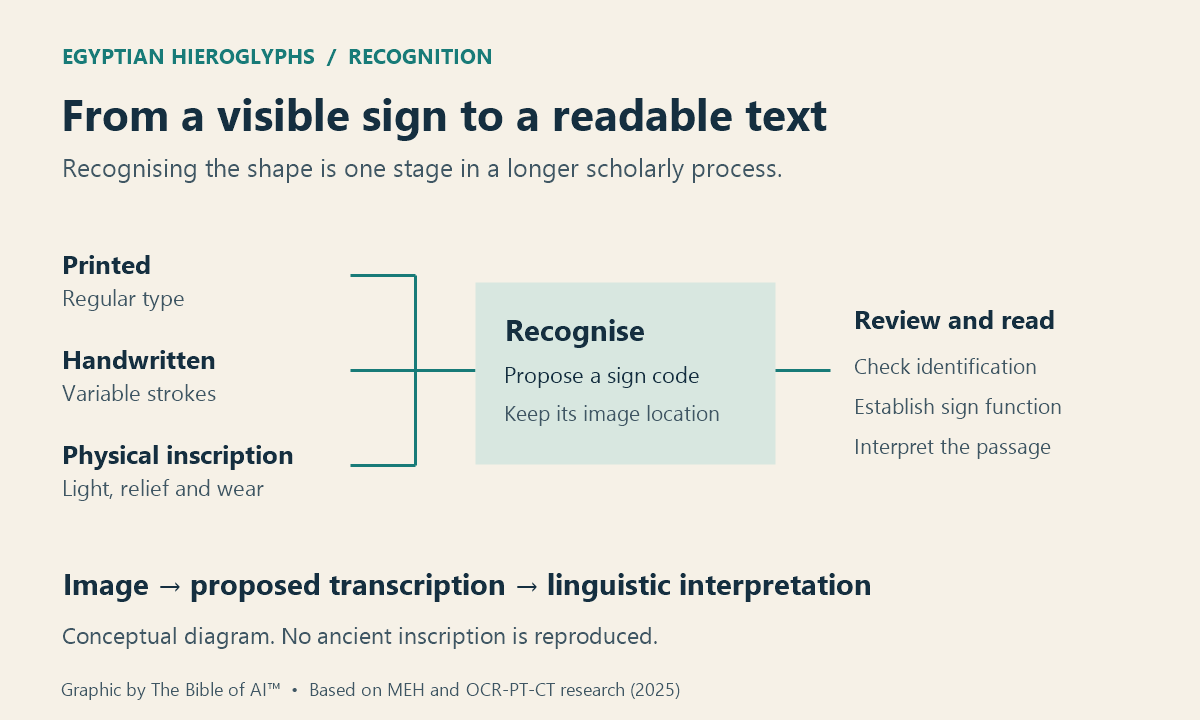
One sign inventory, several appearances
The MEH study, published at ICCV 2025, brings together printed, handwritten and physical inscriptions. These categories pose different problems: orderly type, variable pen strokes, or surfaces affected by erosion and lighting. The paper describes 40 source images containing 12,744 annotated sign instances across 639 sign codes. Those are counts of examples and categories, not a claim that a machine can translate 639 words.
Reference annotations required manual work and specialist review. The research also uses synthetic images to expose recognition models to varied appearances. A useful test asks whether a model can recognise signs in a style different from the examples used to train it. Success on familiar typography alone would tell us little about an unfamiliar photographed inscription.
The current dataset documentation provides boxes around lines and individual signs, reading directions and sign codes. Such annotations preserve a crucial connection: a proposed identification can be checked against its location in the image.
What remains after a sign has a code?
Hieroglyphs are more than pictures of objects. As the Metropolitan Museum of Art’s guide explains, signs can represent sounds, while unpronounced determinatives help indicate meaning. A recognised outline therefore does not supply its linguistic function automatically. Reading order, neighbouring signs and grammar still matter before a sequence becomes a defensible translation.
A separate project shows how recognition can enter that scholarly process. The OCR-PT-CT preprint, submitted in December 2025, works with images from published editions of the Coffin Texts and Middle Kingdom copies of the Pyramid Texts. It extracts sign candidates, proposes codes and organises results by spell and textual witness. A witness here means a particular surviving copy, such as the version preserved on a coffin.
Its metric-learning approach compares visual representations of signs with known examples, addressing the difficulty posed by rare categories. Egyptologists review the resulting transcriptions before they are linked with the wider corpus’s transliterations and translations. The recognition model is not itself the source of those translations, and results on these editions do not establish equivalent performance on weathered temple walls.
The historical opportunity lies in comparison: reliable, traceable transcriptions can make it easier to investigate how different copies preserve or vary a passage. Each accepted identification remains attached to an image and open to correction. That is how the recognition of small marks can support larger questions about the transmission of Egyptian texts.
Liked this post? Follow this blog to get more.