Writing software is only one part of making it dependable. Someone must understand what a proposed change does, check its consequences and take responsibility for the result. AI assistance can alter that balance, but faster production does not automatically mean better jobs. The evidence raises a more precise question: when generating work becomes easier, who gains time, who acquires expertise, and who carries the burden of verification?

Sector profile
This article examines software development and maintenance. Its economic context uses two related service industries, rather than counting everyone who writes software. Developers employed within banking, manufacturing or other industries are outside these industry totals.
European Union
Computer programming, consultancy and related activities — NACE Rev. 2 J62, EU-27.
Eurostat records 1,027,378 enterprises and estimated turnover of €940 billion in 2024. Employment is withheld as confidential in the queried aggregate; it is not zero. [1]
United States
Computer systems design and related services — NAICS 54151, private industry.
In 2025, QCEW records annual averages of 2,393,049 covered jobs and 419,484 establishments. Average annual pay was US$176,274 across the industry’s occupations. [2]
These boundaries, years and units differ. Enterprises are not establishments; industry pay is not the median salary of a developer. The US category includes programming and related services but excludes software publishing. These figures describe context, not an effect of AI. [3]
What changes in the work?
Consider a proposed change to an existing application: producing it, reviewing it and establishing that it works are distinct activities. Assistance with the first does not eliminate the others. For a less experienced worker, a suggestion may provide a useful starting point; learning still requires understanding why it is appropriate. For an experienced colleague, reviewing additional suggestions can itself become work. These are questions about how a team allocates attention and responsibility, not assumptions that every workplace experiences the same outcome.
What does the evidence show?
The published summary of three company experiments involving 4,867 developers reports a 26.08% increase in completed tasks among tool users, with a standard error of 10.3 percentage points. Individual experiments were imprecise. [4] The June 2025 manuscript identifies an effect for workers induced to adopt the assistant, not the average effect on every eligible worker; its output measure counts completed changes tracked through the review process. Quality indicators were limited and varied across settings. [5]
A different randomised study assigned 246 real tasks to 16 experienced open-source developers. With AI permitted, completion took 19% longer (95% confidence interval: 2%–39% longer). The outcome used participants’ reported implementation time, including revisions after review. This was familiar work in mature projects using February–June 2025 tools, not a representative sample of the profession. [6]
The studies measure different outcomes in different settings; their percentages cannot be averaged. Nor should the older result stand in for current tools: METR’s February 2026 follow-up reports selection and measurement problems, while its May survey provides self-reported experience rather than a new causal estimate. [7] [8]
What do workers report?
In Stack Overflow’s 2026 survey, the largest trust category was conditional on easy verification. The chart describes 14,304 answers to this item, not all 30,903 valid survey responses. Recruitment through the platform’s own channels makes it a voluntary international sample, not a representative survey of EU or US employment. Its published validation procedure can retain some responses flagged by automated checks, adding a further quality caveat. [9] [10]
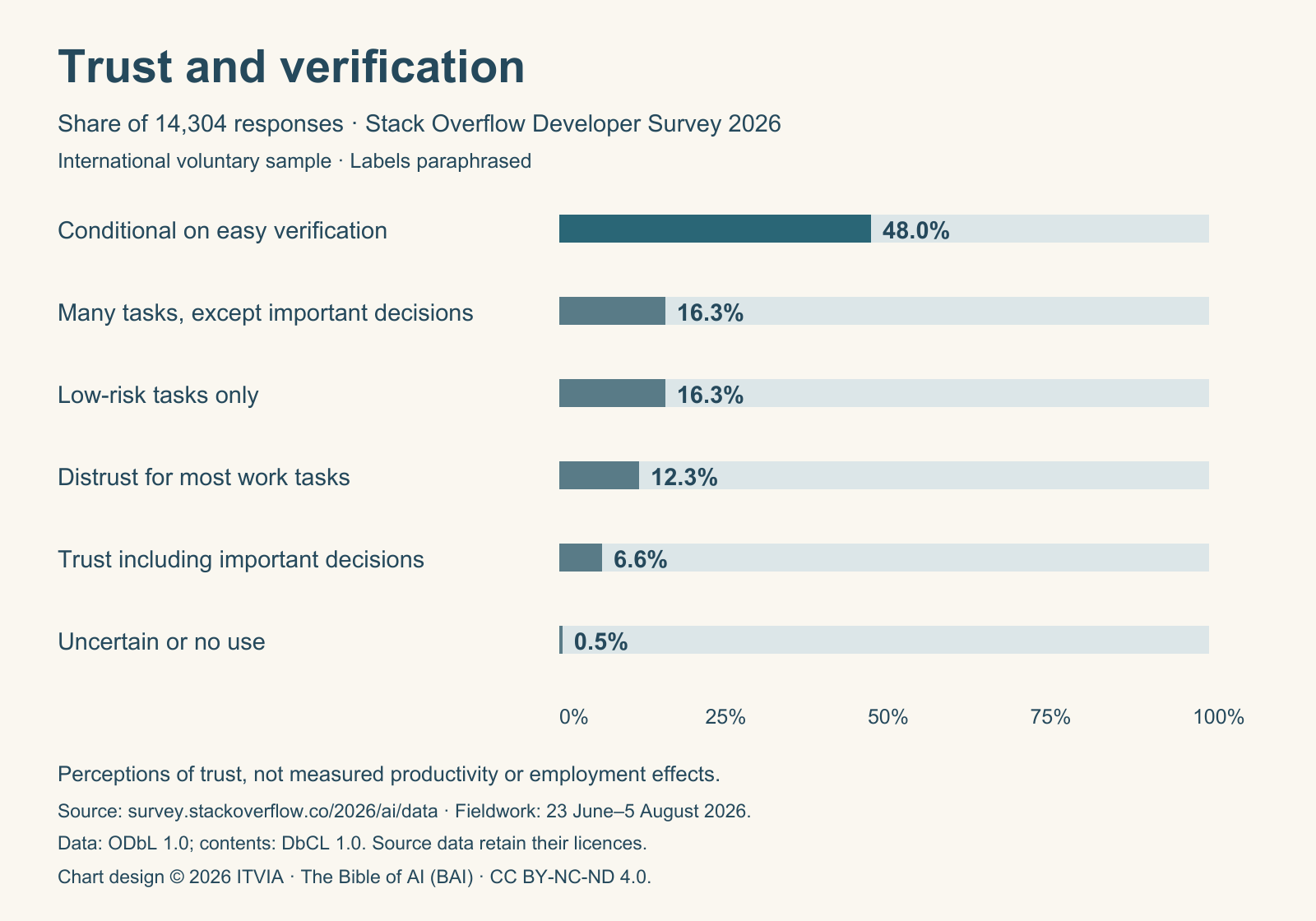
Read the chart data
| Response, paraphrased | Count | Share |
|---|---|---|
| Conditional on easy verification | 6,872 | 48.0% |
| Many tasks, except important decisions | 2,329 | 16.3% |
| Low-risk tasks only | 2,326 | 16.3% |
| Distrust for most work tasks | 1,754 | 12.3% |
| Trust including important decisions | 949 | 6.6% |
| Uncertain or no use | 74 | 0.5% |
These answers express attitudes. They do not establish that checking was effective, measure time saved or show that employers reduced staffing.
Who gains, and what remains uncertain?
Neither productivity experiment establishes how gains affect pay, recruitment or long-term learning. An employer might use additional capacity to expand services, improve quality or limit hiring; the experiments do not determine which choice follows. Evaluation should therefore include review time, errors, workload and opportunities to develop judgement, alongside output.
Employment evidence deserves separate attention. An August 2026 analysis of US payroll records associates younger workers’ weaker outcomes in AI-exposed occupations primarily with reduced hiring. The authors explicitly describe the findings as non-causal and discuss earlier trends and sample differences. This is broader occupational evidence, not a measured AI displacement rate for software services. [11] For someone entering the profession, access to a first job and supported learning may matter as much as the speed of an individual task.
What does the ILO perspective add?
The International Labour Organization identifies growing exposure among web and multimedia developers and application programmers. Exposure concerns tasks that technology might perform; it does not count jobs already lost. Its discussion emphasises opportunities to learn and worker participation in adoption. [12] Applied here, that perspective supports an editorial question: are workers given the time, training and authority to assess the output for which they remain responsible?
A useful assistant still needs accountable work
AI can change the effort required to produce software, but the benefit depends on the task, the worker’s knowledge and the surrounding checks. Better work should be judged through dependable results, sustainable workloads and opportunities to learn. Claims about employment require evidence on hiring and retention; a faster task alone cannot supply it.
Evidence and method
This focused narrative review closes on 19 November 2026. The company-study result was checked against its published abstract; methodological detail comes from the separately cited June 2025 manuscript, not an inaccessible final full text. Provider affiliations and MIT GenAI Initiative funding are disclosed by the published record. The review examines selected primary sources, without reproducing their analyses or claiming exhaustive coverage.
References
Sources accessed 19 November 2026. References are listed by title, with the publishing body or repository identified.
- Annual enterprise statistics by detailed NACE Rev. 2 activity. Eurostat. SBS_OVW_ACT; EU-27, J62, 2024; ENT_NR, EMP_NR, NETTUR_MEUR. doi:10.2908/SBS_OVW_ACT. Employment confidential; turnover estimated.
- QCEW: 2025 annual averages, industry 54151. U.S. Bureau of Labor Statistics. National private-sector row, US000, ownership 5, size 0. Official data.
- 54151: Computer Systems Design and Related Services. U.S. Census Bureau. NAICS 2022. Definition and exclusions.
- The Effects of Generative AI on High-Skilled Work: Evidence from Three Field Experiments with Software Developers. Management Science. 2026;72(11):9408–9420. doi:10.1287/mnsc.2025.00535. Published abstract.
- Same study, June 2025 manuscript. Author repository. Sections 2.3 and 4; Table 3. This earlier version is cited separately for methodology.
- Measuring the Impact of Early-2025 AI on Experienced Open-Source Developer Productivity. METR. arXiv:2507.09089v2, 25 July 2025. doi:10.48550/arXiv.2507.09089. Sections 2–4 and Figure 1.
- We are Changing our Developer Productivity Experiment Design. METR, 24 February 2026. Methodological update.
- Measuring the Self-Reported Impact of Early-2026 AI on Technical Worker Productivity. METR, 11 May 2026. Methods and limitations.
- 2026 Developer Survey: AI data. Stack Overflow. Trust item and published frequencies.
- 2026 Developer Survey: Methodology. Stack Overflow. Fieldwork, inclusion rules and data licences.
- Canaries in the Coal Mine? Six Facts about the Recent Employment Effects of Artificial Intelligence. Stanford Digital Economy Lab. Working paper, August 2026 revision, pp. 1–5; data through June 2026. Document.
- Generative AI at work: What it means for jobs in Europe and beyond. International Labour Organization, 29 September 2025. Institutional discussion.
Liked this post? Follow this blog to get more.