AI and the economy · Semiconductors and computing equipment
An order for an AI server can support a chip designer, a factory, an equipment supplier and a team of engineers in different economies. The resulting revenue has several destinations. Whether it produces lasting prosperity depends on what those businesses build, how effectively it is used and how the gains and costs are shared.
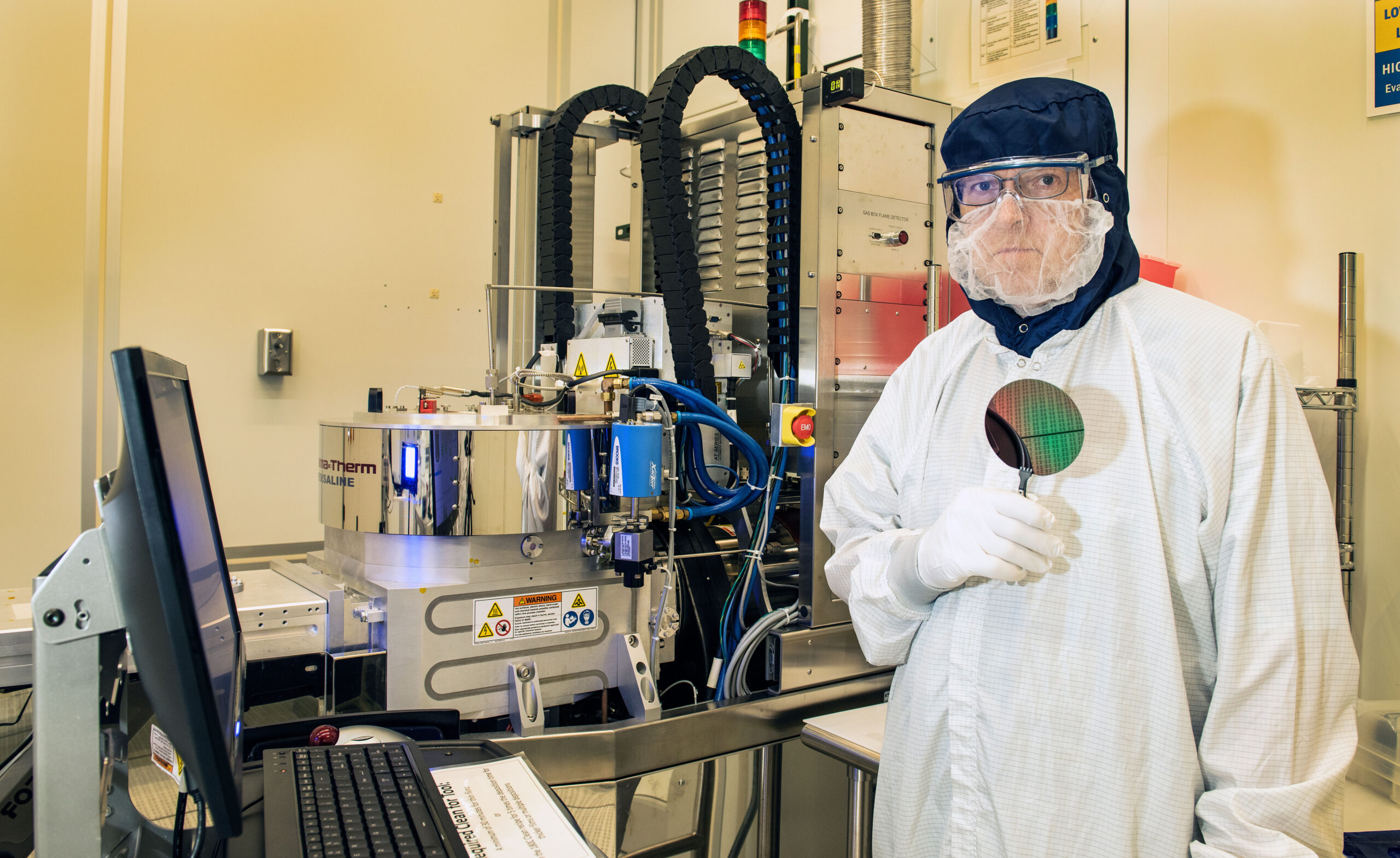
Photograph: Curt Suplee/NIST. Uploaded 22 August 2018. Original photograph · NIST reuse terms. Reduced-resolution version; no further alteration.
Following the value through the industry
The sector comprises chip design, wafer fabrication, assembly, testing and packaging, alongside specialist materials and manufacturing equipment. These activities have different business models. A company can design chips while contracting out their manufacture; a factory can operate in one economy while belonging to a company headquartered elsewhere. The OECD’s mapping identifies substantial interdependence across these stages. Japanese suppliers are important in wafers and processing materials; Dutch and Japanese firms supply lithography equipment; US firms occupy major positions in design software and manufacturing tools. [1]
For economic assessment, the useful distinction is between sales and value added: revenue includes purchased inputs, whereas value added measures what an activity contributes beyond those inputs. Adding chip sales, equipment sales and the price of the finished server would count some of the same production more than once.
Sector profile: three different measures
These indicators describe different parts of the industry. Their years, populations and denominators differ; they cannot be ranked or added together.
European Union
€90 billion
Estimated EU-27 semiconductor value-chain revenue in 2022, equivalent to 9.8% of the global total in that measure. This historical baseline appears in the European Court of Auditors’ 2025 report; it is neither current output nor a measure of AI alone. [2, fig. 11]
United States
US$425 billion
Semiconductor sales by US-headquartered companies in 2025, reported by the Semiconductor Industry Association (SIA): 53.4% of worldwide chip sales. Headquarters identify the companies, not the location of their factories or the domestic value added. [3]
Asian production centres
87% across five economies
China, Taiwan, South Korea and Japan, together with the United States, accounted for 87% of worldwide in-production wafer capacity in September 2025. This OECD measure concerns fabrication capacity, not sales, utilisation or an Asian aggregate. [4, p. 13]
The OECD also finds that production capabilities are difficult to substitute: a plant configured for analogue or power chips cannot simply manufacture advanced logic or memory instead. This helps explain why a large global capacity total can coexist with shortages of particular components. [4]
A larger market, with limits to what sales reveal
The finalised release from World Semiconductor Trade Statistics (WSTS) reports global semiconductor sales of US$795.6 billion in 2025, up 26.2%. Computer applications were a major contributor, including data-centre and AI-related demand. WSTS also identifies improved memory pricing. These are monetary sales figures: they do not measure an equivalent increase in chip volumes, computing capability or GDP, and the total cannot be attributed entirely to AI. [5]

| 2025 quarter | Sales, rounded |
|---|---|
| Q1 | 167 |
| Q2 | 180 |
| Q3 | 210 |
| Q4 | 239 |
What makes investment economically useful?
Investment can expand supply, improve production methods and support specialised knowledge. Its wider value depends on whether users gain access to reliable computing at an affordable cost. The OECD’s 2026 competition assessment identifies high fixed costs, long development periods and switching costs in AI hardware. These characteristics can reward innovation while also making entry difficult and strengthening established suppliers. The report treats competition as a condition for distributing gains through better quality, choice and prices. [6, table 1]
For a purchasing business, a cheaper chip is only one component of the calculation. Integration, software, maintenance and effective use also matter. For a producing region, a factory announcement becomes an economic contribution through completed facilities, viable output, supplier relationships and employment. Announced expenditure should therefore remain separate from investment actually delivered.
Public support deserves the same discipline. The European Court of Auditors found progress in implementing the Chips Act, alongside weaknesses in the prospects for meeting its original market-share ambition. It also identified the risk of financing activity that would have happened without aid. That is a reason to examine additional capacity, research and skills attributable to support, rather than treating either a subsidy or its absence as proof of success. [2, summary and para. 92]
What executives report about workforce investment
KPMG and the Global Semiconductor Alliance surveyed 151 senior executives online in Q4 2025. Asked how their companies were securing the talent needed for growth, respondents could select up to three actions. Selected results are shown below. [7, pp. 14, 21]
| Action, paraphrased | Respondents selecting it |
|---|---|
| Using technology, AI and automation to improve workforce productivity | 54% |
| Investing in employee training and development | 46% |
| Partnering with education providers or industry bodies to develop talent | 25% |
These are selected responses, not an exhaustive distribution. The report gives no separate item-level sample size, response rate or weighting information. Its respondent profile includes 52% from companies with annual revenue of at least US$1 billion. The findings describe participating executives’ reports, not verified expenditure or outcomes, and do not establish representativeness of the sector or workers’ views.
The gains must reach beyond the balance sheet
The International Labour Organization (ILO), in its assessment of the wider electronics industry, emphasises skills development, safe work, fair treatment across subcontracting chains and dialogue between governments, employers and workers. It also recognises that technological change can improve occupational safety while creating adjustment pressures. This is sectoral guidance, not a measurement of AI’s employment effects in semiconductor factories. [8, chapters 3–5]
A serious evaluation should therefore follow more than headline employment. It should ask whether training leads to recognised skills, whether workers can raise safety concerns, and whether local suppliers acquire capabilities that survive a single investment cycle. For communities contributing land, water or public funds, the relevant comparison includes the services and opportunities those resources could otherwise support.
The evidence supports a substantial expansion in chip sales and a geographically interdependent production system. It does not establish how much net welfare AI-related investment has generated in each economy. Progress should be judged through productive capacity, usable technology, working conditions and the distribution of returns and risks. Those outcomes require measurement after the announcements.
Method and scope
This review combines market statistics, institutional studies and an executive survey, consulted on 19 November 2026. The 2025 annual sales release supplies a completed-year baseline. Regional indicators retain their original dates and definitions. Taiwan is labelled Chinese Taipei in the OECD source. No causal estimate, country ranking or investment recommendation is inferred.
References
- OECD. (2025a). Mapping the semiconductor value chain: Working towards identifying dependencies and vulnerabilities. OECD Science, Technology and Industry Policy Papers, 182. OECD Publishing. doi:10.1787/4154cdbf-en.
- European Court of Auditors. (2025). The EU’s strategy for microchips: Reasonable progress in its implementation but the Chips Act is very unlikely to be sufficient to reach the overly ambitious Digital Decade target. Special report 12/2025, fig. 11 and para. 92. Report. doi:10.2865/0902427.
- Semiconductor Industry Association. (2026). 2026 State of the Industry Report: Historic growth amid intensifying global competition. 27 July. Research summary.
- OECD. (2025b). The chip landscape: Geographical distribution of wafer fabrication capacity. OECD Science, Technology and Industry Policy Papers, 188, pp. 7, 10–14. OECD Publishing. doi:10.1787/02dbd028-en.
- World Semiconductor Trade Statistics. (2026). Global semiconductor market grows 26% in 2025 to $796 billion. Finalised fourth-quarter release, 6 March, pp. 1–2. Release.
- OECD. (2026). Artificial Intelligence markets: Recent developments and competition issues. Policy brief, published 10 July; document dated 24 June. doi:10.1787/d531d73f-en.
- KPMG LLP & Global Semiconductor Alliance. (2026). Is the semiconductor industry in a supercycle? 2026 Global Semiconductor Industry Outlook, pp. 14, 21. Report and survey methodology.
- International Labour Organization. (2024). The future of work in the electronics industry: Advancing decent work in more inclusive, sustainable and resilient electronics supply chains. Geneva: ILO, chapters 3–5. ISBN 978-92-2-036740-7. Publication.
Liked this post? Follow this blog to get more.