A phone is playing music on a kitchen counter. You sweep your hand above it to skip a song. A minute later you reach across the same spot for a cup. Both movements send a radio echo back to the phone. What allows it to act on the first and leave the music alone the second time?
Google put a miniature 60 GHz radar in the Pixel 4. Its receiver could follow a hand without needing light from the room. The harder problem was deciding when a sequence of echoes justified a command. A slow sweep could be counted twice. A hand wiping the counter could trigger a command nobody gave. Researchers have measured these two mistakes in different ways, with quite different implications for an AI interface. [1] [3] [4]
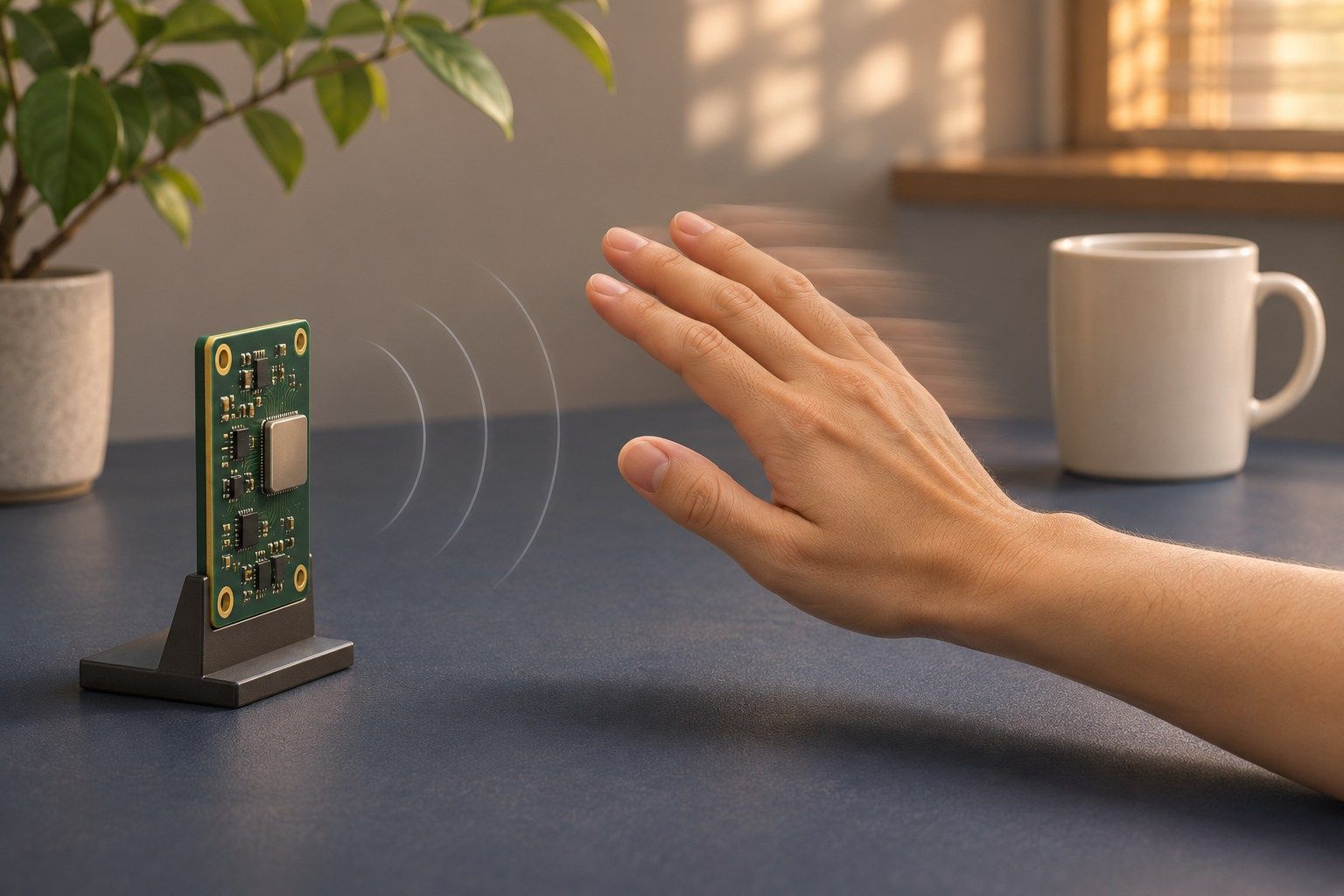
What a hand leaves in a radio echo
A millimetre-wave radar sends out a radio signal and receives a mixture of reflections from the hand, the arm and nearby objects. In a frequency-modulated radar the transmitted frequency sweeps over a band. An echo takes time to return. Comparing it with the signal being transmitted gives the receiver a way to organise reflections by distance. Changes in phase across successive sweeps reveal motion towards or away from the sensor. Differences between receiving antennas can also help resolve direction. [1] [4]
Try passing your hand from left to right in front of a single point on the counter. For part of the sweep your hand approaches that point, then it recedes. Reversing the sweep can produce a similar sequence of approach and retreat. A receiver looking only at radial speed loses part of the distinction. Signals from different antennas supply another clue. The AI can then use the order of these changes to recognise a learned movement. An early ETH Zurich and Google experiment reported 87% average recognition across eleven dynamic gestures performed by ten people. [1] [2] [3]
Where does one gesture end?
Suppose a program examines half a movement at a time. A slow sweep can remain visible in two successive windows, giving the program two opportunities to change the song. A team in Hefei compared two ways of choosing the window while keeping the gesture classifier the same. In one, its duration was fixed. In the other, the system located the beginning and end of the movement in the stream of echoes. [4]
In the most demanding single-person comparison in table 5, the room, the position in it and the person were new to the system. The four new participants each performed six gestures ten times. The researchers counted a missed or misclassified gesture as an error and separately measured the excess of predictions. [4]
| Measure | Fixed window | Adaptive window |
|---|---|---|
| Recognised gestures | 84.58% | 92.91% |
| Multiple-prediction index | 27.93% | 4.38% |
The gain in recognition was 8.33 percentage points. The second row answers a different question. If N gestures were performed and P predictions issued, the authors calculated the index as 1 − N/P. It compares totals. A missed gesture and a duplicated one can cancel out in that calculation. Finding how often a device acts in an hour with no commands requires recordings of precisely that situation. [4]
What happens while nobody is giving an order?
The Google team behind RadarNet tested this explicitly. First they marked the intervals in which people had been asked to swipe. An interval counted as correct only if it contained exactly one correct prediction. They also examined 40.2 hours of ordinary actions chosen because they might confuse the phone, such as wiping the surface on which it rested. [3]
For a swipe in any direction parallel to the screen, at an operating point detecting 80% of the marked gesture intervals correctly, the system produced 0.06 false activations per hour on those selected ordinary activities. At the same detection rate, it produced 1.0 per hour on a separate test in which people repeatedly made movements resembling swipes, such as transferring an object across the phone. The recordings describe two deliberately different settings. Neither rate predicts how often a particular reader’s music will skip at home. [3]
What changes with a new person or room?
A person may swipe with the wrist while another moves the whole forearm. Work by the Technical University of Munich and Infineon shows how much can already be done with signal filtering and explicit rules. Their system found the start of a gesture within four radar frames of its labelled onset in 90.13% of cases on average across users. Recognising that a movement has started still leaves the task of deciding which command it represents. In an associated data release, the fast, slow and wrist-led variants all came from one meeting room. [5] [6]
A study in the November 2026 issue of Physical Communication reported 96.28% classification accuracy when both the people and the environments in its test differed from training. It combined changes in radial velocity and angle over time. The team analysed the MCD-Gesture recordings collected in Hefei. That is evidence about a different way to interpret those echoes. An independent acquisition by CEA-LIST, called MIRAGE, examines what happens when someone else moves near the person giving the command. Its researchers reserved a laboratory for testing after collecting training data in three other settings. [8] [9] [10]
How much power buys that recognition?
The radio must listen while the processor is waiting. In TinyRadarNN, an ETH Zurich and University of Bologna team measured an average of 21 mW for the GAP8 microcontroller over two cycles of inference and sleep, at five predictions per second. With the radar sweeping 160 times per second, the authors estimated about 115 mW for one sensor plus processing, and about 200 mW with two sensors. Measurements on the sensor development board provided an upper bound for the sensor contribution. Each figure describes a particular configuration. [7]
Who performs the gesture matters here too. On the eleven-gesture, 26-person dataset, the model correctly classified 86.64% of sequences under five-fold validation. Reserving an entire person for testing on each round brought that figure to 78.85%. Those results give a designer a reason to test the intended users before deciding whether a second radar sensor, a more elaborate model or a simpler vocabulary is worth its power budget. [7]
When is radar worth using for AI?
Radar is a credible choice for a small set of touch-free commands that must work in darkness. Its advantage lies in the motion it can measure. AI earns its place when it can use that signal to reject the ordinary actions around a command and respond once, promptly, to the intended movement. The cited trials establish physical feasibility and quantify some of the errors. Performance in a particular kitchen, workshop or accessible interface depends on the people and activities there. [1] [3] [4] [5]
For a page-turning interface, a useful comparison would give the same readers the same task with radar and explicit rules, radar and a trained classifier, and a camera with local processing. It would count pages turned exactly once, commands missed, unintended turns per idle hour, and the delay from the end of a gesture to the page turning. Measuring energy at the input to each complete device over that same session would settle the power question. Does the page turn when the reader asks, and stay put when they reach for their cup?
For a second way of recognising movement with little visual information, see how an event camera turns changes in brightness into signals for AI.
Sources and scope
Evidence reviewed through 19 November 2026. The focus is short-range hand gestures for human–computer interaction. The figures discussed here come from experiments with different users, tasks and definitions of success. The proposed page-turning comparison is an example of how to test a future interface.
- Google Research (2020). Soli Radar-Based Perception and Interaction in Pixel 4. Design of the 60 GHz receiver, motion features and phone integration.
- ETH Zurich and Google (2016). Interacting with Soli: Exploring Fine-Grained Dynamic Gesture Recognition in the Radio-Frequency Spectrum. ACM UIST, pp. 851–860. Early recognition experiment and gesture vocabulary. DOI 10.1145/2984511.2984565.
- Google (2021). RadarNet: Efficient Gesture Recognition Technique Utilizing a Miniature Radar Sensor. ACM CHI. Sections 8.3–8.4 and figures 15–16 define the continuous detection and false-activation tests.
- University of Science and Technology of China and Hefei Comprehensive National Science Center (2023). Towards Domain-Independent and Real-Time Gesture Recognition Using mmWave Signal. IEEE Transactions on Mobile Computing, 22, 7355–7369. Author manuscript, section 5.5.1, equations 13–14 and table 5. DOI 10.1109/TMC.2022.3207570.
- Technical University of Munich, Infineon and Software Competence Center Hagenberg (2025, online). Interpretable hand gesture recognition: a rule-based framework for radar-based gesture onset detection and classification. International Journal of Microwave and Wireless Technologies. Equation 17 and table 4. DOI 10.1017/S1759078725102535.
- Technical University of Munich, Infineon and Johannes Kepler University Linz (2025). Frame-Labeled 60 GHz FMCW Radar Gesture Dataset. Version 1. Recording protocol, participants and location of the unusual gestures. DOI 10.5281/zenodo.15178095.
- ETH Zurich and University of Bologna (2021). TinyRadarNN: Combining Spatial and Temporal Convolutional Neural Networks for Embedded Gesture Recognition With Short Range Radars. IEEE Internet of Things Journal. Tables IV and XI–XIII, especially the power boundary in section VI-F. DOI 10.1109/JIOT.2021.3067382.
- Physical Communication (2026). Domain-generalized millimeter-wave radar gesture recognition via multi-scale feature learning. Volume 80, article 103376. Reported test on MCD-Gesture with people and environments held out.
- University of Science and Technology of China. MCD-Gesture Dataset. Original acquisition protocol, sensor settings and definitions of the commanded and background movements.
- CEA-LIST (2026). Lightweight and Robust Embedded Radar-based Gesture Recognition with Graph Neural Networks. IEEE/CVF CVPR Workshops, pp. 7058–7066. Official MIRAGE data, environment split and post-publication correction.
Explore the Horizons of Electronics collection.
Liked this post? Follow this blog to get more.