A carbonised roll can preserve a book while keeping its pages beyond reach. Pulling at the layers risks taking the writing apart with them. At Herculaneum, the question begins with the object: can a reader reach the surface of a sheet that must remain wound inside a fragile lump?
The 2026 account of PHerc. 1667 follows one such survivor. Earlier attempts at physical opening had left an inner core about eight centimetres high. The reconstruction follows the lower portions of roughly twenty-two columns, with gaps where material has been lost. The surviving text concerns human nature, impulse and moral progress. Its damaged condition remains part of every interpretation.
From a closed roll to a readable surface
An earlier milestone concerned a different roll, PHerc. Paris 4. In the result announced in February 2024, specialists examined anonymous submissions and recovered passages from fifteen columns. The challenge required four passages of at least 140 characters, with at least 85 per cent of their characters recoverable. That threshold described a particular reading test. Only about five per cent of the roll had then been read.
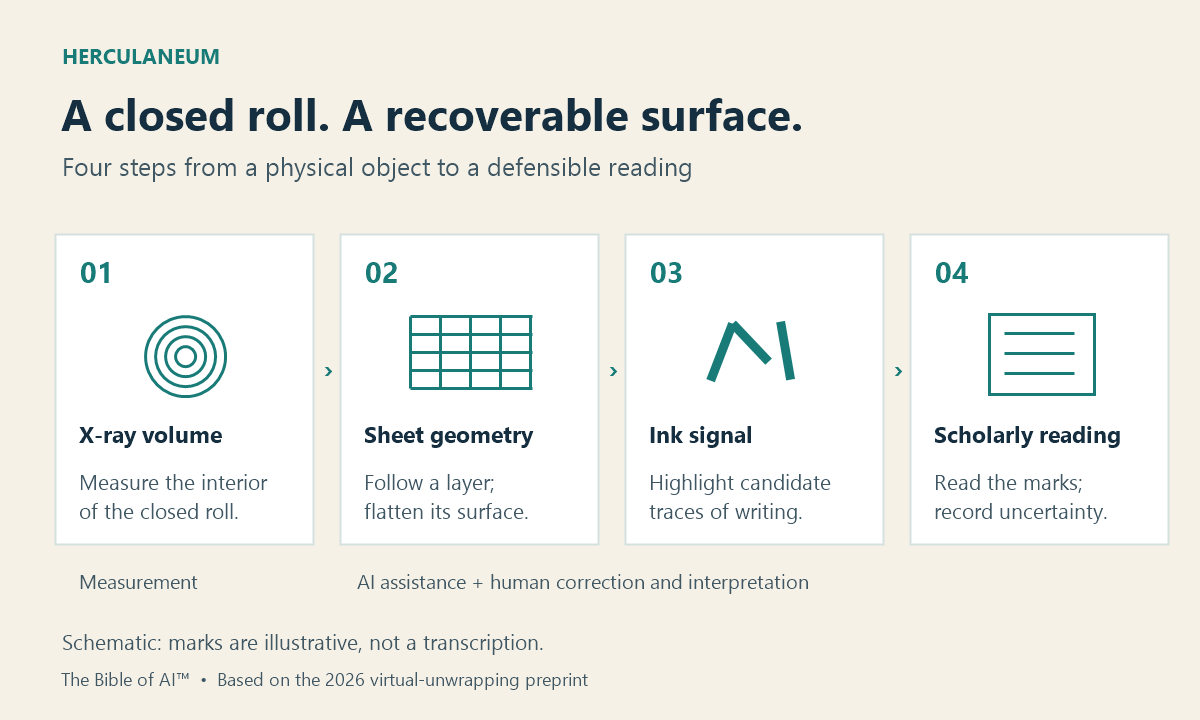
PHerc. 1667 extends the scale of access. The June 2026 preprint describes X-ray tomography, surface reconstruction and ink recovery. A model helps locate the layers. A mesh, corrected by people where necessary, follows and flattens the sheet. Each point retains its location in the scan, allowing doubtful traces to be checked against the material.
The ink detector was trained to recognise local image signals, without word or transcription labels. Its output makes candidate traces easier to inspect. Papyrologists still have to decide which marks support letters and which readings remain uncertain. The preprint also reports a separate check on PHerc. Paris 4: ink visible in a higher-resolution volume corresponds to writing recovered on its flattened surface. That comparison concerns Paris 4, rather than a direct validation of every mark in PHerc. 1667.
What the surviving text can tell us
The project’s presentation of the recovered text places the argument in a Stoic setting. One passage connects inquiry with remaining faithful to human nature; another turns to research, learning and practical wisdom. These are pieces of an ancient philosophical discussion that can now be studied in sequence. Their value lies partly in the questions they reopen: how did the argument move from one claim to the next, and what did its writer mean by human improvement?
The preprint leaves the title and authorship uncertain. It marks doubtful letters and supplies brackets where an editor restores missing writing. Some surviving traces remain too fragmentary for secure transcription. “Complete” virtual unwrapping refers to the preserved surface included in the reconstruction. It does not recover the parts of the original book that have physically disappeared.
For a reader, the important change is the possibility of returning to the evidence. A proposed letter has a place on a reconstructed sheet; that sheet has a place in the scanned roll. The book remains physically closed while an argument about its words can proceed in public. Recovering the past begins here with making the surviving object available for further questions.
Liked this post? Follow this blog to get more.