A red band reaches the edge of a broken piece of plaster. Another piece carries a band of the same colour. Bringing them close may suggest a pattern, but a convincing join needs more: the broken edges, the painted lines and the material must support the same arrangement. A repeating decoration can make the wrong neighbour look plausible.
At Pompeii, RePAIR brought artificial intelligence and robotics to this problem. The project’s final account describes tests on ceiling frescoes from the House of the Painters at Work. The paintings had suffered the eruption of AD 79 and later bombing during the Second World War. Their fragments preserve an ancient interior and the history of its subsequent destruction.
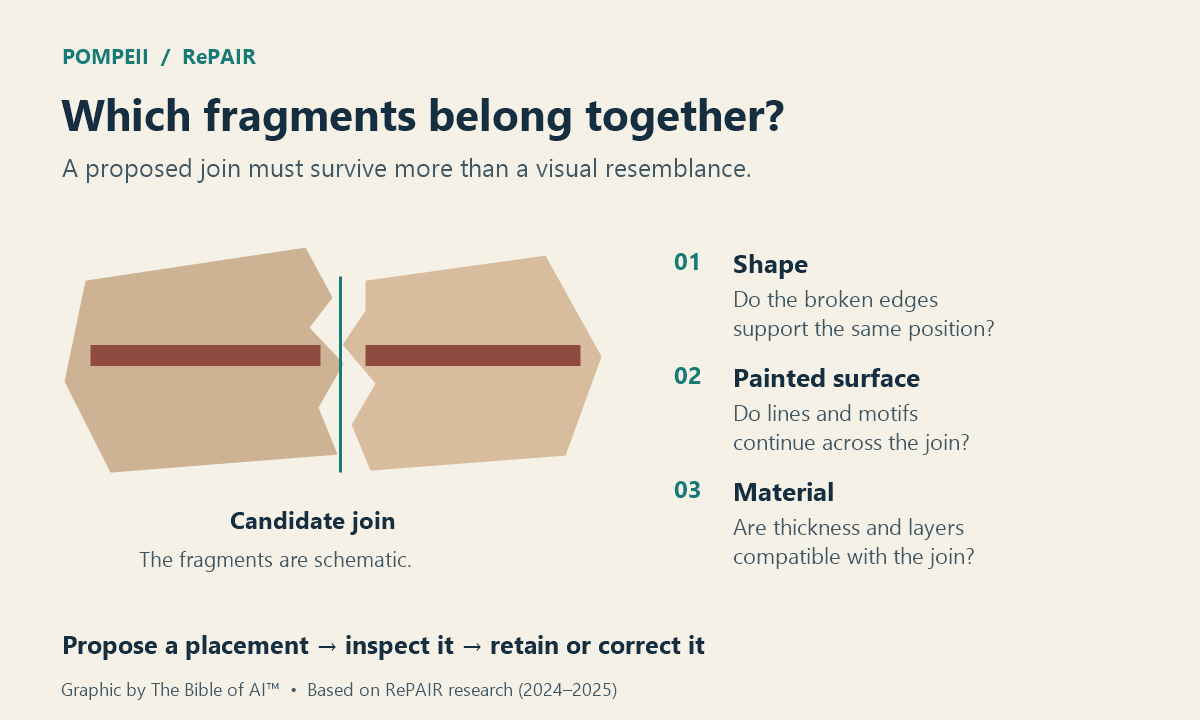
What makes a join convincing?
The RePAIR study presented at NeurIPS 2024 turned part of that material into a test that other researchers could repeat. The dataset contains 1,070 digitised fragments. It documents 117 groups reassembled by archaeologists, but also includes 150 isolated fragments whose place in an assembly remains unknown. The documented groups provide reference arrangements against which proposed reconstructions can be checked. The wider collection contained about 16,000 pieces; the evaluated groups were a subset, providing local assemblies of fragments.
Each digitised fragment combines surface appearance with three-dimensional geometry. The painted face offers lines and motifs. The back and thickness provide further clues about how the plaster was formed and used. These are real fractures, with erosion and missing pieces. A method that succeeds on an intact photograph cut into clean puzzle pieces faces a harder problem here. The 2024 experiments found substantial limitations in the automatic methods they tested.
A group assembled by an archaeologist serves a second purpose beyond looking complete. It gives a new method something specific to get wrong. A plausible-looking arrangement can be compared with the documented position and orientation of each piece. This makes it possible to ask whether a reconstruction preserves the relationships between fragments, even when the complete ancient ceiling is no longer available.
When can a machine move the pieces?
A study presented at MLSP 2025, whose accepted manuscript was deposited in 2026, puts human correction inside the search. The system proposes placements using compatibility between fragments. A person can inspect a proposal, reposition a piece and lock an accepted arrangement. Those fixed pieces then guide the search for further neighbours. The study evaluated three groups from RePAIR. Human-guided versions improved geometric alignment compared with the automatic solver, while taking longer than that solver’s unsuccessful attempts. The table did not report a corresponding accuracy score for the manual-only condition.
Physical movement introduces another responsibility. According to the university’s December 2025 account, the prototype used two robotic arms with soft hands to place fragments at the proposed positions. Archaeologists could identify errors or suggest changes during the process. The report establishes a working prototype and initial trials; it does not document an autonomous reconstruction of all the stored fragments.
A recovered join can restore the course of a painted line, the relationship between motifs or the layout of part of a room’s ceiling. A gap remains evidence of what is missing. The scientific value of assistance lies in making more possible arrangements examinable, while preserving the reason for accepting each one. The fresco returns through relationships between surviving pieces, one justified placement at a time.
Liked this post? Follow this blog to get more.