One of the four walkers chose a road with gentle slopes and a gravel path in a park. Another chose an urban greenway. All four had survived a stroke. When researchers asked where they would like to try a soft robotic ankle support, each picked somewhere close to home or work. The team checked the routes. Then the walkers took the equipment out on their own. For four weeks, a question usually asked on a laboratory floor went with them: how much of the next step could the weaker leg do for itself? The community walking study.
The choice of route deserves as much attention as the machine. In a separate interview study, a man explained why he and his wife went to a park to walk. There were benches. He could judge the distance to the next one and know where he could rest if his leg stiffened. He had the physical ability to walk outdoors in his neighbourhood. What the park gave him was a reason to trust the return journey. Read the study of 20 stroke survivors’ experiences outdoors.
Before the first step, a buckle
A stroke can leave one side of the body weaker than the other. Watch what your own ankle does when you take a slow step. As your heel comes up, the front of your foot presses into the ground and helps send your body forward. A moment later, the toes have to clear the ground as that leg swings through. Someone can cover a respectable distance by asking the stronger leg to do more, while getting relatively little push from the other one. Timing the walk tells only part of that story.
The experimental ankle support addressed both moments. A flexible rod helped hold the foot up during the swing. A motor pulled on a cable to help the ankle push off. The rod did a second job before the walker even stood up: it held the calf wrap in shape while the person fastened it. A magnetic buckle and straps could be managed mainly with the stronger hand. At their final assessment, the four people took roughly two to three and a half minutes each to put the suit on. That modest design detail put the decision to go out within the wearer’s reach. Device design and fitting procedure.
All four were experienced walkers after stroke and had previously tried similar equipment in the laboratory. They demonstrated that they could put it on, switch it on and off, and judge their exertion. A member of the research team also checked their ability to use it at the chosen location. That preparation matters to anyone who imagines taking the same device home. The study began with people who could already make the journey. The question was what assistance could add.
What the floor knows
In the photograph below, a therapist walks beside a participant in a different study of ankle assistance. The rectangles beneath their feet are force plates. Whenever a foot lands on one, the plate records the forces that the walker exerts on the ground. Cameras above the track follow the movement. That combination lets researchers connect something they can see, a foot clearing the floor, with something they cannot judge by eye, the force that helped carry the walker forward.
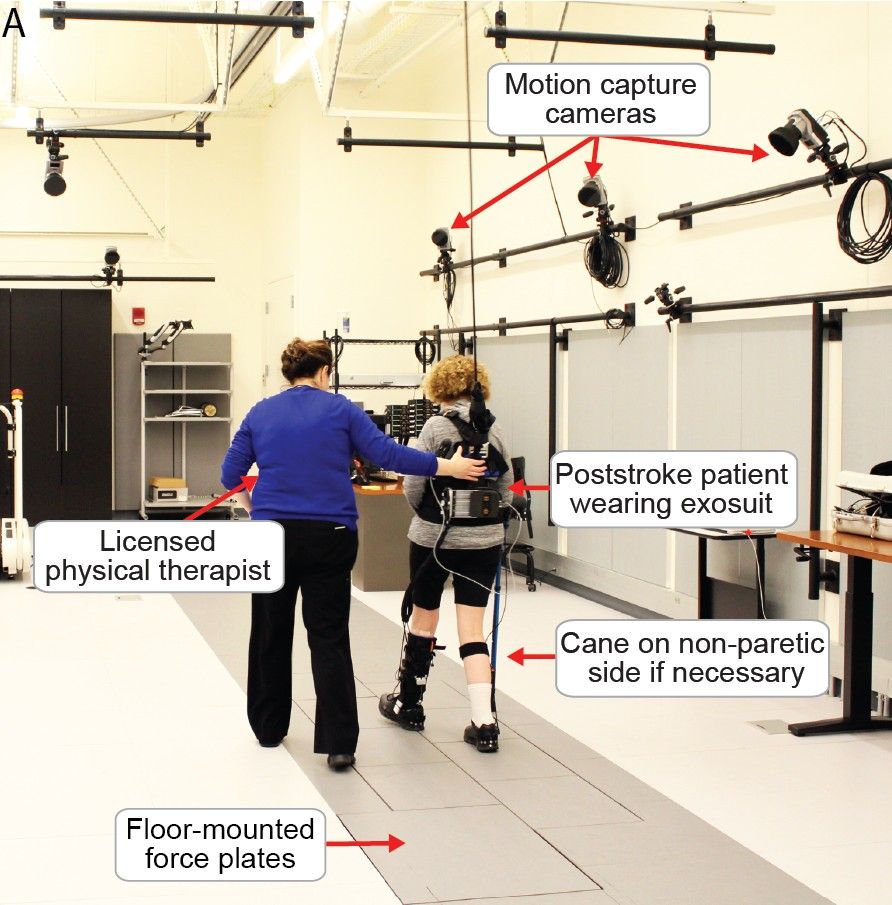
Nineteen people completed that laboratory study. Each walked around an indoor track at a comfortable pace, once wearing the active suit and once without it. The slower walkers increased their speed by an average of 0.08 metres per second with assistance. The faster group showed little change in average speed. The team also assessed energy expenditure and found no significant overall change in the energy needed to cover a given distance. A person can therefore have a quicker step in this test without the researchers being able to promise a less tiring outing. The study pictured above.
There are no force plates under an ordinary gravel path. To follow the four walkers into the community, the researchers used small motion sensors on the foot, lower leg and pelvis. They trained a model by pairing movement signals with forces measured in the laboratory, then adapted it to each walker using overground measurements. Out on a route, it could estimate how strongly the affected leg pushed forward. The distinction is quite practical. The cable helped the person walk. Machine learning helped the researchers interpret the walk afterwards. Whoever chose the park knew something neither system measured. How the researchers estimated push-off outdoors.
The week the suit came off
All four finished the programme. Two of them, the walkers who had started with the weakest push-off, produced more forward force with the affected leg even when tested afterwards without the suit. The walker who chose the gravel path improved after one four-week programme. The walker on the greenway showed little change at that point and improved only after a second four-week programme. These two walkers also averaged about 4,000 more steps a day in the week after the programme than in the week before it. Of the other two, one recorded fewer steps during a spell of poor weather; the fourth did not wear the step counter consistently enough to provide a comparison. Those are results from four individual lives, and the follow-up for that step count lasted one week. Individual results and follow-up.
There was no comparison group taking the same walks without the device. A scheduled walk several times a week, familiarity with the route and the assistance itself could each have mattered. Imagine wanting to know whether the suit would help you get to the park a month after you handed it back. The fairest answer is that the study gives you a reason to ask for that test. It also gives the researchers a clue about whom to invite, including people with a weak push-off and others whose main difficulty is something else.
The number on a step counter has a further limitation. A thousand steps can bring someone to a friend’s door or take them around an indoor track and back to the starting line. Both may be worthwhile, for different reasons. People interviewed about walking after stroke described the freedom of doing something without depending on someone else, and the hope they took from seeing progress for themselves. The destination, the company and the choice to turn back belong in any account of success. What real-world walking meant to people after stroke.
Would the walk feel easier?
Seven people with long-standing weakness after stroke tried a different device in a study published in 2026. This one assisted the hips. On a treadmill, the net metabolic cost of walking was 18 per cent lower on average with the device than without it. For someone who plans an outing around how much energy the return trip may take, that is a result worth hearing. The researchers measured the energy used during treadmill walking. How far a participant would choose to walk in a neighbourhood, or how tired they would feel that evening, remains an open question. Portable hip assistance after stroke.
Timing that assistance is another job that AI can do. In a separate engineering study, a controller learned in simulation when to assist the hips and was then tested during walking, running and stair climbing. It reduced energy expenditure in those tests. The community ankle study used learning to estimate a force. The engineering team used learning to control a motor. A newer preprint used signals from five stroke survivors wearing a powered knee device to estimate where each person was in the step cycle. Its estimates were tested on recorded walks. Whether acting on them would make a future walk easier or safer still has to be tested with people. Learning to control hip assistance · Personalised timing study, reported as a preprint.
Families early in recovery face a different choice: how best to use time with a therapist. An international randomised trial assigned 151 people with substantial difficulty walking after a recent stroke to two schedules. One group divided its training time between an exoskeleton and conventional walking therapy. The other spent the same time in conventional training. After four weeks both groups had improved, and the trial found no significant difference between them on its main measure of walking ability. Leg strength improved more in the group that used the device. That is encouraging for strength, while the answer about walking independence remains more modest. Multicentre rehabilitation trial.
What a rehabilitation team can offer now
A person need not wait for an experimental suit to talk to a physiotherapist about a familiar route. In England, NICE recommends walking training for people who can already walk with or without assistance. Its guidance also asks clinicians to consider an ankle–foot orthosis when difficulty clearing the foot or controlling the leg during stance interferes with walking. This is a brace. Part of assessing it is finding out how comfortable it is, whether the person can put it on and what difference it makes to walking. NICE places electromechanical gait training in the context of research. NICE guidance on walking after stroke.
A device can have a recognised clinical use and still be unsuitable for an unsupervised trip to the shops. In the United States, for example, the FDA clearance for the ReStore soft exosuit specifies rehabilitation institutions and supervision by a trained therapist, for people meeting its walking criteria. That is a different arrangement from the experimental community programme. A useful conversation at an appointment might start with the route itself: where the foot catches, where the walker needs to stop and whether getting ready to leave already requires another person. Each detail gives the therapist and the walker something specific to assess together. FDA indications for ReStore.
The strongest reason to take these machines outdoors is that people already know where they would like to go. On a gravel path, the researchers could estimate how much the weaker leg helped push the walker forward. The man who chose a park for its benches had identified something equally precise about his own mobility. He needed to know there would be a place to sit. A good rehabilitation programme can make room for both kinds of knowledge, and leave the last word about the value of the walk to the person who made it.
Liked this post? Follow this blog to get more.