A chip designer can finish an accelerator and still have nothing to ship. A foundry must make the silicon. A packaging line must then connect the processor to the memory that feeds it. On 10 November 2026, the board of Taiwan Semiconductor Manufacturing Company approved investment in both kinds of capacity. Its decision tells us who can authorise expansion. A customer looking for its own delivery date needs a different document.
Taiwan Semiconductor Manufacturing Company · TWSE 2330 · NYSE TSM
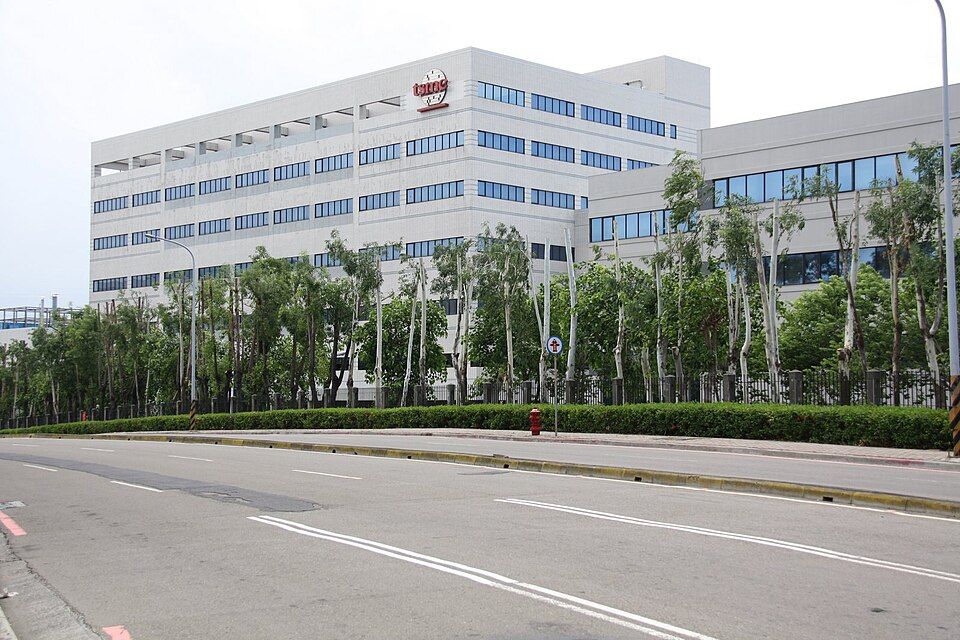
TSMC began in Taiwan in 1987 with a proposition that made a new kind of chip company possible. A designer could bring its plans to a manufacturer that made chips for customers and sold no competing chips under its own brand. In 2025 TSMC manufactured products for 534 customers across its business. Its manufacturing business serves markets ranging from smartphones to high-performance computing. Company history and customer figures
Capital and voting rights. TSMC’s annual report recorded the chair’s direct holding at 0.03% on 28 February 2026. That figure measures a shareholding. The authority to approve the November investment is visible in the resolution adopted by the board. Dated directors’ holdings · Board resolution of 10 November
Two places a chip can wait
A foundry processes a silicon wafer carrying many copies of a circuit. For an accelerator that uses high-bandwidth memory, there is another manufacturing step after the usable chips have been identified. TSMC’s CoWoS-S packaging connects the processor and stacks of memory through a thin piece of silicon called an interposer. Those short, dense connections let data move between memory and processor. A customer with enough processor chips can still be waiting for memory or for a compatible packaging line. ASML enters the picture at an earlier stage. Its extreme-ultraviolet lithography machines expose patterns on selected wafer layers. How CoWoS works · How EUV lithography works
What the board decided
On 10 November the board approved approximately US$40.93 billion in capital appropriations. The resolution groups advanced chipmaking and packaging with mature and speciality technologies, factory construction, facilities, research and development investment, and other capital items. It gives one total for the group. Readers can establish the size of the authorisation, but the resolution supplies neither a separate packaging budget nor a schedule of deliveries to individual designers. Board resolution, item 3
Management described its planning in the October earnings call. TSMC said it sent staff to check progress on US data centres and their power supply. The reason reaches beyond the foundry gate. A laboratory may want more accelerators than it can put to work in a building still waiting for an electricity connection. That is one reason to examine what a customer can install as well as what it asks a supplier to make. Third-quarter call, 15 October 2026
Who else can put the package together?
Arizona offers a test of the idea that any one company holds the whole chain. In October 2024, TSMC and Amkor signed a memorandum under which TSMC intended to contract packaging and testing at Amkor’s planned Peoria facility. They identified CoWoS among the technologies they would consider for shared customers. The US Department of Commerce subsequently awarded Amkor up to US$407 million towards the project. The award and the memorandum document a route by which a second firm could do the work. Establishing what a customer can receive today requires evidence of a qualified line and actual shipments. Joint memorandum announcement · US Department of Commerce award record
For a reader following an AI accelerator from design to delivery, three dates matter. When did the designer finish the chip? When did the foundry have working silicon? When could the packaging line deliver a tested unit? TSMC’s influence lies partly in the distance between the second and third dates. The board can fund the equipment that narrows that gap. The public resolution leaves open whose accelerator will leave the line first. The collection’s profile of NVIDIA
Information checked on 17 November 2026. The ownership figure, corporate decisions and public award refer to the dates in the linked records.
Liked this post? Follow this blog to get more.