In 2019, Warner Bros. got a film back from a piece of glass. Microsoft had written 75.6 GB of Superman onto a square plate scarcely wider than a coffee cup, with extra room for error correction. Imagine making the same request in thirty years, this time for the exact AI model and test data behind a scientific result. What would it take to get those files back? [1]
A laser can leave a permanent mark beneath the surface of glass. The plate can then sit on a shelf without power. That makes it a candidate for the work now done by magnetic tape and by hard drives holding rarely requested files. Whether it earns that place depends on three things an archivist can measure: how quickly new records can be written, how reliably they can be read and how long someone must wait for a complete restore. [3] [5] [6]
What the five dimensions encode
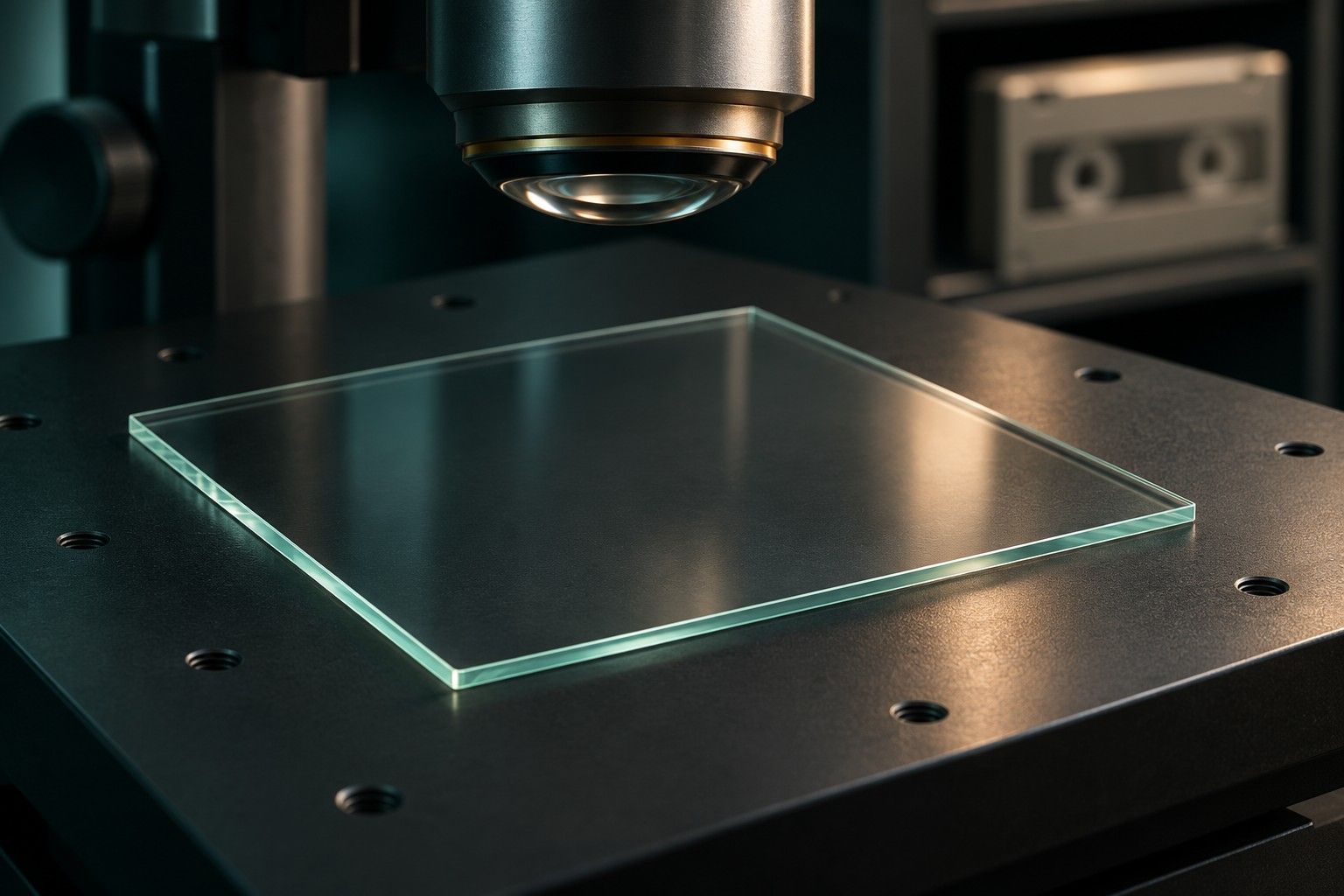
The material often called a “quartz crystal” is usually fused silica: silicon dioxide with the disordered structure of a glass. A femtosecond laser pulse can alter a tiny volume at a chosen depth while leaving the surface intact. Three coordinates locate that volume, or voxel. In classic 5D recording, two further quantities carry information: the orientation of an optical axis and the relative delay that the mark introduces between two polarizations of light. A microscope can distinguish those states long after the writing laser has been switched off. [2] [3]
A useful variant makes a different mark. In borosilicate glass, the writer can change the refractive index locally. A phase-contrast microscope turns the resulting phase shift into a change in brightness. In April 2026, Microsoft researchers compared 30 commercial glasses using this method. BOROFLOAT 33 gave the most recoverable information per mark, 1.76 user bits per voxel. SCHOTT K10 was the most efficient at using the energy of the writing pulse. Choosing a material therefore depends in part on whether plate area or writing energy is the scarcer resource. [4]
How much glass has actually been read?
At Southampton, researchers reported recording 5 GB of text with readout accuracy close to 100%. Their much larger figure of roughly 500 TB was the capacity a disc could reach at the demonstrated density. One figure describes a file put through a reader. The other helps design a future disc. [2]
Microsoft’s 2026 study measured recoverable data density across layers. In fused silica, 301 layers gave a usable capacity equivalent to 4.84 TB on a 120 × 120 × 2 mm plate. In borosilicate, 258 layers gave 2.02 TB on the same external dimensions. The researchers estimated usable capacity from the geometry and the quality of decoded sectors sampled through the depth. A full-plate restore would answer a further question: can every file be returned intact and on time? [3]
The competitor on the shelf
| Writing system | Data rate | Transfer time |
|---|---|---|
| Fused silica, one beam | 3.20 MB/s | 86.8 hours |
| Borosilicate, four beams | 8.24 MB/s | 33.7 hours |
| LTO-10 tape, full-height drive | Up to 400 MB/s | 41.7 minutes at maximum rate |
The times are calculations for an uninterrupted stream. The glass rates come from two different experiments, and the tape rate is a native, uncompressed drive specification. A library can install several glass writers to accept incoming data faster. It has to pay for each laser and keep the writers sufficiently busy. Retrieval poses a different problem. Once a plate is mounted, the microscope can focus on a chosen region. A tape drive has to position the tape. Both libraries must also find the medium and deliver it to a reader. For an archivist retrieving one small file, those delays may matter more than peak throughput. [3] [5] [6]
A hard drive spins its platters. A flash SSD has no moving parts: retention depends partly on the wear and temperature of its NAND cells. Archival tape, like glass, already needs no power on the shelf. The strongest energy argument for glass is the possibility of avoiding repeated migrations of an entire collection. Testing that claim means measuring electricity at the wall for the writers, readers, transport and verification, with the same number of independent copies and the same retrieval deadline. Energy delivered in a laser pulse covers only one step. [3] [5] [6] [12]
What survives the years?
Hitachi and Kyoto University reported reading marks in fused silica after two hours at 1,000 °C. Microsoft tested a different material and mechanism. It heated phase marks in borosilicate, measured how their optical signal faded and extrapolated a characteristic lifetime exceeding 10,000 years at 290 °C. The furnace experiment establishes survival of a particular exposure. The extrapolation describes one process by which marks weaken. Neither result measures the chance of retrieving an entire archive after a plate breaks or its last compatible reader is retired. [3] [7]
There are already customers for long-lived records. SPhotonix says it has accepted orders for its Swiss writing and reading service since 2024. The Wuhan municipal government reports small-series production by Yiyao Technology and use in Chinese archives and hospitals. Those accounts establish a market for specialist services. Published figures for a comparable fleet-wide restore and its cost are still missing. Microsoft itself reported completion of Silica’s research phase in February 2026. CERN is evaluating another approach: it decoded test patterns in a ceramic layer on a glass carrier, a different recording medium from the volumetric glass discussed here. [8] [9] [10] [11]
What an AI laboratory would keep
Consider an observatory that releases an AI-generated sky catalogue. Ten years later, an astronomer finds a possible artefact. Re-running the analysis requires the original images, calibration files, code, model weights and a record of which versions were used together. A glass archive could preserve that release as one immutable set, alongside checksums and instructions for decoding it. A second copy elsewhere would protect against physical loss. Preserving those records gives a future team a way to investigate the result even after the original storage servers have been retired.
During recovery the files would move onto an SSD. During inference, the active weights and intermediate values would move through the accelerator’s working memory. One commercial HBM3E stack supplies more than 1.2 TB/s of bandwidth. Glass does a different job in this sequence. It offers a place for the version that must survive while the team continues to change its working copy. There is also a role for AI inside the reader: in the April study a convolutional network helped identify stored symbols from microscope images before error correction. [4] [13]
Glass could take over a share of tape and disk used for long-retention, infrequently retrieved records. A scientific archive, a hospital or a film studio has a reason to use it today if the service meets its recovery needs. For an AI laboratory choosing between media, the decisive trial would be to restore a complete release on a second reader, check every file and count the cost and energy per recoverable terabyte over the agreed retention period. A material that can retain a mark for millennia has done its job only when somebody can use what was written.
Sources and scope
Evidence reviewed on 17 November 2026. Capacities are decimal. The table compares write throughput and excludes setup, queues and end-to-end verification.
- Microsoft and Warner Bros. (2019). Project Silica proof of concept stores the Superman movie on quartz glass.
- Lei et al. (2021). High speed ultrafast laser anisotropic nanostructuring by energy deposition control via near-field enhancement. Optica 8, 1365–1371.
- Microsoft Research Project Silica Team (2026). Laser writing in glass for dense, fast and efficient archival data storage. Nature 650, 606–612.
- Lawson et al. (2026). Property-driven analysis of glasses for data storage via femtosecond laser writing. Optica 13, 698–706.
- Anderson et al. (2023). Project Silica: Towards Sustainable Cloud Archival Storage in Glass. Proceedings of SOSP.
- LTO Program. LTO-10 native cartridge capacities and drive transfer rates.
- Hitachi and Kyoto University (2014). Read/write of digital data in fused silica glass. Includes the earlier two-hour thermal test.
- SPhotonix. Technical FAQ, service availability and capacity targets.
- Wuhan Municipal Government (February 2026). Glass archival storage at Yiyao Technology.
- CERN openlab. Ceramic nanolayers for archival data storage. Results of the 2025 sample-readout test.
- Microsoft Research (February 2026). Project Silica’s advances in glass storage technology.
- Dell Technologies. Data retention in solid-state drives following extended power-off.
- Micron. HBM3E high-bandwidth memory, specifications per stack.
Liked this post? Follow this blog to get more.