Creative Commons
Fourier Neural Operator for Parametric Partial Differential Equations
The classical development of neural networks has primarily focused on learning mappings between finite-dimensional Euclidean spaces. Recently, this has been generalized to neural operators that learn mappings between function spaces. For partial differential equations (PDEs), neural operators directly learn the mapping from any functional parametric dependence to the solution.
Probabilistic Machine Learning for Healthcare
Machine learning can be used to make sense of healthcare data. Probabilistic machine learning models help provide a complete picture of observed data in healthcare. In this review, we examine how probabilistic machine learning can advance healthcare. We consider challenges in the predictive model building pipeline where probabilistic models can be beneficial including calibration and missing data. Beyond predictive models, we also investigate the utility of probabilistic machine learning models in phenotyping, in generative models for clinical use cases, and in reinforcement learning.
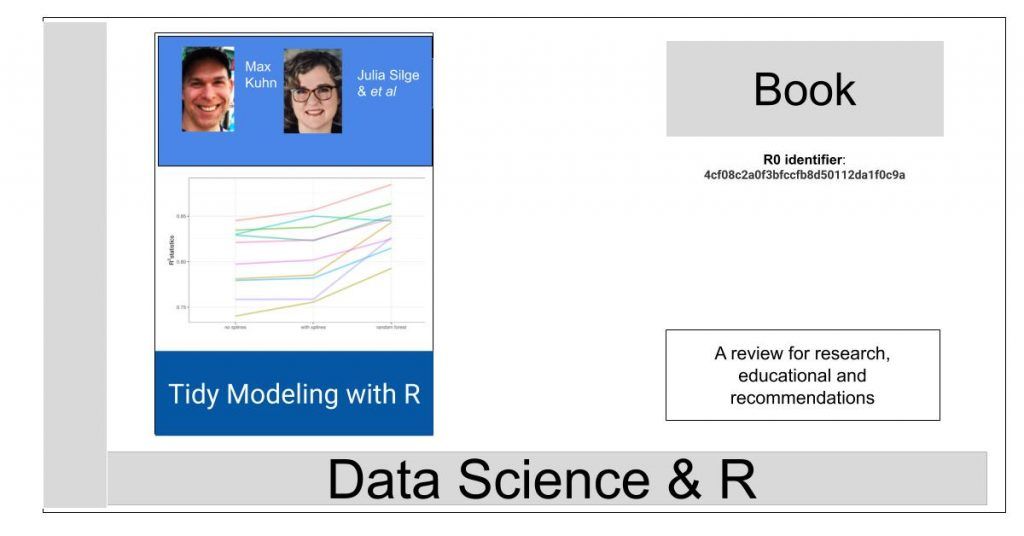
Tidy Modeling with R
This book provides an introduction to how to use our software to create models. We focus on a dialect of R called the tidyverse that is designed to be a better interface for common tasks using R. If you’ve never heard of or used the tidyverse, Chapter 2 provides an introduction. In this book, we demonstrate how the tidyverse can be used to produce high quality models. The tools used to do this are referred to as the tidymodels packages
IEEE Use Case–Criteria for Addressing Ethical Challenges in Transparency, Accountability, and Privacy of CTA/CTT
There are substantial public health benefits gained through successfully alerting individuals and relevant public health institutions of a person’s exposure to a communicable disease. Contact tracing techniques have been applied to epidemiology for centuries, traditionally involving a manual process of interview and follow-up. This is time-consuming, difficult, and dangerous work. Manual processes are also open to incomplete information because they rely on individuals being willing and able to remember and report all contact possibilities.
The Deep Learning Revolution and Its Implications for Computer Architecture and Chip Design
The past decade has seen a remarkable series of advances in machine learning, and in particular deep learning approaches based on artificial neural networks, to improve our abilities to build more accurate systems across a broad range of areas, including computer vision, speech recognition, language translation, and natural language understanding tasks.
TextAttack: A Framework for Adversarial Attacks, Data Augmentation, and Adversarial Training in NLP
This paper introduces TextAttack, a Python framework for adversarial attacks, data augmentation, and adversarial training in NLP. TextAttack builds attacks from four components: a goal function, a set of constraints, a transformation, and a search method. TextAttack’s modular design enables researchers to easily construct attacks from combinations of novel and existing components. TextAttack provides implementations of 16 adversarial attacks from the literature and supports a variety of models and datasets, including BERT and other transformers, and all GLUE tasks.