Medicine (Paper)

A Human-Centered Evaluation of a Deep Learning System Deployed in Clinics for the Detection of Diabetic Retinopathy

A Human-Centered Evaluation of a Deep Learning System Deployed in Clinics for the Detection of Diabetic Retinopathy

This paper contributes the first human-centered observational study of a deep learning system deployed directly in clinical care with patients. Through field observations and interviews at eleven clinics across Thailand, we explored the expectations and realities that nurses encounter in bringing a deep learning model into their clinical practices. First, we outline typical eye-screening workflows and challenges that nurses experience when screening hundreds of patients. Then, we explore the expectations nurses have for an AI-assisted eye screening process. Next, we present a human-centered, observational study of the deep learning system used in clinical care, examining nurses’ experiences with the system, and the socio-environmental factors that impacted system performance. Finally, we conclude with a discussion around applications of HCI methods to the evaluation of deep learning algorithms in clinical environments.

A Human-Centered Evaluation of a Deep Learning System Deployed in Clinics for the Detection of Diabetic Retinopathy Leer más »

Artificial Intelligence and Machine Learning in Software as a Medical Device: discussion Paper and Request for Feedback

Artificial Intelligence and Machine Learning in Software as a Medical Device: discussion Paper and Request for Feedback

Artificial intelligence and machine learning technologies have the potential to transform health care by deriving new and important insights from the vast amount of data generated during the delivery of health care every day. Medical device manufacturers are using these technologies to innovate their products to better assist health care providers and improve patient care. The FDA is considering a total product lifecycle-based regulatory framework for these technologies.

Artificial Intelligence and Machine Learning in Software as a Medical Device: discussion Paper and Request for Feedback Leer más »

The need for a system view to regulate artificial intelligence/machine learning-based software as medical device

The need for a system view to regulate artificial intelligence/machine learning-based software as medical device

FDA need to widen their scope from evaluating medical AI/ML-based products to assessing systems. This shift in perspective—from a product view to a system view—is central to maximizing the safety and efficacy of AI/ML in health care, but it also poses significant challenges for agencies like the FDA who are used to regulating products, not systems. We offer several suggestions for regulators to make this challenging but important transition

The need for a system view to regulate artificial intelligence/machine learning-based software as medical device Leer más »

EEG-based Brain-Computer Interfaces (BCIs): A Survey of Recent Studies on Signal Sensing Technologies and Computational Intelligence Approaches and their Applications

EEG-based Brain-Computer Interfaces (BCIs): A Survey of Recent Studies on Signal Sensing Technologies and Computational Intelligence Approaches and their Applications

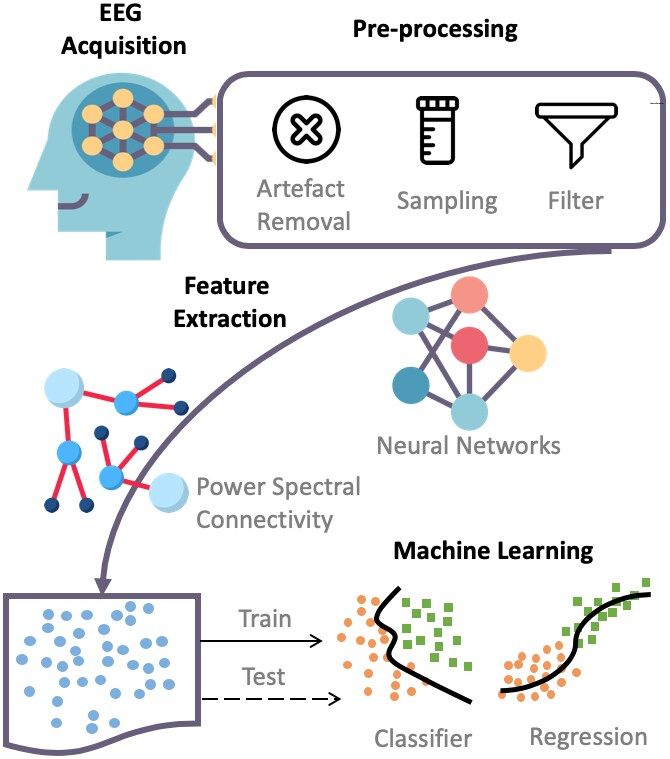
Recent technological advances such as wearable sensing devices, real-time data streaming, machine learning, and deep learning approaches have increased interest in electroencephalographic (EEG) based BCI for translational and healthcare applications.

EEG-based Brain-Computer Interfaces (BCIs): A Survey of Recent Studies on Signal Sensing Technologies and Computational Intelligence Approaches and their Applications Leer más »

A scalable pipeline for designing reconfigurable organisms

Most technologies are made from steel, concrete, chemicals, and plastics, which degrade over time and can produce harmful ecological and health side effects. It would thus be useful to build technologies using self-renewing and biocompatible materials, of which the ideal candidates are living systems themselves. Thus, we here present a method that designs completely biological machines from the ground up: computers automatically design new machines in simulation, and the best designs are then built by combining together different biological tissues. This suggests others may use this approach to design a variety of living machines to safely deliver drugs inside the human body, help with environmental remediation, or further broaden our understanding of the diverse forms and functions life may adopt.

A scalable pipeline for designing reconfigurable organisms Leer más »

Implicaciones legales y regulatorias de la inteligencia artificial. El caso de los vehículos autónomos, m-health y data mining

Implicaciones legales y regulatorias de la inteligencia artificial. El caso de los vehículos autónomos, m-health y data mining

Este informe presenta los hallazgos de un proyecto conjunto EIT / JRC que busca identificar los desafíos legales y regulatorios que el uso de la tecnología de IA puede traer a las nuevas empresas, en un intento de crear conciencia y conocimiento sobre posibles obstáculos.

Implicaciones legales y regulatorias de la inteligencia artificial. El caso de los vehículos autónomos, m-health y data mining Leer más »