Artificial Intelligence inMedicine, Cybersecurity, Automotive & Society
-
Who answers for AI? Lessons from the newsroom and the assembly line
A reader wrongly identified in a photograph needs a correction. A driver warned about a faulty weld needs to know whether the car is safe. Neither can get…
-
When AI gets it wrong, who can put it right?
A shopper flagged by a camera and a family told to repay a debt face the same question: who can reverse the decision? Court orders, public inquiries and…
-
Who gets to say yes to AI? A data centre in your town
Who pays for the power lines when a data centre leaves town? Residents weigh promised jobs against electricity demand, water use and the cost of putting things right.…
Can LLMs Improve Their Own Harness? A Controlled Study on ARC-AGI-3
FrontierPhysics: Evaluating Agents for End-to-End Physics Research
Proving and Improving the Platonic Representation Hypothesis with JEPAs
Explainable deep learning improves human mental models of self-driving cars
The Bible of AI™
Artificial Intelligence Trends in Focus
News
-
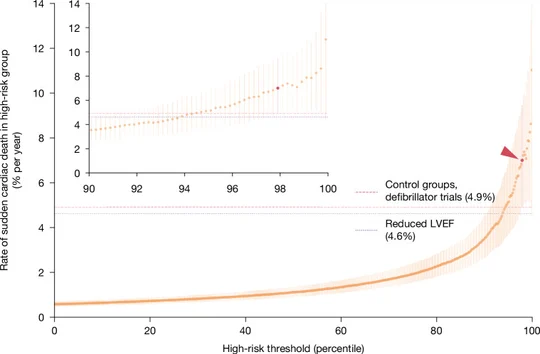
A team trained a model on Swedish heart recordings, then tested the warning signal against records from the United States and Taiwan. It identified a group at higher risk. The clinical question is whether acting on that warning improves outcomes. The study measured prediction, and a treatment trial would answer the next question.
-
A developer can now let DeepSeek handle a search or read a document on its servers and pass the result back to an application. That changes who builds and maintains the retrieval machinery. The release opens up functions of an existing model. It supplies no new benchmark for the model’s reasoning.
-
Stimulating the visual cortex can make a person perceive spots of light. Researchers trained a model to choose stimulation settings and compared its predictions with the participant’s reports. They could shape the neural response with less current. Reading a sign or recognising a face remains a different test.
Research
-
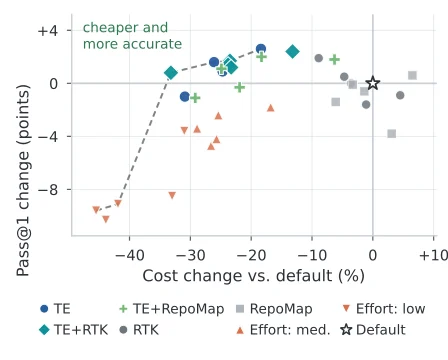
When a coding assistant returns to the same project, it can spend tokens rediscovering things it has already learned. TokenEconomizer removes irrelevant tools and intervenes when the assistant repeats an unproductive step. Across the configurations tested, average token costs fell by 18.4–30.9% with comparable task success. The saving depends on the workload.
-
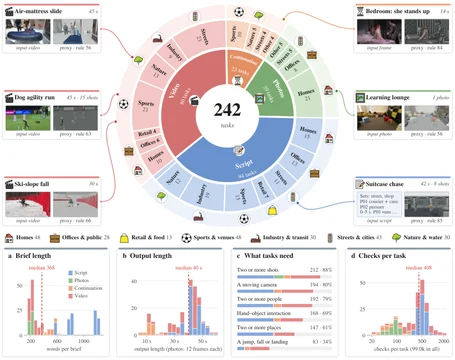
A camera movement can look convincing even when an object is in the wrong place. VibePrevisBench tests both sides of that problem. Across 242 tasks, it checks the scene created in Blender and asks whether its required features survive rendering. That distinction helps identify what actually failed when a generated shot misses the brief.
-
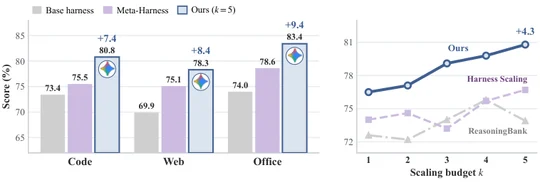
Harness² revises the instructions and tools around an agent and carries lessons from those revisions into later tasks. The authors report gains on three professional benchmarks. Spending more attempts on a task can improve its score, so the results are best read alongside the extra computation each attempt requires.
Sources and scoring · 16 Nov 2026, 19:52 UTC
News. Our editors review stories with documented audience interest, link them to the original evidence and write each summary. Documentation earns two points for a primary source and two more for inspectable material. Scope earns one point for a documented announcement, two for a public demonstration or pilot, and three for testing in an external setting. Recency earns three points within 48 hours of the news report, two within seven days, and one within fourteen days. We include up to two stories per publication. Readership evidence comes from Zeniteq’s weekly views and the intersection of the AI and popular feeds offered by ScienceDaily.
Research. Each entry links to a preprint. A documented method and comparison earn two points. Public code or data earn two more. Our test-scope score runs from one for a single setting to three for separate settings or domains. We add one point for appearance on Papers with Code or Daily Papers together, one for a matching OpenAlex record and one for at least one recorded citation. We check subjects and records against arXiv. Ties go to the newer publication. Scores express editorial priority within the reviewed selection.
- What an ECG can reveal about sudden cardiac death — Documentation 4/4 · scope 3/3 · recency 3/3. External patient cohorts in two countries. ScienceDaily · Primary source · Supporting material · Obermeyer et al., Nature, Fig. 1. Reduced for display. CC BY 4.0.
- The tools inside DeepSeek’s app are reaching other developers — Documentation 4/4 · scope 2/3 · recency 3/3. Publicly documented endpoints and a runnable example. Zeniteq · Primary source · Supporting material
- A visual implant learns from what one participant actually sees — Documentation 4/4 · scope 2/3 · recency 2/3. A proof of concept tested with one participant. ScienceDaily · Primary source · Supporting material
- A coding agent can spend less on the same kind of job — Documentation 4/4 · test scope 3/3 · external signals 2/3. Tested across different repositories, agents and application domains. arXiv · Supporting material · Li et al., TokenEconomizer, Fig. 1b. Reduced for display. CC BY 4.0.
- Can a coding agent build the moving scene that a director asked for? — Documentation 4/4 · test scope 2/3 · external signals 2/3. Four input types and eleven coding agents tested within the same benchmark. arXiv · Supporting material · Chen, Diao et al., VibePrevisBench, Fig. 6. Reduced for display. CC BY 4.0.
- What changes when an AI agent can revise its working instructions? — Documentation 2/4 · test scope 3/3 · external signals 3/3. Three benchmarks and several model–harness combinations. arXiv · Xu et al., Harness², Fig. 1. Reduced for display. CC BY 4.0.
Embed this panel on your website
Copy this HTML into your page. The six stories update together. The source link belongs beside the panel.
LLM-Based Agents for Cybersecurity: A Systematic Review of Architectures, Applications, and Open Challenges
Large language models detect methodological errors that human peer review misses in clinical trials
Contemporary AI lacks the imagination to diverge or negate in science
An Embarrassingly Simple Graph Heuristic Reveals Shortcut-Solvable Benchmarks for Sequential Recommendation
Browse all proposals, including earlier publications →
Deterministic Governance of Artificial Intelligence
Research on visual reasoning, evidence from model evaluations, measured hardware behaviour and controlled cybersecurity trials: these four resources document how claims are examined within the Sistema Vectorial (SV). Readers can consult methods, results and limitations, with ongoing work distinguished from demonstrated findings.
US listings · USD · Quotes may be delayed
AI & Hardware — Stock Market
NVIDIA, Alphabet, Intel, AMD, Microsoft, Broadcom, Arm, TSMC, Oracle, Amazon and SpaceX: share prices, daily changes and charts for the AI and computing industry. Select a company to explore its market information.
Market data and charts by TradingView. Data loads directly from the provider when this section comes into view. Quotes may be delayed; when markets are closed, the latest available session remains visible. Refresh the page to reconnect.
The US panel above shows dollar quotations. TSM represents TSMC’s US-listed depositary shares (ADR). These market indicators provide economic context, not a ranking of AI capabilities or investment advice.
SpaceX includes xAI; its share price reflects the wider group, including its space and connectivity businesses. Alphabet is shown as GOOGL, providing exposure to Google and Gemini within another diversified group.
Why SpaceX matters here — Musk, Terafab and global reach
One listed group, several businesses. SpaceX began trading as NASDAQ: SPCX on 12 June 2026. Its acquisition of xAI was completed on 2 February 2026. The quotation is therefore for SpaceX shares, not a separate xAI security. Listing information · Quarterly filing, 30 September 2026.
Elon Musk is the central decision-maker. As founder, chief executive, chief technical officer and chairman, his role combines corporate direction with engineering leadership. The offering documents describe a dual-class share structure concentrating voting control in him, with limited influence for ordinary public shareholders. Governance and risks in the offering documents.
Compute, models and connectivity. Colossus supplies large-scale AI-training infrastructure; Grok is the group’s frontier language-model family. Starlink adds a global communications network: the September filing reports service across 174 countries, territories and other markets. These are distinct capabilities within the group, rather than proof that every service already operates as one integrated product. Colossus · Group segments and reach.
Terafab and the supply of AI chips. Colossus uses chips to train models. With Terafab, SpaceX and Tesla aim to manufacture chips for AI on Earth and for future data centres in orbit. Intel joined the project in April 2026. The partners plan to bring logic chips, memory and advanced packaging together at a single site. Terafab project · SpaceX filing on the partnership.
Tesla describes its ambition as building the largest chip factory in history. In August 2026, Texas announced Grimes County as the site and put planned investment for the first phase at more than $16.8 billion. The long-term target is to make enough new chips each year to equip one terawatt of computing hardware. Neither the size record nor that output has been demonstrated. Tesla’s description · Texas announcement.
The strategic question. Combining computing capacity, AI models, applications, satellite connectivity and launch capability could reduce some dependencies and support coordinated deployment. It could also concentrate access to infrastructure and bargaining power. This is an interpretation of the group’s structure, not a forecast of market dominance; energy, spectrum, regulation, capital requirements and competing networks constrain what can be achieved.
A historical comparison, with limits. Rockefeller’s Standard Oil combined cost reduction and operational integration with acquisitions and favourable railway rates. The Library of Congress reports that it controlled about 90% of American refineries by the late 1880s. The useful parallel is the relationship between scale, distribution and concentration. It does not establish that SpaceX follows the same pricing strategy, holds an equivalent market share or has committed the same antitrust violations. Standard Oil: historical context.
Frontier AI is not confined to this stock. Alphabet also develops frontier models through Google DeepMind’s Gemini programme. Neither SPCX nor GOOGL isolates the value or performance of its AI models. Google DeepMind: Gemini.
Corporate context reviewed 13 November 2026. Terafab sources checked 14 November 2026. This date concerns the explanation above; quotations in the interactive panel are supplied separately by TradingView.
AI Markets and Models in Asia
Alibaba and Baidu develop the Qwen and ERNIE models in China. India’s Tech Mahindra works on models for Indian languages. On the hardware side, follow Cambricon’s accelerators, Sony’s vision sensors in Japan, ASE’s chip packaging in Taiwan and SK hynix’s high-bandwidth memory in South Korea.
Market data by TradingView. Shanghai (CNY) and Bombay (INR) show end-of-day prices. The US listings are depositary receipts in USD and may be delayed. Each price reflects the entire company.
Company guide, sources and Hong Kong listings
| Company and market of origin | Role in AI · company source | Chart listing |
|---|---|---|
| AlibabaChina | Qwen language models | NYSE:BABAUSD |
| BaiduChina | ERNIE foundation models | NASDAQ:BIDUUSD |
| Tech MahindraIndia | Project Indus for Indian languages | BSE:TECHMINR |
| CambriconChina | MLU accelerators for AI computing | SSE:688256CNY |
| Sony GroupJapan | IMX500 image sensors that run AI on the sensor | NYSE:SONYUSD |
| ASE Technology HoldingTaiwan | Advanced packaging that connects chips in AI systems | NYSE:ASXUSD |
| SK hynixSouth Korea | High-bandwidth memory for AI processors | NASDAQ:SKHYUSD |
Two more model developers trade in Hong Kong dollars. Zhipu (2513) develops the GLM family. MiniMax (0100) develops multimodal models. Their charts open on TradingView.
Semiconductor sector · NASDAQ: SMH · USD
Semiconductor market
VanEck Semiconductor ETF (SMH) brings together US-listed semiconductor and semiconductor-equipment companies, including international firms. An ETF is an exchange-traded fund: its share price offers a view of a basket of companies rather than a single business.
Chart by TradingView · Official fund information — VanEck. This is the US fund, quoted in USD, not its European UCITS counterpart.
The chart loads from the provider when this row comes into view. Read its time axis and market status: quotes may be delayed, and the latest session remains visible while the market is closed. A price chart does not include all distributions or represent the whole semiconductor industry. For editorial context, not investment advice.
Corporate debt · USD · Fixed rate · Senior unsecured
AI infrastructure — bond market
CoreWeave specialises in GPU cloud infrastructure for training and running AI models. Oracle combines GPU computing with a broader enterprise business in databases, cloud services and applications. Amazon (AWS), Alphabet (Google Cloud) and Microsoft (Azure) also operate extensive cloud platforms within diversified groups. The bonds below represent debt of the named issuer as a whole; they do not isolate the performance of its AI activities.
How this updates: the table records fixed coupons and contractual maturity dates. The interactive chart below requests market data directly from TradingView / Bonds.com when it loads. Updates depend on the source; quotes may be delayed or indicative, and a bond with no new observations can retain an older value. Use Refresh chart to request the chart again.
| Issuer | Annual coupon | Maturity |
|---|---|---|
| Microsoft | 1.350% | 15 Sep 2030 |
| CoreWeave | 9.625% | 15 Jul 2032 |
| Oracle | 4.800% | 26 Sep 2032 |
| Alphabet | 4.375% | 15 Nov 2032 |
| Amazon | 4.700% | 1 Dec 2032 |
Common basis: USD, fixed-rate, non-convertible senior unsecured notes; the same market-data source and daily chart interval. Compare YTM with YTM, or price with price, over the same dates. The four 2032 issues have closer maturities; Microsoft’s 2030 issue provides a shorter horizon. Credit quality, liquidity and early-redemption terms still differ. This is a comparison panel, not a ranking of investment quality.
CoreWeave · USD senior unsecured notes · Fixed annual coupon: 9.625% · Maturity: 15 July 2032 · ISIN: USU2069EAE06 (Reg S).
The interactive chart loads as this section comes into view.
Read the measure: YTM is the annualised yield to maturity implied by price and scheduled payments, not the coupon or a guaranteed return. Price is expressed as a percentage of face value. Use the cursor and time axis to check observation dates; the viewer’s clock is not a last-trade timestamp.
Data loads directly from TradingView / Bonds.com when this section comes into view. Quotes may be delayed or indicative; illiquid bonds can retain older observations. Reload to reconnect. Market data is fetched separately from the site’s CDN.
Issue documents and scope
Contractual terms last checked on 11 November 2026. This date records the editorial check of the issue documents; it is not a market-data timestamp. The table and the choice of issuers are editorially maintained, not automatically synchronised with corporate actions.
SEC filings: CoreWeave · Oracle · Alphabet · Amazon · Microsoft.
The selection covers verifiable, embeddable issues and is not restricted to one maturity year. Matured securities belong in historical analysis, not the current comparison. Convertibles and floating-rate debt require separate treatment. These are corporate obligations, not dedicated AI bonds or an AI-sector index. CoreWeave’s displayed issue is the Reg S tranche; distribution restrictions may apply. A common currency and debt category do not make the risks identical.
Editorial market information, not investment advice.
The AI Oligarchy and Its Suppliers
-
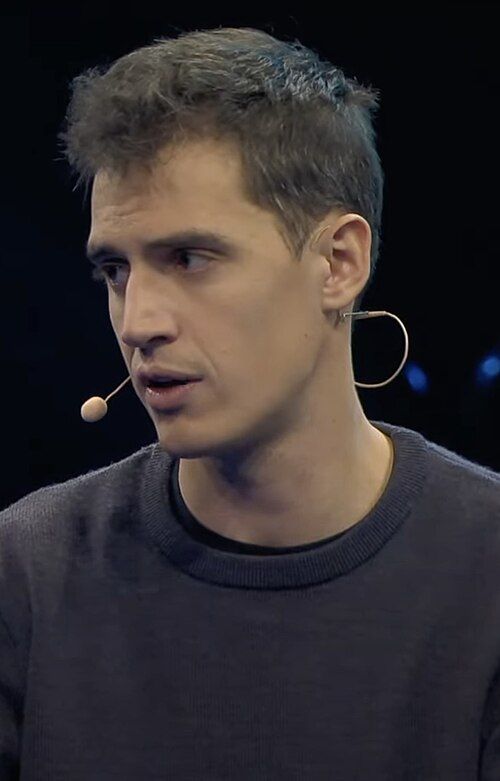
Arthur Mensch and Mistral AI: what does it take to keep a model in European hands?
Read the profile →: Arthur Mensch and Mistral AI: what does it take to keep a model in European hands?An organisation may want to run a powerful model close to the people whose records it processes. Mistral offers one route: release weights that can be deployed under the customer’s control, and sell the infrastructure and expertise needed to operate them. Arthur Mensch’s French company gives Europe a stake in frontier research. Its training hardware and industrial shareholders show how international that…
-
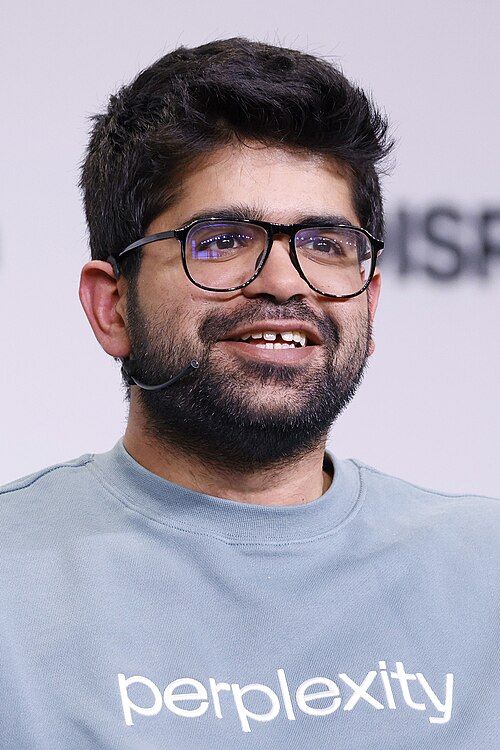
Aravind Srinivas and Perplexity: who chooses the sources behind an answer?
Read the profile →: Aravind Srinivas and Perplexity: who chooses the sources behind an answer?A list of blue links lets the reader choose which account to open. An answer engine makes that decision once before the reader gets there. Aravind Srinivas built Perplexity around that exchange. Its citations can make research faster, but the order of the sources, the passages the system leaves out and the model used to assemble them all shape what the reader…
-

Liang Wenfeng and DeepSeek: what did the famous training bill actually buy?
Read the profile →: Liang Wenfeng and DeepSeek: what did the famous training bill actually buy?One of the most consequential figures attached to DeepSeek was a dollar amount. Readers could reasonably ask whether a small laboratory had reproduced the work of much larger companies for less than six million dollars. Founder Liang Wenfeng’s history in quantitative finance explains where some of the machinery came from. The training paper explains which work the figure covers. Both are needed…
-

Zhilin Yang and Moonshot AI: who can promise capacity for Kimi?
Read the profile →: Zhilin Yang and Moonshot AI: who can promise capacity for Kimi?A subscription buys access to a model only while the service can answer. When demand for Kimi outstripped the available computing capacity, Moonshot paused new subscriptions. That episode illuminates founder Zhilin Yang’s two jobs. One is to improve a language model. The other is to secure the machines and capital to deliver it to the people who have paid for it.
-

Dayiheng Liu and Qwen: who steers the model inside Alibaba?
Read the profile →: Dayiheng Liu and Qwen: who steers the model inside Alibaba?A developer can download some Qwen models, rent others by the token and run either on infrastructure supplied by Alibaba. Three decisions lie behind that apparent choice. The researchers decide what to train, the cloud business decides what to sell and the parent company decides where capital goes. Dayiheng Liu’s career shows how much influence a technical leader can exercise within that…
-
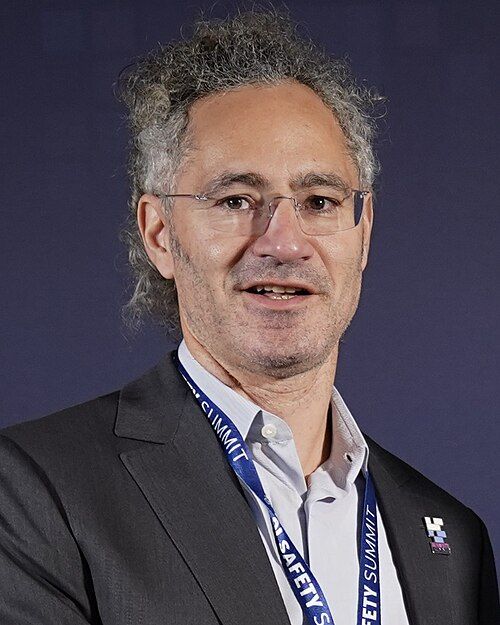
Alex Karp and the software between the model and the decision
Read the profile →: Alex Karp and the software between the model and the decisionAn AI supplier can shape a decision without training the model that produced the answer. Palantir links data, permissions and actions inside institutions. Alex Karp’s influence is easiest to see at the point where an analyst’s suggestion becomes something a hospital, factory or government agency can actually do.
-
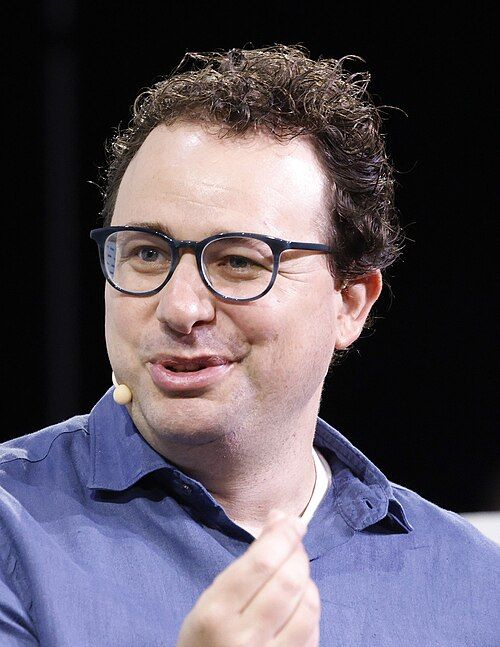
Dario Amodei and the terms on which Anthropic can go public
Read the profile →: Dario Amodei and the terms on which Anthropic can go publicAnthropic promises to consider the long-term effects of the systems it builds. A proposed stock offering brings that promise into contact with shareholders seeking a return. Who can vote, who can appoint directors and who supplies the computing capacity each tell a different part of Dario Amodei’s story.
-

Elon Musk and the connection between satellites, servers and AI
Read the profile →: Elon Musk and the connection between satellites, servers and AIA customer can ask Grok a question over a Starlink connection. Parts of that journey now belong to the same listed group. Following the money from rockets and satellite subscriptions to servers explains why SpaceX belongs in a discussion about AI, and why its share price tells only part of the story.
-
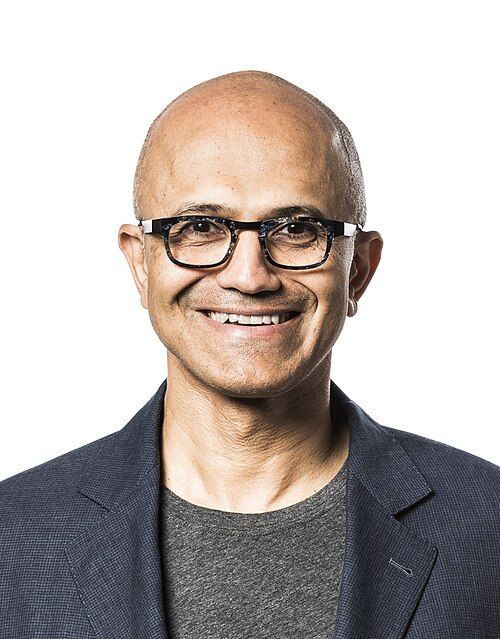
Satya Nadella and Microsoft’s place on both sides of an AI purchase
Read the profile →: Satya Nadella and Microsoft’s place on both sides of an AI purchaseA company buying an AI assistant may already buy its office software, identity service and cloud capacity from Microsoft. Satya Nadella helped build the cloud business before he became chief executive. His position matters wherever a customer must decide how easily one part of that bundle can be replaced.
-
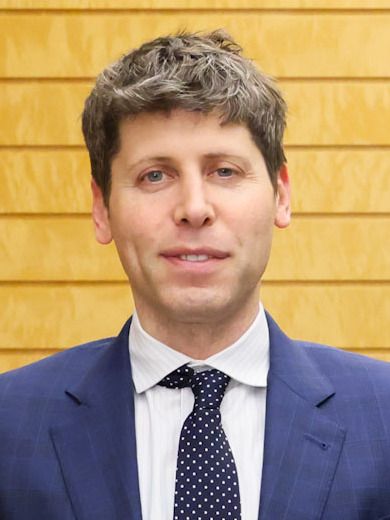
Sam Altman and the question of who controls OpenAI
Read the profile →: Sam Altman and the question of who controls OpenAIWho gets to appoint the board of a company that builds frontier AI? Sam Altman runs OpenAI, Microsoft owns an economic interest and a nonprofit holds governing rights. Following those three strands helps explain how a model can change a market without its chief executive owning that market.
-

Mark Zuckerberg and the votes behind Meta’s AI strategy
Read the profile →: Mark Zuckerberg and the votes behind Meta’s AI strategyA shareholder may own part of Meta and still have little say over the next generation of its AI. Mark Zuckerberg’s voting majority connects decisions about models, data centres and the distribution of information to one founder. The company’s public filings show exactly how that majority works.
-
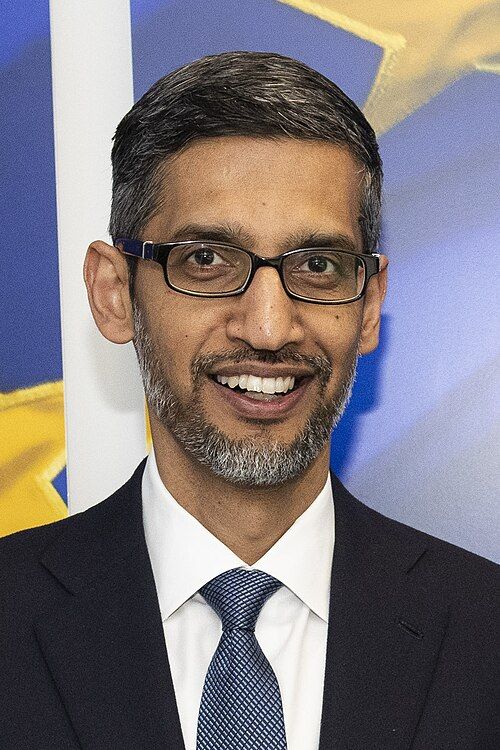
Sundar Pichai and the routes through which Google brings AI to the public
Read the profile →: Sundar Pichai and the routes through which Google brings AI to the publicA model can reach millions before anyone chooses it by name. At Alphabet, Sundar Pichai oversees the researchers who build Gemini, the infrastructure that runs it and the products through which people encounter its answers. Google’s founders retain voting power that the chief executive himself does not possess.
-

Colette Kress and the board that chose NVIDIA’s interim chief
Read the profile →: Colette Kress and the board that chose NVIDIA’s interim chiefWhen a founder leaves, who gets to choose a successor? At NVIDIA the answer arrived in a securities filing. The board appointed its finance chief, Colette Kress, to run the company while it searches for a permanent chief executive. It gave someone else the chair.
The Director’s Eye
Editorials on artificial intelligence, science and society.
-

The horizon of artificial intelligence: LLMs and hardware, its current pillars
Competition between accelerators expands AI’s possibilities, but capacity contracts and dependence on their tools also shape which paths can be pursued. This editorial examines GPUs, TPUs and Trainium, the influence of CUDA and competing software ecosystems, and the commitments linking model developers to cloud providers. It distinguishes announced capacity from computing resources already available, and hardware performance from the quality of reasoning obtained. It also considers an alternative research direction based on explicit knowledge and verifiable visual transformations, whose implementation and comparative costs still require demonstration. The central question is how to judge progress without allowing computing expenditure to stand in for scientific evidence.
-

A number with no recorded reason may end up deciding for a patient
Transparency in artificial intelligence has become a question of provenance. Yet identifying where content came from does not explain why a decision was made. This editorial examines AI-generated scientific hypotheses, expert assessments recorded as scores, and experiments showing that a model’s explanation may omit influences that changed its answer. It considers how research incentives and simplified headlines can obscure important qualifications. The concern is especially acute when decisions guide medical research and may eventually affect patients. The article argues for preserving the reasons behind judgments, so scientific conclusions remain open to scrutiny rather than becoming an archive of unexplained results.
-

Not yet: the third answer in machine intelligence
The most difficult thing to build into an artificial intelligence is not accuracy. It is restraint. Contemporary systems are rewarded, structurally, for producing an answer — a label, a score, a confident sentence — because a fluent reply reads as competence and a hesitation reads as failure. Yet in the places where these systems will matter most, medicine among them, the honest reply is often neither yes nor no. It is not yet. A machine that cannot say so, and instead manufactures closure to satisfy the shape of a question, is not intelligent in any sense a physician would recognise. It
-

External validation is not a bureaucratic detail
Systems for diagnosis, prognosis and imaging have repeatedly been deployed or promoted on the strength of performance that proved fragile under independent testing. A model that performs well in the hospital where it was born has proven only one thing: that it works at home. Consider the most instructive failure in recent clinical AI. The Epic Sepsis Model, a proprietary early-warning tool, was integrated into electronic health records across hundreds of hospitals and trusted to flag patients sliding toward sepsis. Its developer reported respectable performance. Then, in 2021, researchers at the University of Michigan did what should have happened before deployment,
-
A medical algorithm must not confuse cost with health
In 2019, a research team led by the physician and economist Ziad Obermeyer reverse-engineered a commercial algorithm already running quietly across the United States health system. The tool, sold by Optum, helped decide which patients — out of a population of roughly 200 million a year — would be flagged for extra medical attention. To estimate who needed that help, its designers had made a choice that looked entirely reasonable: they used each patient’s past health-care costs as a stand-in for future clinical need. Costs are measurable, structured and available at scale. The logic seemed sound. It was also, the researchers
-

When AI sounds certain but should say “I do not know”
In an internal review that later became public, IBM’s Watson for Oncology was shown a patient much like thousands treated every day: a 65-year-old man with lung cancer who was also suffering from severe bleeding. The system recommended bevacizumab — a drug that carries an explicit warning against use in patients with severe hemorrhage, precisely because it can cause fatal bleeding. Watson did not hesitate, did not flag the contradiction, did not signal doubt. It answered with the same fluent confidence it brought to every other case. That is the danger in its purest form: not that a system makes a
AI and Society
-
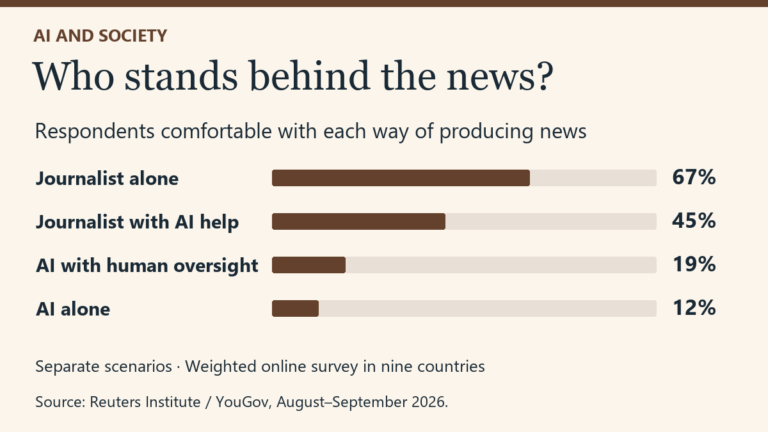
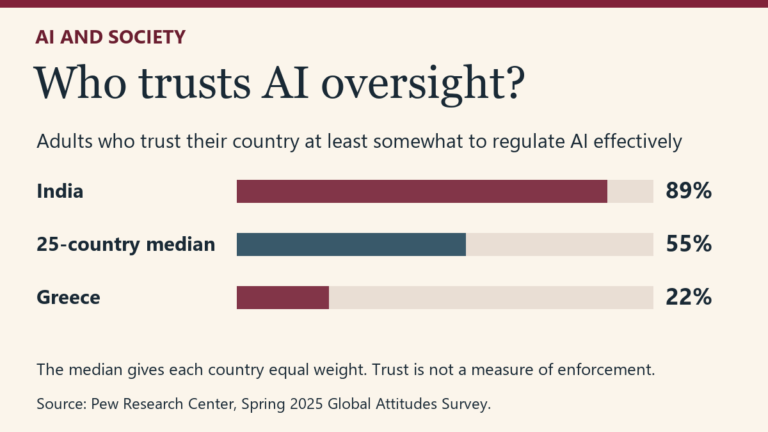
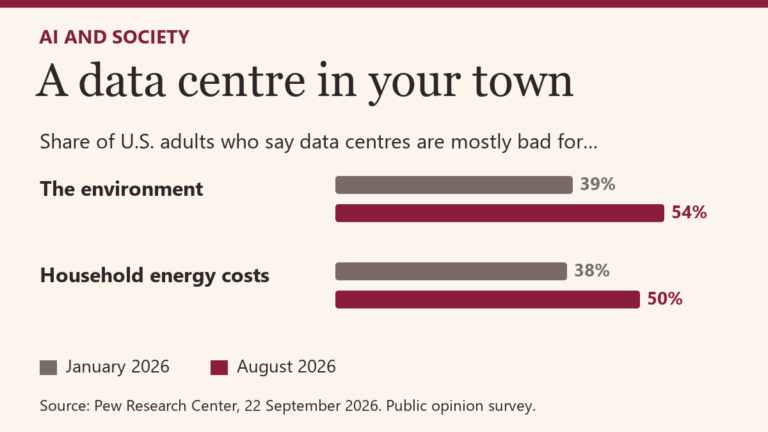
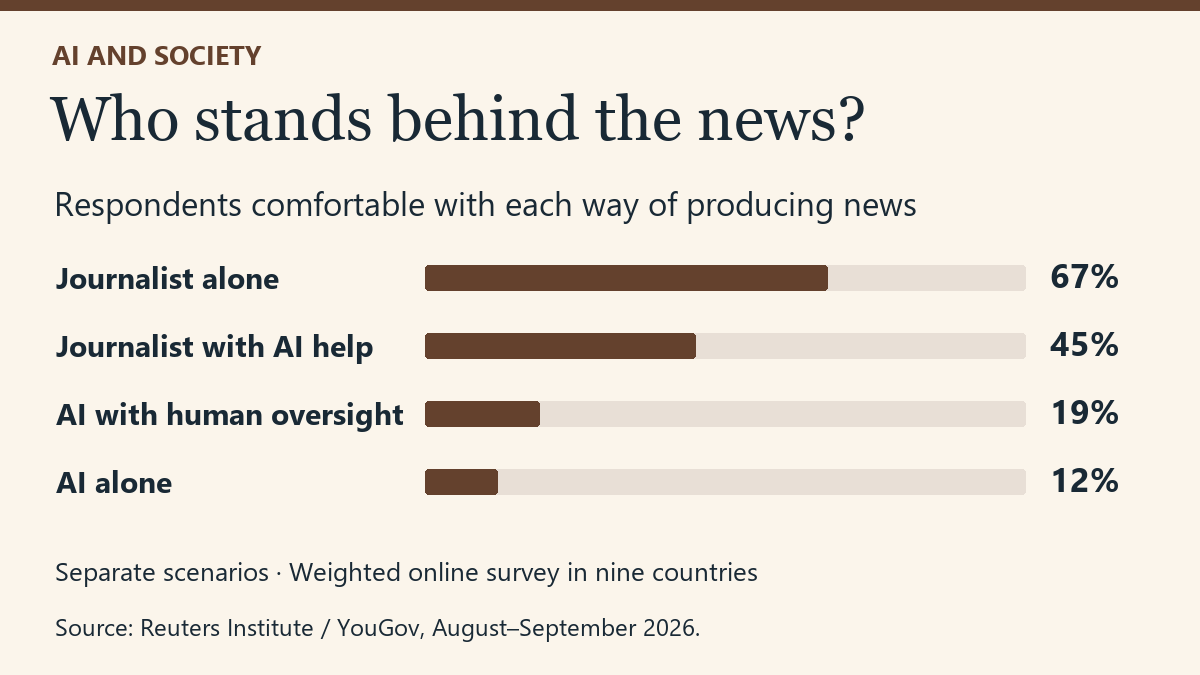
In a Reuters Institute and YouGov survey across nine countries, 67% of respondents felt comfortable with news produced by a journalist alone. That share fell to 19% when AI did most of the work under human oversight.In Pew Research Center’s 2025 survey, 89% of adults in India trusted their country to regulate AI effectively, compared with 22% in Greece. The midpoint among the 25 countries surveyed was 55%.In two US surveys in 2026, the share who saw data centres as mostly bad for household energy costs rose from 38% to 50%. The bars trace a change in public opinion about electricity bills. Who answers for AI? Lessons from the newsroom and the assembly line
Read the article →: Who answers for AI? Lessons from the newsroom and the assembly lineA reader wrongly identified in a photograph needs a correction. A driver warned about a faulty weld needs to know whether the car is safe. Neither can get an answer from the machine that helped make the product. A newspaper, a documented vehicle recall and a ruling about an airline’s chatbot show how to trace responsibility to the people and organisations that can act. An AI label can tell us how an image was made. Who will put things right?
The recall offers a revealing detail. Subaru used the welding robots’ records to find 293 vehicles that needed checking. All 293 passed inspection. For the driver waiting for an answer, what mattered was that somebody could find the car, inspect the welds and report the result.
In the United States, a court order barred one pharmacy chain from using facial recognition for surveillance for five years. In Australia, an inquiry into automated welfare debts asked how people could challenge the calculation behind a demand for repayment. Follow either case from the citizen’s side and a practical test emerges. Who can reopen the file, how long will it take, and who can correct the record before the mistake follows someone elsewhere?
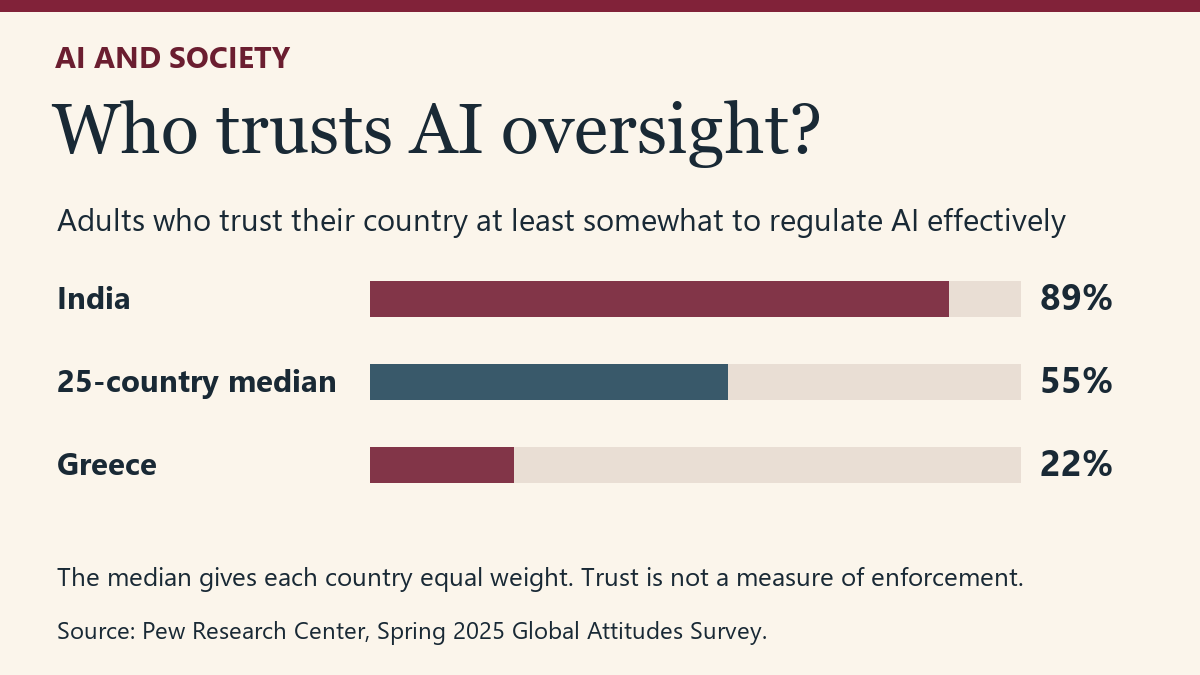
In a Reuters Institute and YouGov survey across nine countries, 67% of respondents felt comfortable with news produced by a journalist alone. That share fell to 19% when AI did most of the work under human oversight.In Pew Research Center’s 2025 survey, 89% of adults in India trusted their country to regulate AI effectively, compared with 22% in Greece. The midpoint among the 25 countries surveyed was 55%.In two US surveys in 2026, the share who saw data centres as mostly bad for household energy costs rose from 38% to 50%. The bars trace a change in public opinion about electricity bills. When AI gets it wrong, who can put it right?
Read the article →: When AI gets it wrong, who can put it right?A shopper flagged by a camera and a family told to repay a debt face the same question: who can reverse the decision? Court orders, public inquiries and national plans reveal what governments have actually delivered and where citizens still have to take protection on trust.
The recall offers a revealing detail. Subaru used the welding robots’ records to find 293 vehicles that needed checking. All 293 passed inspection. For the driver waiting for an answer, what mattered was that somebody could find the car, inspect the welds and report the result.
In the United States, a court order barred one pharmacy chain from using facial recognition for surveillance for five years. In Australia, an inquiry into automated welfare debts asked how people could challenge the calculation behind a demand for repayment. Follow either case from the citizen’s side and a practical test emerges. Who can reopen the file, how long will it take, and who can correct the record before the mistake follows someone elsewhere?
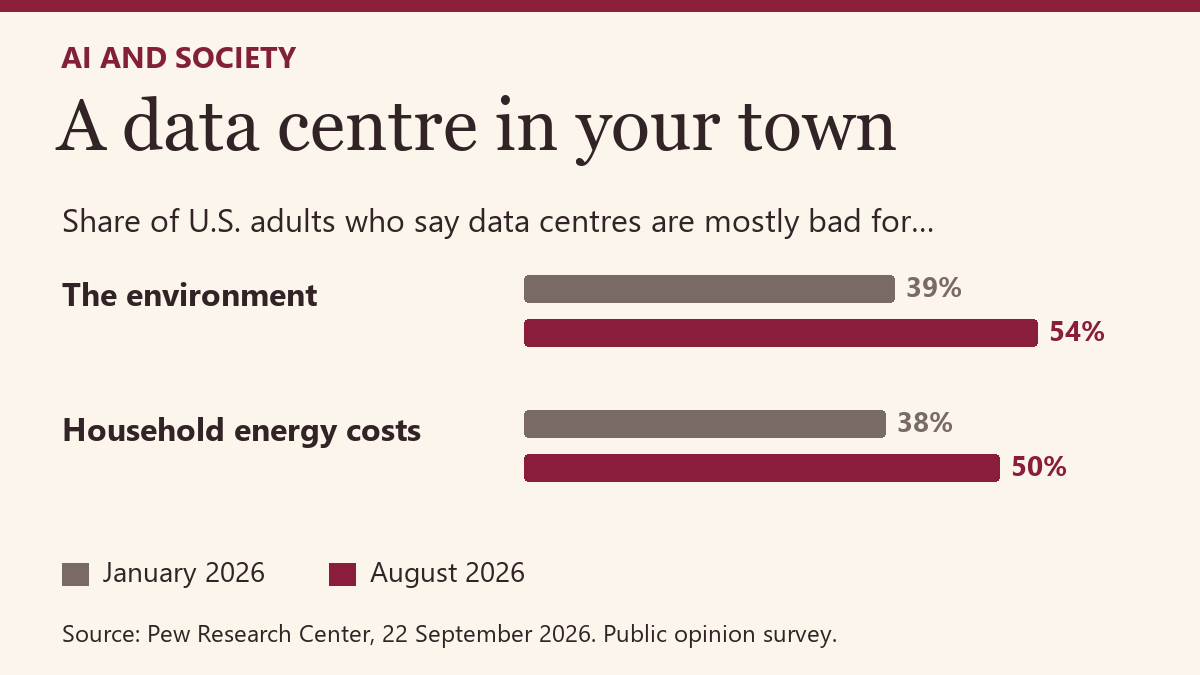
In a Reuters Institute and YouGov survey across nine countries, 67% of respondents felt comfortable with news produced by a journalist alone. That share fell to 19% when AI did most of the work under human oversight.In Pew Research Center’s 2025 survey, 89% of adults in India trusted their country to regulate AI effectively, compared with 22% in Greece. The midpoint among the 25 countries surveyed was 55%.In two US surveys in 2026, the share who saw data centres as mostly bad for household energy costs rose from 38% to 50%. The bars trace a change in public opinion about electricity bills. Who gets to say yes to AI? A data centre in your town
Read the article →: Who gets to say yes to AI? A data centre in your townWho pays for the power lines when a data centre leaves town? Residents weigh promised jobs against electricity demand, water use and the cost of putting things right. U.S. survey evidence shows how public attitudes towards energy costs and the environment have changed. Global electricity projections tell a different part of the story. This opening essay follows the decision back to the town that must live with it, from the promise of permanent jobs to water use in a dry year. It asks what residents should be able to inspect before a permit is granted, how people who seldom attend a public hearing can take part, and which conditions would give them a remedy if a promise is broken.
The recall offers a revealing detail. Subaru used the welding robots’ records to find 293 vehicles that needed checking. All 293 passed inspection. For the driver waiting for an answer, what mattered was that somebody could find the car, inspect the welds and report the result.
In the United States, a court order barred one pharmacy chain from using facial recognition for surveillance for five years. In Australia, an inquiry into automated welfare debts asked how people could challenge the calculation behind a demand for repayment. Follow either case from the citizen’s side and a practical test emerges. Who can reopen the file, how long will it take, and who can correct the record before the mistake follows someone elsewhere?