The Bible of AI

Altair: Declarative Visualization in Python

Altair: Declarative Visualization in Python

Altair is a declarative statistical visualization library for Python. With Altair, you can spend more time understanding your data and its meaning. Altair’s API is simple, friendly and consistent and built on top of the powerful Vega-Lite JSON specification. This elegant simplicity produces beautiful and effective visualizations with a minimal amount of code. Altair is developed by Jake Vanderplas and Brian Granger in close collaboration with the UW Interactive Data Lab.

Robots in a rush: time-aware AI aids human-machine interaction

Robots in a rush: time-aware AI aids human-machine interaction

The TIMESTORM consortium, funded by the EU’s Future and Emerging Technologies (FET) programme, has transformed the notion of time perception in artificial intelligence from an immature, poorly defined subject into a promising new research strand, drawing on diverse expertise in psychology and neurosciences as well as robotics and cognitive systems.

Keras Succinctly

Keras Succinctly

Neural networks are a powerful tool for developers, but harnessing them can be a challenge. With Keras Succinctly, author James McCaffrey introduces Keras, an open-source, neural network library designed specifically to make working with backend neural network tools easier.

Efficient R programming

Efficient R programming

There are many excellent R resources for visualization, data science, and package development. Hundreds of scattered vignettes, web pages, and forums explain how to use R in particular domains. But little has been written on how to simply make R work effectively-until now.

SQL Notes for Professionals book

SQL Notes for Professionals book

This SQL Notes for Professionals book is compiled from Stack Overflow Documentation. (166 pages, published on May 2018)

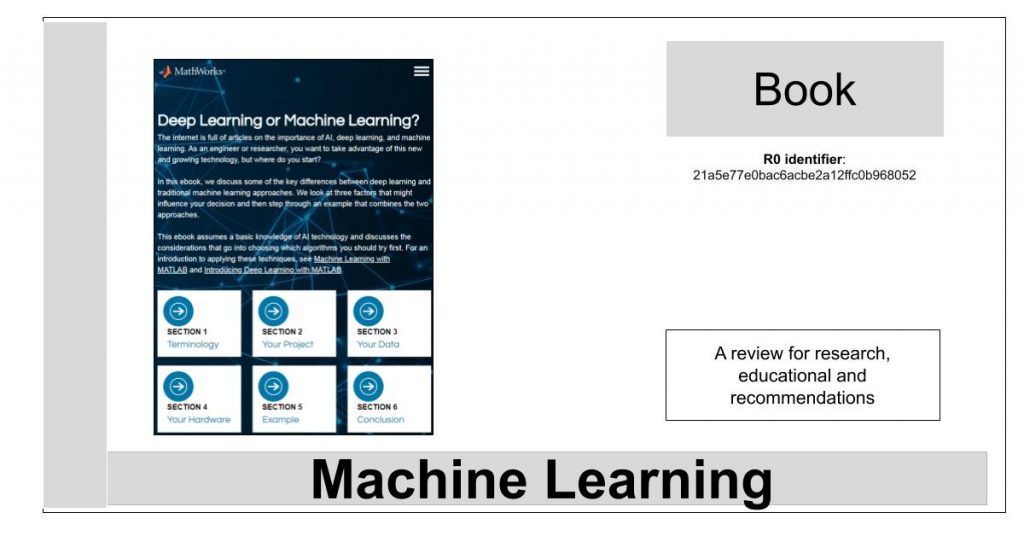
Deep Learning or Machine Learning? (MathWorks)

Deep Learning or Machine Learning? (MathWorks)

«In this ebook, we discuss some of the key differences between deep learning and traditional machine learning approaches. We look at three factors that might influence your decision and then step through an example that combines the two approaches». (MathWorks).

Artificial Intelligence in Society

Artificial Intelligence in Society

«The artificial intelligence (AI) landscape has evolved significantly from 1950 when Alan Turing first posed the question of whether machines can think. Today, AI is transforming societies and economies. It promises to generate productivity gains, improve well-being and help address global challenges, such as climate change, resource scarcity and health crises. Yet, as AI applications are adopted around the world, their use can raise questions and challenges related to human values, fairness, human determination, privacy, safety and accountability, among others. This report helps build a shared understanding of AI in the present and near-term by mapping the AI technical, economic, use case and policy landscape and identifying major public policy considerations. It is also intended to help co-ordination and consistency with discussions in other national and international fora». (OECD)

Inteligencia artificial centrada en el ser humano: confiable y segura

Inteligencia artificial centrada en el ser humano: confiable y segura

El objetivo de este documento es alentar a los investigadores de inteligencia artificial y diseñadores de productos a cambiar del pensamiento unidimensional sobre los niveles de automatización / autonomía a un nuevo marco HCAI bidimensional.

Matriz de recursos de Deep Learning

Matriz de recursos de Deep Learning

El siguiente recurso describe los siguientes marcos:
TensorFlow
Theano
Cafe
MXNet
apache
SystemML (proyecto de incubadora)
BigDL
DistBelief